
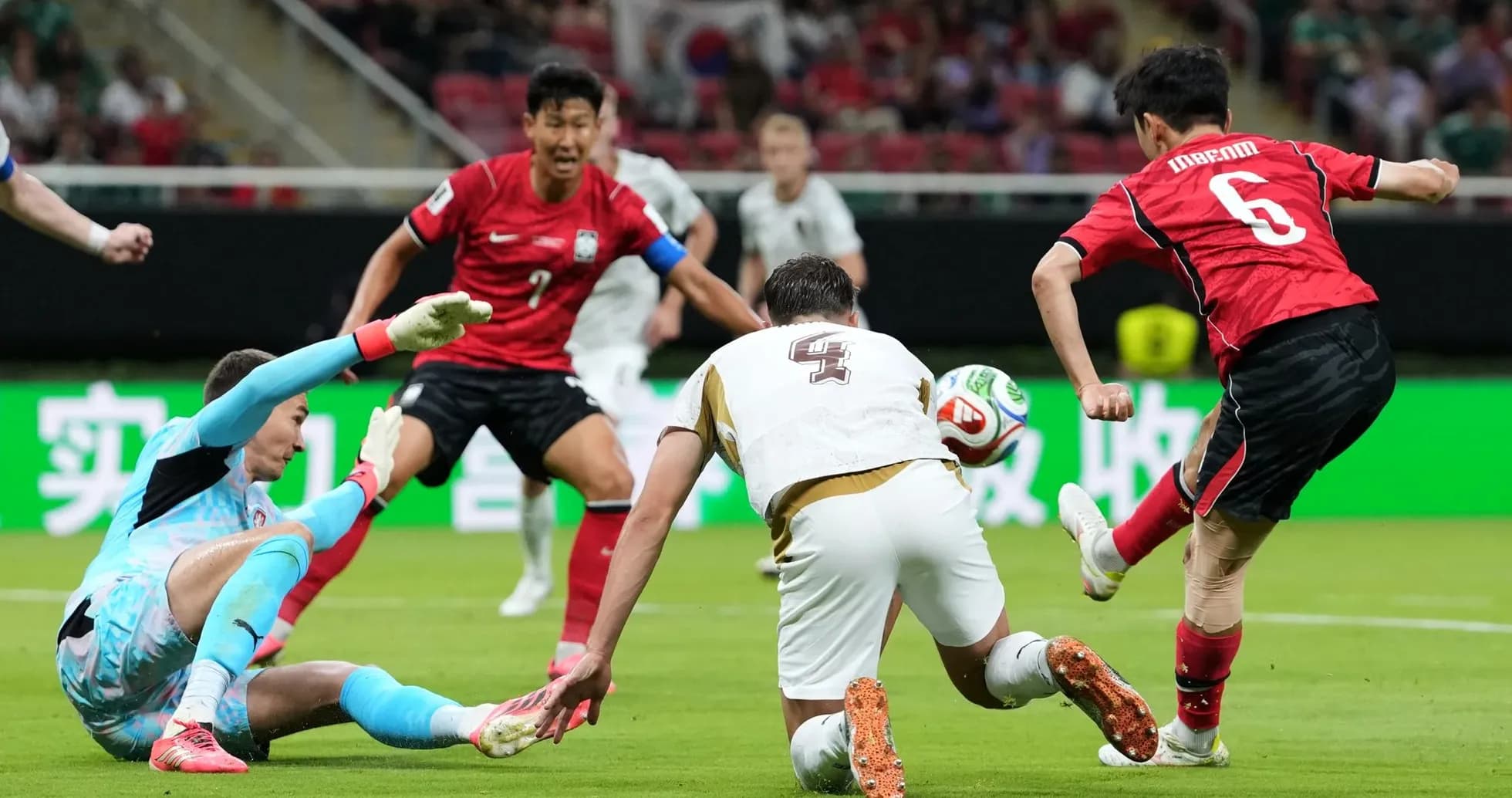
South Korea's Tactical Masterclass in 2-1 Victory Over Czechia
South Korea’s 2-1 comeback win over Czechia at Estadio Akron was a controlled, possession-heavy display built on a mirrored 3-4-2-1 structure, sharper use of the half-spaces, and superior bench impact. Both sides lined up in the same base system, but the way they occupied the pitch and managed transitions created a clear territorial and statistical edge for South Korea, reflected in 62% possession, a 15–8 shot advantage, and higher xG (2.0 vs 0.84).
South Korea's Tactical Setup
South Korea’s back three of Gi-Hyuk Lee, Kim Min-jae, and Han-Beom Lee formed a high, aggressive line that compressed the field. With the wing-backs Young-woo Seol and Lee Tae-seok (before his substitution) providing width, Myung-Bo Hong’s side turned the 3-4-2-1 into a 3-2-5 in settled possession. Hwang In-beom and Seung Ho Paik acted as the double pivot, but with very different roles: Paik more as the first receiver and circulator, Hwang as the vertical connector stepping into the right half-space.
The structure allowed South Korea to dominate the ball: 542 total passes to Czechia’s 323, with 469 accurate passes at 87%. The circulation was not sterile; 10 of their 15 shots came from inside the box, underlining how effectively they progressed play into dangerous central zones. Kang-in Lee and Jae-sung Lee operated between Czechia’s midfield and defensive lines, constantly pulling Ladislav Krejčí, Robin Hranáč, and Štěpán Chaloupek out of shape. Son Heung-min’s starting position as the lone forward was less about aerial duels and more about dragging Tomáš Souček and the outside centre-backs away to open channels for late runners.
Czechia's Approach
Czechia, under Miroslav Koubek, mirrored the 3-4-2-1 but with a far more direct and vertical interpretation. Vladimír Coufal and Jaroslav Zelený were tasked with early deliveries and aggressive overlaps, while Souček and Alexandr Sojka tried to win first and second balls in central areas. With just 38% possession and 71% pass accuracy (228 accurate from 323), Czechia accepted long spells without the ball, aiming to strike through quick transitions and set-pieces. Their 5 corner kicks and 5 shots inside the box show that, when they did get up the pitch, they were able to engineer threatening moments, even if in lower volume.
Opening Goal
The opening goal on 59 minutes, when Ladislav Krejčí scored for Czechia from a Vladimír Coufal assist, captured their plan perfectly: a quick pattern exploiting South Korea’s high line and a well-timed arrival from the back. It was one of only 4 shots on target for Czechia, but it briefly validated their low-possession, high-impact approach.
Second Half Adjustments
Hong’s response was immediate and decisive, and it changed the tactical balance. At 62', Hwang Hee-chan (IN) came on for Jae-sung Lee (OUT), injecting more direct running and depth on the left side. Czechia countered with a triple change at 64' — Adam Hložek (IN) for Pavel Šulc (OUT), Tomáš Chorý (IN) for Patrik Schick (OUT), and Michal Sadílek (IN) for Lukáš Provod (OUT) — signalling a desire to add physicality and fresh pressing legs up front and in midfield.
However, the game swung towards South Korea. At 67', Hwang In-beom finished a move he had helped construct, scoring for South Korea from a Kang-in Lee assist. The pattern underlined South Korea’s superiority in the right half-space: Hwang stepping beyond the pivot line, Kang-in Lee finding pockets between Czechia’s wing-back and centre-back, and the front triangle rotating fluidly. That combination play was a direct consequence of their pass-heavy, patient structure.
Further substitutions at 69' sharpened South Korea’s threat in behind. Eom Ji-sung (IN) replaced Lee Tae-seok (OUT), and Hyeon-gyu Oh (IN) came on for Son Heung-min (OUT). Functionally, this shifted the attack: Oh became a more traditional penalty-box reference, while Eom offered fresh energy and width. The front line now had a clearer focal point for crosses and cut-backs, which in turn pinned Czechia’s back three deeper and reduced their ability to step into midfield.
Disallowed Goal
Czechia thought they had re-taken the lead at 77', but a potential goal by Tomáš Souček was disallowed by VAR for offside. Tactically, that incident again highlighted their set-piece and second-ball threat rather than sustained possession play.
Decisive Moment
The decisive moment came at 80'. Hyeon-gyu Oh, who had been introduced just over ten minutes earlier, scored South Korea’s second, assisted by Hwang In-beom. The move encapsulated South Korea’s evolution over the 90 minutes: the pivot stepping high to combine, the substitute striker attacking central spaces, and Czechia’s reshaped back line struggling to track late runs after their own substitutions.
From there, Hong managed the game by reinforcing midfield control. At 84', Kim Jin-gyu (IN) replaced Hwang In-beom (OUT), and Park Jin-seob (IN) came on for Seung Ho Paik (OUT), essentially refreshing the double pivot to protect the lead and maintain passing security. Simultaneously, Czechia brought on Mojmír Chytil (IN) for Alexandr Sojka (OUT), chasing more direct threat up front, but they struggled to generate sustained pressure against South Korea’s compact 5-4-1 out-of-possession shape in the closing stages.
Defensive Discipline
Defensively, South Korea’s approach was front-footed but disciplined. They committed only 9 fouls to Czechia’s 16, reflecting control rather than desperation. The one booking, at 90+6', went to Gi-Hyuk Lee (South Korea) for Roughing, a late sign of game management under pressure rather than systemic ill-discipline. Czechia’s higher foul count was a by-product of repeated late attempts to disrupt South Korea’s rhythm and stop transitions at source.
Goalkeeping Performances
In goal, Kim Seung-gyu (South Korea) was asked to make 3 saves, a modest workload given the stakes, underlining how well the outfield structure limited Czechia to 8 total shots and only 4 on target. At the other end, Matěj Kovář (Czechia) produced 4 saves but was exposed by the volume and quality of South Korea’s entries into the box.
Statistical Verdict
The statistical verdict aligns with the tactical story. South Korea’s 2.0 xG from 15 shots, 10 inside the box, and 4 blocked attempts shows a side consistently arriving in dangerous areas and forcing defensive interventions. Their 542 passes, 469 accurate at 87%, reflect both technical superiority and a clear positional play framework. Czechia’s 0.84 xG, 8 shots, and 323 passes at 71% accuracy describe a team reliant on moments, set-pieces, and direct play rather than sustained control.
Ultimately, South Korea’s use of the 3-4-2-1 — with an assertive high line, fluid half-space occupation, and decisive in-game adjustments — allowed them to overturn a deficit and see out a 2-1 win with relative tactical authority, despite Czechia’s sporadic but dangerous surges.
Related News
Thomas Tuchel Reflects on England's 10-Man World Cup Triumph and a Surprising Regret

Robert Moreno Takes Over as Interim South Korea Coach After World Cup Setback

Jude Bellingham Returns to Form with Real Madrid After World Cup Success

Chloe Kelly, Beth Mead & 13 Lionesses Who Must Shine in the Upcoming WSL Season for England’s 2027 World Cup Bid
Barcelona Cancels World Cup Tribute Amid Political Tensions
Messi Breaks Record for Most Penalties Taken and Missed in FIFA World Cup History