
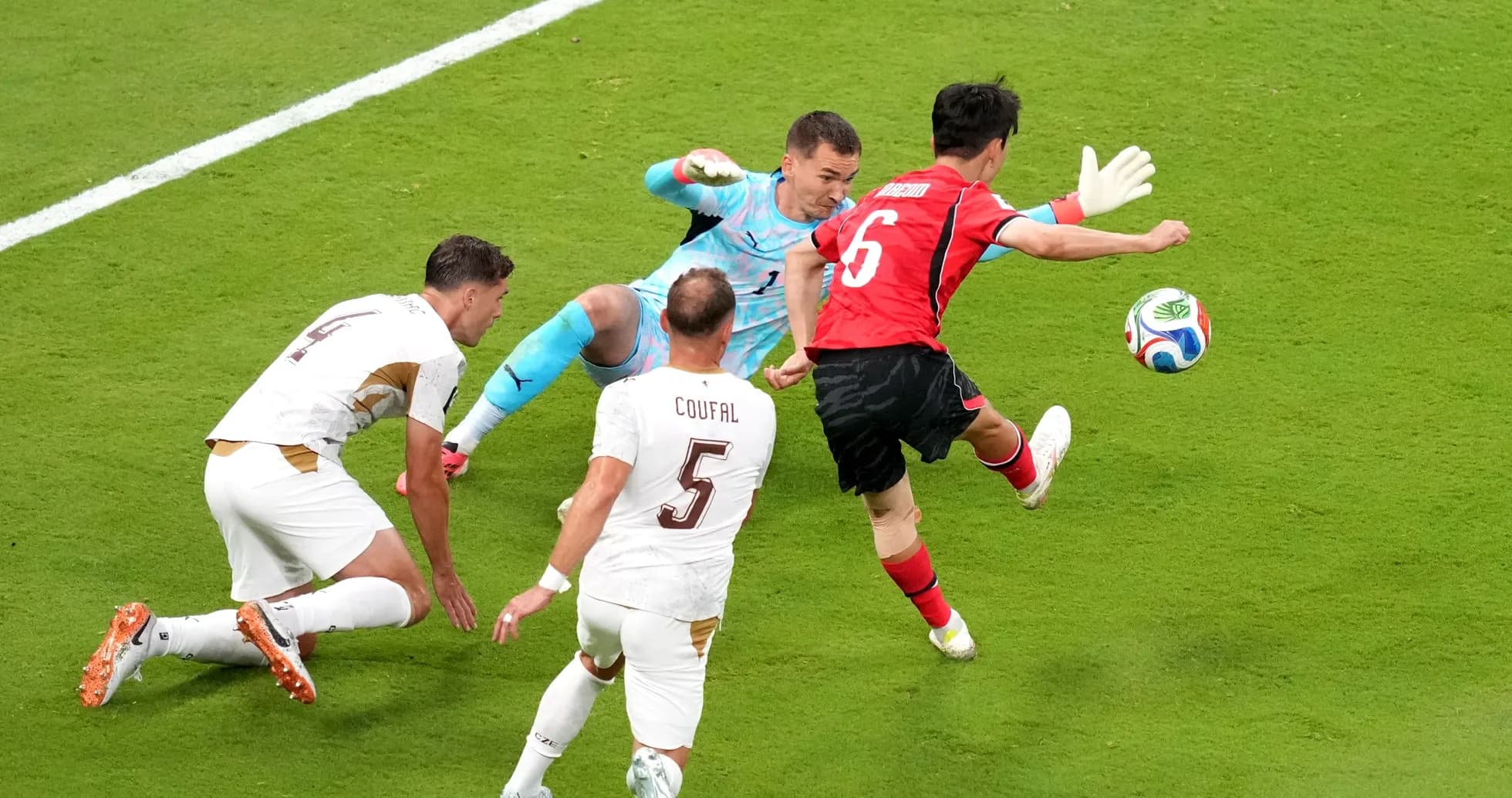
South Korea's Tactical Identity in 2–1 Victory Over Czechia
Under the lights of Estadio Akron, South Korea’s 2–1 victory over Czechia felt less like an opening group game and more like a statement of identity. In a World Cup where margins are slim, this was a contest defined by structure, risk, and the subtle rebalancing of power within Group A.
I. The Big Picture – Structure and Stakes
Both coaches mirrored each other on the board: 3-4-2-1 against 3-4-2-1. For South Korea, Myung-Bo Hong doubled down on a shape that has become their early tournament blueprint. Following this result, they sit 2nd in Group A with 3 points, a goal difference of 1, and an overall record of 2 goals for and 1 against across 1 match. The numbers underline a simple truth: this side can hurt you. At home in this World Cup, they average 2.0 goals scored and 1.0 conceded per match, and while the sample is small, the pattern is clear—front-foot football with just enough defensive steel.
Czechia, under Miroslav Koubek, leave Guadalajara with nothing on the board but a clear tactical identity. They are 3rd in Group A, 0 points, goal difference -1, having scored 1 and conceded 2 overall. On their travels in this tournament, they have 1.0 goals for and 2.0 against per game. It is not yet a crisis, but it is a warning: the balance between aggression and protection in their back three is not fully calibrated.
II. Tactical Voids – Discipline, Absence, and Risk
There were no notable absentees listed for either side, so the “voids” here were tactical rather than personnel-driven.
For South Korea, the most significant disciplinary storyline belongs to Gi-Hyuk Lee. Already prominent in the defensive metrics, he carries both a yellow and a red card in the season’s disciplinary charts, underlining how fine a line he walks in this role. The team’s card distribution is revealing: their only recorded yellow this World Cup came in the 91–105' window, a late flash of jeopardy in a game they were otherwise controlling. It suggests a side that finishes emotionally high, sometimes over the edge.
Czechia, by contrast, emerge from this fixture without recorded bookings in the seasonal data, but that can be misleading. Players like Ladislav Krejčí and Vladimír Coufal committed multiple fouls in this match, hinting at a physical, confrontational approach on the flanks and in the half-spaces. The lack of cards so far is more about refereeing thresholds than restraint; this is a team that will happily foul to disrupt rhythm.
III. Key Matchups – Hunter vs Shield, Engine Room vs Enforcer
Hunter vs Shield
The most intriguing “striker vs defence” duel wasn’t purely about the nominal No. 9. For South Korea, the attacking threat is distributed. Hwang In-beom, officially a midfielder, emerged as a de facto advanced scorer-creator: 1 goal, 1 assist, and an 8.9 rating in his 84 minutes. He is already among the top scorers and top assist providers in the competition. His 3 shots (2 on target) and 81 passes at 90% accuracy reveal a player who both initiates and finishes moves.
Behind him, Oh Hyeon-gyu sharpened the point of the spear from the bench. In just 28 minutes, he scored once from his only shot on target, added a key pass, and won 3 of 4 duels. He is the pure “hunter” in this squad, a late-game finisher who thrives when the structure in front of him has already stretched the opponent.
Czechia’s “shield” against this came in the form of a back three anchored by Robin Hranáč and the physically dominant Krejčí. Yet it was Krejčí who ended up as their top scorer, heading in Czechia’s only goal of the campaign so far. He took 1 shot, scored with it, and won 7 of 13 duels, an imposing presence but also a symptom: when your centre-back is your main goal threat, the attacking line has not fully fired.
Engine Room – Playmaker vs Enforcer
The heart of this game lay in midfield. For South Korea, Hwang In-beom and Lee Kang-in formed a devastatingly technical axis. Lee Kang-in’s numbers are as elegant as his play: 37 passes at 100% accuracy, 3 key passes, and 5 successful dribbles from 6 attempts. He operated between the lines, pulling Czechia’s midfielders and wide defenders into awkward, reactive positions.
Hwang In-beom, deeper but just as influential, stitched the phases together. His 2 interceptions and 3 won duels show he was not just a conductor but a disruptor. Together, they turned South Korea’s 3-4-2-1 into a 3-2-4-1 in possession, with the double “10s” (Hwang and Lee Kang-in) constantly overloading the Czech half-spaces.
On the other side, Tomáš Souček was tasked with being the enforcer, screening the back three and contesting aerial and second balls. Yet it was Vladimír Coufal who ended as Czechia’s primary creative outlet: 1 assist, 1 key pass, and 26 total passes, often from advanced wing-back positions. His 3 fouls committed and 2 duels won from 9 underline the strain he was under, repeatedly exposed to 1v1s and combinations down his flank.
IV. Statistical Prognosis – What This Game Tells Us
Following this result, the statistical picture is clear. South Korea’s overall record of 2.0 goals for and 1.0 against per match, combined with zero failures to score and zero clean sheets, marks them as a high-variance, high-entertainment side. Their biggest win so far is this 2–1 home result, and their formation usage—3-4-2-1 in 100% of their games—speaks to tactical continuity.
Czechia, with 1.0 goals scored and 2.0 conceded on their travels, are living on the wrong side of the margins. They have yet to keep a clean sheet or fail to score, suggesting their matches will remain open. Krejčí’s dual status as a top scorer and one of their most active duelists hints at a team still searching for balance between defence and attack.
Even without explicit xG numbers, the shot profiles and passing data point to South Korea generating higher-quality chances through structured possession and individual flair, while Czechia lean on set-pieces, crosses, and the physicality of their defenders and wing-backs.
If this match is a template, South Korea’s path forward is clear: keep Hwang In-beom and Lee Kang-in on the ball, unleash Oh Hyeon-gyu against tiring defences, and trust Kim Min-jae and Gi-Hyuk Lee to hold the line despite their disciplinary edge. For Czechia, the prognosis demands adjustment—either more protection for the back three or greater incision from forwards like Patrik Schick and Pavel Šulc, so that Krejčí is no longer their most decisive figure in both boxes.
In a group that will punish hesitation, this 2–1 feels like more than three points for South Korea. It feels like the unveiling of a side whose tactical identity is already sharper than their rivals’.
Related News
Thomas Tuchel Reflects on England's 10-Man World Cup Triumph and a Surprising Regret

Robert Moreno Takes Over as Interim South Korea Coach After World Cup Setback

Jude Bellingham Returns to Form with Real Madrid After World Cup Success

Chloe Kelly, Beth Mead & 13 Lionesses Who Must Shine in the Upcoming WSL Season for England’s 2027 World Cup Bid
Barcelona Cancels World Cup Tribute Amid Political Tensions
Messi Breaks Record for Most Penalties Taken and Missed in FIFA World Cup History