
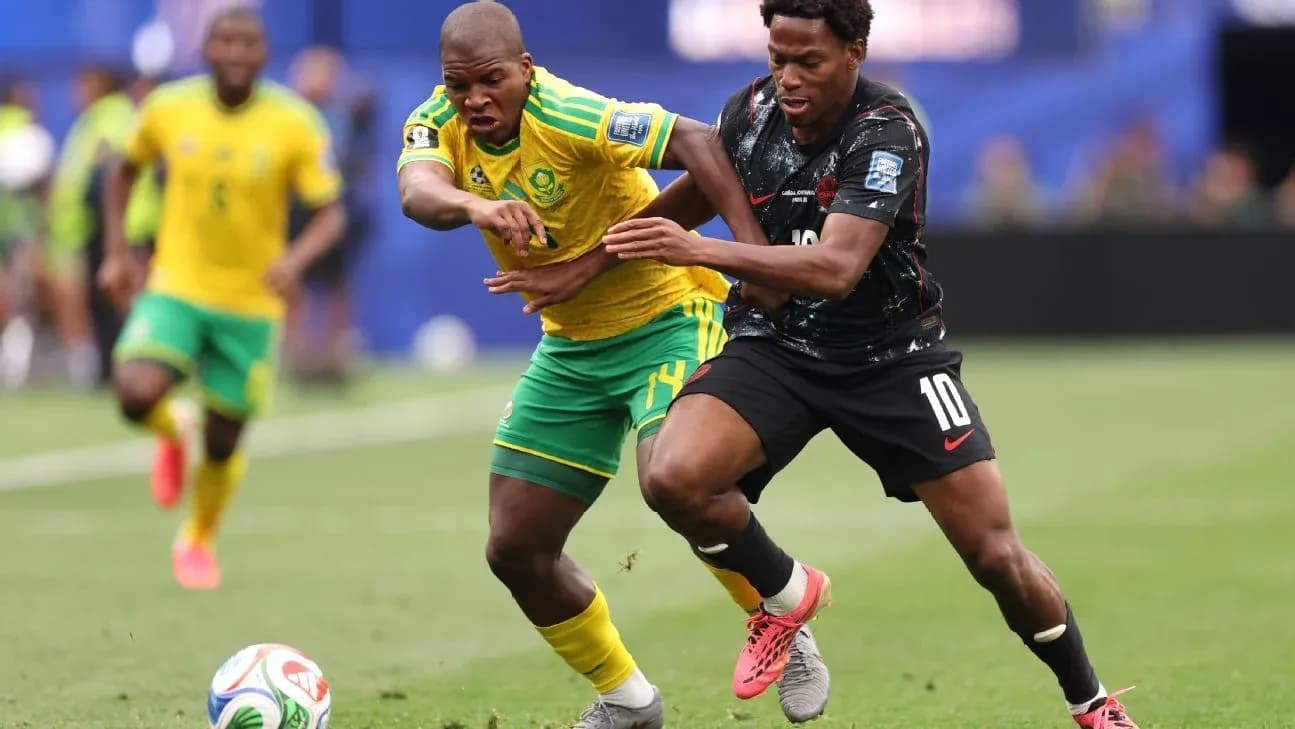
South Africa's World Cup Journey: Hope and Future Potential
South Africa leave with tears in their eyes, but not empty‑handed.
Bafana Bafana’s World Cup return after 16 years ended with a 1-0 defeat to Canada in the round of 32, a narrow, gutting exit that will sting for some time. Yet beneath the heartbreak sits something South African football has not always been able to cling to: evidence of a real, sustainable future.
This was not just a sentimental comeback. It was a statement that the country’s talent, structure and mentality might finally be aligning.
A defence built to last
If there is one department South Africa can stop worrying about, it is the centre of defence.
At this World Cup, Mbokazi and Okon did more than just fill shirts. They owned the space. They started together on the biggest stage and never once looked overawed. Mbokazi, in particular, played himself into the wider conversation as one of the standout centre-backs of the tournament, reading danger early, winning duels, and carrying the authority of a defender who belongs at this level.
Behind them, the queue is already forming.
- Olwethu Makhanya
- Khulumani Ndamane
- Tylon Smith
- Malibongwe Khoza
- Aden McCarthy
- and others are pushing from underneath, ready to step in if injury, suspension or form ever forces a change.
For whoever stands in the technical area next cycle, whether Hugo Broos or a successor, the question at centre-back will not be “who is good enough?” but “who do I leave out?”
For a country that has often scrambled to plug holes at the back, that is a quiet revolution.
Mofokeng, the next ace in the pack
Relebohile Mofokeng’s World Cup told a different story: one of potential still waiting to fully explode.
Many Bafana supporters arrived at the tournament expecting the Orlando Pirates attacking midfielder to be central to the plan. Broos did not share that unshakeable faith. Minutes were limited, frustration grew, and the sense lingered that South Africa were leaving a little creativity on the bench.
Then came South Korea.
In the 1-0 win that changed the trajectory of the campaign, Mofokeng produced the sort of performance that makes coaches rethink pecking orders. He handled the pace, the pressure, the quality of the opposition, and he did it with the kind of calm that suggests this stage will not be his ceiling.
He is only 21. By 2030, he will be entering his prime. If he gets anywhere near his ceiling, the next Bafana coach will have a genuine match-winner to deploy, a player capable of turning tight knockout games with a single moment.
A move to Belgium’s Royale Union Saint-Gilloise is widely reported to be close. If it goes through, it offers him a crucial bridge: a league competitive enough to test him, but open enough to let him play. From there, the world opens up. And so does South Africa’s attacking playbook.
Homegrown and world-class
One of the most powerful messages from this World Cup came from those who never left home.
Teboho Mokoena and Thalente Mbatha bossed midfield for long stretches, the Mamelodi Sundowns and Orlando Pirates men showing a blend of physicality and intelligence that translated seamlessly to the global stage. Out wide and at fullback, Khuliso Mudau and Aubrey Modiba drove forward with the conviction of players who know their level – and know it is high.
Behind them, Ronwen Williams reminded everyone why he has become a global name while never stepping outside South African club football, first with SuperSport United and now with Sundowns. His interventions in key moments kept Bafana alive and competitive, his composure radiating through the back line.
Their performances did something bigger than just carry South Africa to the knockouts. They challenged a long-standing assumption.
Yes, young South African players can benefit from moves abroad. They should seek them. But this tournament showed that staying in the Premiership is not a career limiter. It can be a launchpad. The domestic game, often criticised and undervalued, quietly proved it can produce players who stand shoulder to shoulder with the world’s best.
Maseko, the comeback that moved a nation
No story cut deeper into the national mood than that of Thapelo Maseko.
At 20, he scored his first Bafana goal at the 2023 Africa Cup of Nations, held in early 2024, and looked set to surge. Hugo Broos liked him. The path seemed clear. Then it bent sharply.
His move from SuperSport United to Mamelodi Sundowns should have been a leap forward. Instead, it stalled him. Under Miguel Cardoso, who took charge in December 2024, Maseko slipped down the pecking order. He drifted into the reserves, his confidence draining away from the spotlight.
By January 2026, the situation had become so bleak that he wrote on social media about losing his love for football. For a young winger once tipped as a future star, it sounded alarmingly final.
The loan to AEL Limassol in Cyprus changed everything.
Freed from the weight of expectation, he rebuilt his rhythm. By March, he was back in a Bafana shirt. This month, he wrote himself into South African football folklore.
His goal against South Korea did not just win a match. It broke a ceiling. It sent South Africa into the World Cup knockout rounds for the first time in their history. In that moment, a player who had almost walked away from the game carried a country into uncharted territory.
For a nation often battered by off-field issues and sporting disappointment, Maseko’s arc – from disillusioned reserve to World Cup hero – offered something rare: hope in its purest form.
Money, survival and a chance to reset
Off the pitch, this World Cup arrived with a cloud hanging over the South African Football Association.
SAFA’s finances were under intense scrutiny. Players had been paid late after the previous African Nations Championship. Operating expenses had routinely outstripped revenue. The word “crisis” had become uncomfortably familiar.
The World Cup changed the numbers, at least.
Qualification alone guaranteed SAFA at least $9 million in performance-based payouts, excluding preparation money. Reaching the round of 32 added another $2 million, taking the total to $11 million. For an association wrestling with debt and shortfalls, that is not just a boost – it is a lifeline.
The impact stretches beyond prize money. Sponsors watch performances. They track momentum. A team that returns to the World Cup after 16 years and then reaches the knockouts is a far easier sell than one that never makes it out of qualifying or limps out in anonymity.
Deals that once looked out of reach now move into play. Negotiations that might have stalled suddenly carry a different tone.
This cash injection will not erase years of mismanagement or poor decisions. It will not magically fix every academy, stadium or development pathway. But it gives South African football breathing space, a safety net at a time when the ground beneath it felt dangerously thin.
The real test begins now.
Can SAFA step out of survival mode and start planning with ambition? Can it turn this World Cup run – the defensive steel of Mbokazi and Okon, the promise of Mofokeng, the resilience of Maseko, the authority of Williams and Mokoena – into the foundation of something lasting?
The past few weeks have shown what South Africa can be when talent, belief and opportunity finally meet. The question that lingers, as the team flies home, is simple and unforgiving:
Will this be remembered as a turning point, or just another beautiful chapter left without a sequel?
Related News
Raphinha’s Hat-Trick Powers Barcelona to 7-2 Victory Over Racing Santander
Carabao Cup Fourth Round Draw: Liverpool Set to Clash with Chelsea, Arsenal to Face Fleetwood Town
Key Football Matches to Watch in Azerbaijan This Autumn
Raphinha's Hat-Trick Drives Barcelona to 7-2 Triumph Over Racing Santander
Hansi Flick Leads Barcelona to Record-Breaking Seven Wins in a Row
Gavi Reflects on Injury Return as Barcelona Dominate Racing Santander 7-2