
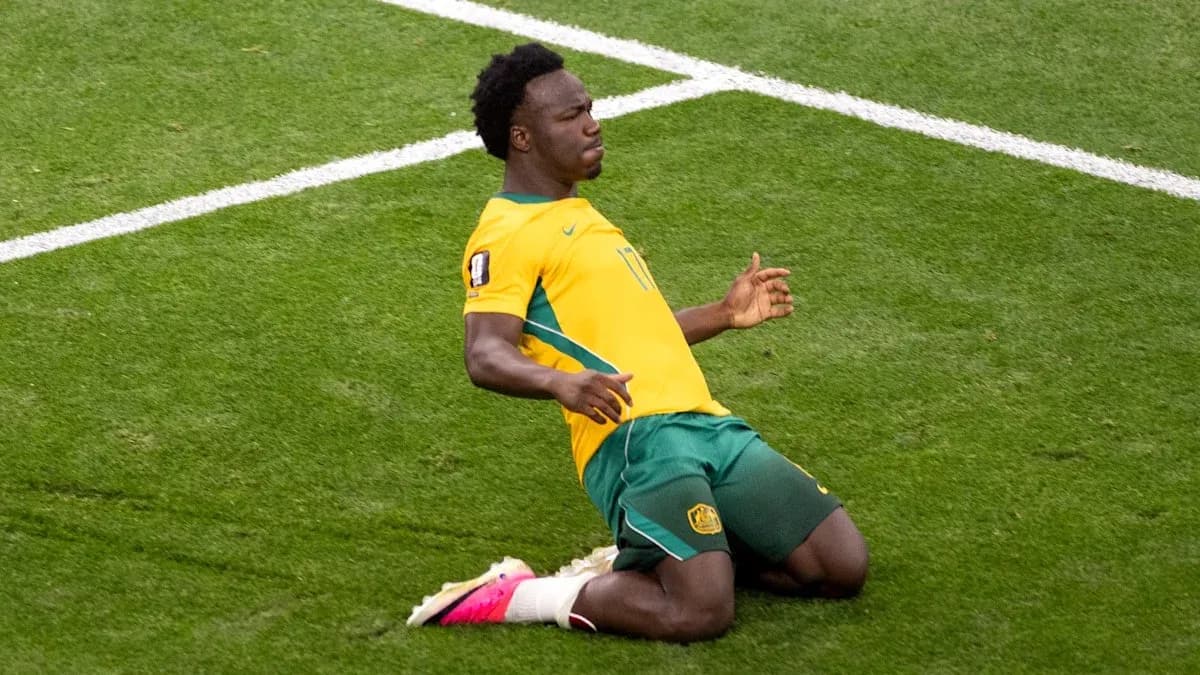
Socceroos Progress with Draw Against Paraguay: Bos Shines
The Socceroos are through. The performance still leaves a knot in the stomach.
Australia’s 0-0 draw with Paraguay was enough to book a place in the round of 32 at the FIFA World Cup, but the night’s headline was as revealing as it was reassuring: the most dangerous Australian on the pitch was a 21-year-old fullback playing out of position.
Bos shines, questions grow
Jordan Bos, thrust onto the right after Jacob Italiano’s late injury withdrawal, played like he had been waiting his whole life for this opening. Tony Popovic shuffled his deck, sliding Melbourne City left-back Aziz Behich across to the left vacancy and trusting Bos to handle the opposite flank.
It worked. Spectacularly, in fact.
Bos drove at Paraguay, carried the ball with purpose, and repeatedly gave Australia an outlet in a game starved of clear chances. His energy and bravery lit up a cautious contest.
That, for two former Socceroos watching on, was exactly the problem.
“Up front is a bit of a worry when we’re looking at Jordy Bos as one of the most threatening (for Australia),” Robbie Slater said on Stan Sport’s Added Time, cutting straight to the unease behind the clean sheet and qualification.
Scott McDonald agreed. For him, the spotlight in a World Cup knockout push should be fixed on Mo Toure or Nestory Irankunda, not a young defender having to drag the attack forward from wide.
No.9 role under the microscope
Popovic’s call to bench Toure and redeploy Irankunda as Australia’s No.9 framed the night’s biggest tactical talking point. Irankunda, usually a winger, found himself wrestling with Paraguay’s back three, often isolated, often feeding on scraps.
McDonald could not see this as anything more than a short-term patch.
“There is a problem in terms of the No.9. Not bringing (Mo) Toure on instead of Tete Yengi tells me today that there’s no trust there,” he said.
That line will sting in the Toure camp. Strikers live off belief as much as service, and McDonald, who spent a career in that unforgiving role, spelled out the psychological hit.
“Does he go and start him (Toure) out of the blue in the next game? You just can’t tell with Tony. But as a striker, being Toure, I don’t like that. That doesn’t fill me with confidence that my coach trusts me.”
On the pitch, the evidence backed up the concern. Irankunda worked, chased, tried to find pockets. The ball rarely stuck. When it did, support arrived late, if at all.
“No matter who we put up there, it’s a thankless task up there,” McDonald said. “Look at Nestory (on Friday), he had very little and was living off scraps.
“But also when he plays up top, we don’t have a box outlet. Jordy Bos playing on the right-hand side was brilliant and it gave us that outlet.”
The praise for Bos doubled as an indictment of the forward line. When your fullback is your best route into the penalty area, something fundamental is missing.
Irankunda’s growing pains
McDonald didn’t hide his admiration for Irankunda’s talent, but he was blunt about the demands of the central role.
At 20, Irankunda is being asked to learn the dark arts of the No.9 on the fly, on the biggest stage, against a rugged South American defence that relished the physical battle.
“Look, he’s gotta hold it up a little bit better,” McDonald continued. “I think at times he struggled because it’s not his natural game.”
Paraguay knew exactly where the danger lay. They squeezed the space, locked down the channels, and forced Irankunda into traffic.
“With the way Paraguay were set up as well with the back three, it is very hard for him to get down the sides of the opposition. There was no space.
“They were aware of his threat also, with three taking care of him. But he probably sometimes needs to be more in central positions and wait for things to happen.”
That last line cut to the heart of the positional shift. Irankunda’s instincts drag him wide, into areas where he can face up defenders, beat a man, and unleash from the edge of the box. The role Popovic has handed him demands something colder, more patient.
“As we see the best strikers in the world – like Erling Haaland – they’re not interested any more. They just get into the right areas and allow others and trust others to do the dirty work then get on the end of things.
“That’s not naturally probably where (Irankunda) thinks. He wants to be the guy creating that and doing things, getting on the edge of the box and having shots. So if you’re gonna play that role, you just need to play it a little bit more smarter and be a bit more patient.”
The old truth about Australian No.9s
For McDonald, this isn’t a new debate. It’s the latest chapter in a long-running Australian question: what does a Socceroos centre-forward need to be?
“I didn’t like it either,” he admitted of the current set-up. “I mean, for the majority of my career it was always you played off the big man or whatever.”
Target men, aerial threats, forwards who can take a beating and still make the ball stick – that’s the template he knows.
“But I’ve always said it, if you can head it, you’ve got a better chance of being a No.9 for the Socceroos. It’s as simple as that.”
Right now, the picture is anything but simple. Australia are in the knockouts, Bos is the breakout story, and yet the central striking role looks no closer to a settled answer.
Popovic has time, but not much. The next team sheet will say plenty about who he trusts to carry the weight of the shirt – and whether the Socceroos can find a forward as fearless as the young fullback currently stealing the show.
Related News
Raphinha’s Hat-Trick Powers Barcelona to 7-2 Victory Over Racing Santander
Carabao Cup Fourth Round Draw: Liverpool Set to Clash with Chelsea, Arsenal to Face Fleetwood Town
Key Football Matches to Watch in Azerbaijan This Autumn
Hansi Flick Leads Barcelona to Record-Breaking Seven Wins in a Row
Gavi Reflects on Injury Return as Barcelona Dominate Racing Santander 7-2
Buffon Stands Firm in Support of Gattuso and Reflects on Italy Exit