
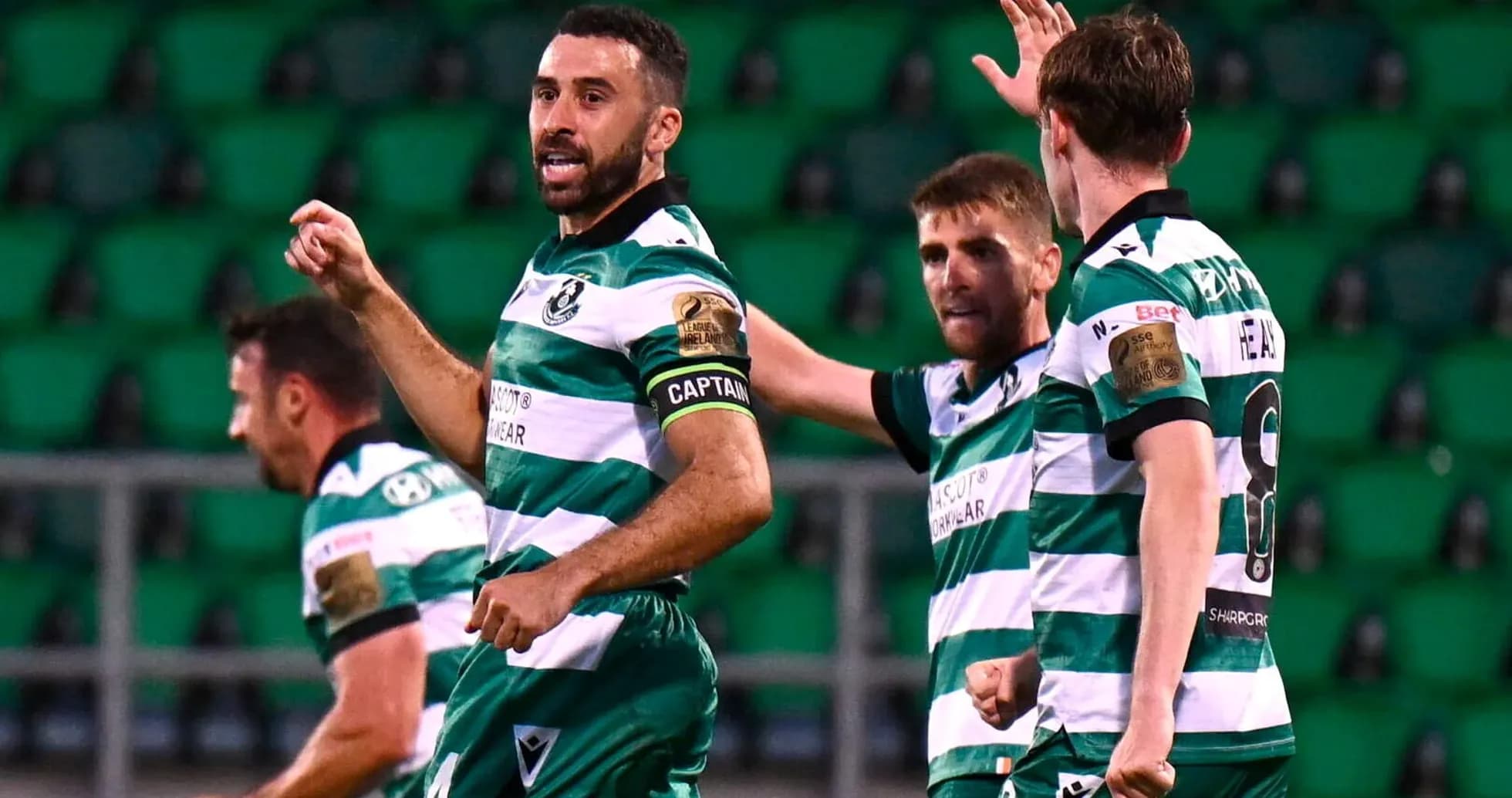
Shamrock Rovers Defeat Egnatia Rrogozhinë 3-1 in UEFA Europa League
Shamrock Rovers’ 3-1 win over Egnatia Rrogozhinë at Tallaght Stadium in the UEFA Europa League 3rd Qualifying Round was shaped less by volume metrics and more by structural clarity and execution in key moments. With both sides mirroring each other in a 3-5-2, the home team ultimately controlled the decisive zones better, turned set-piece and wide dominance into goals, and managed the game state more intelligently once ahead.
Rovers’ 3-5-2 was built on a back three of T. Sobowale, R. Lopes and E. Stevens, with wing-backs W. Fitzgerald and A. Brennan giving the system its width. In possession, this often resembled a 3-3-4: the wing-backs pushed high, while central midfielders J. Byrne and D. Watts stepped into advanced half-spaces around M. Healy, who held the central pivot. Forwards G. Burke and A. Greene worked on different lines, Burke frequently dropping into the left pocket to overload midfield and Greene stretching the back line with runs across the channels.
First Key Tactical Theme
The first key tactical theme was Shamrock Rovers’ comfort in constructing through the thirds against Egnatia’s matching 3-5-2. Egnatia’s central trio of Fernando Medeiros, A. Kryeziu and I. Diabate were consistently asked to defend large lateral distances. When they failed to shift as a unit, Byrne and Watts found pockets to receive between the lines, especially on the right side, where Byrne’s positioning later produced the assist for Lopes’ goal. The opening goal from G. Burke’s penalty at 29' came from Rovers’ ability to pin Egnatia deep and force errors in the box, a direct consequence of sustained territorial pressure rather than isolated transition play.
Egnatia’s response revolved around their own back three (E. Sota, E. Bitri, Z. Aliyev) and a wing-back line including G. Jaime and A. Yago. Their 3-5-2 was more reactive, looking to spring forward via the ball-carrying of I. Gruda and the forward presence of D. Adjessa. The equaliser sequence around 41' – a missed penalty by Guillem Jaime followed almost immediately by a normal goal from G. Jaime – underlined their threat from wide overloads and second-phase chaos rather than sustained positional attacks. Rovers struggled momentarily to track runners from deep, allowing Jaime to appear in an advanced position to finish after the initial miss.
Half-Time Adjustments
Half-time at 1-1 forced both coaches to adjust. Stephen Bradley’s first move at 46' was to introduce J. Mulraney (IN) for A. Brennan (OUT). This change sharpened Rovers’ right flank: Mulraney, a more natural winger-type, offered direct 1v1 threat and better delivery, while Fitzgerald on the opposite side maintained width. The effect was to stretch Egnatia’s back five horizontally, opening central lanes for late runs and set-piece opportunities. Bradley then doubled down on attacking freshness with J. Afolabi (IN) for A. Greene (OUT) at 58', giving Rovers a more physical focal point up front to pin Egnatia’s centre-backs and create space for Burke and the advancing midfielders.
Turning Point
The turning point tactically came with Rovers’ second and third goals in quick succession. At 55', R. Lopes’ goal, assisted by J. Byrne, reflected a clear set-piece or second-phase routine: the centre-back stepping into a dangerous area while Byrne’s delivery and positioning exploited Egnatia’s disorganisation. Just two minutes later, at 57', an own goal by A. Yago under pressure turned the score to 3-1 and fundamentally changed the game state. From that point, Rovers could manage tempo, protect central spaces, and choose their pressing triggers more selectively.
Bradley’s subsequent substitutions at 69' – D. Mandroiu (IN) for G. Burke (OUT) and N. Razi (IN) for D. Watts (OUT) – were about energy management and control. Mandroiu offered fresh legs and technical security between the lines, while Razi added dynamism in midfield after Watts had been booked at 60' for “Foul”. At 77', J. O’Sullivan (IN) for J. Byrne (OUT) further refreshed the midfield, allowing Rovers to maintain intensity in central pressing and defensive transitions in the closing stages.
Egnatia's Adjustments
Nevil Dede’s adjustments for Egnatia at 46' were more radical but less cohesive. He made a triple change: A. Albanese (IN) for I. Diabate (OUT), K. Loukili (IN) for I. Gruda (OUT), and J. Montenegro (IN) for D. Adjessa (OUT). In theory, this injected attacking quality and fresh legs, but in practice it disrupted their midfield and front-line relationships. Albanese, who was booked at 47' for “Foul”, struggled to impose control in central areas, and the early yellow constrained his defensive aggression. Loukili and Montenegro offered movement, but without stable central circulation behind them, Egnatia’s attacks became more direct and easier for Rovers’ back three to read.
Later, at 69', N. Ajetovikj (IN) replaced Z. Aliyev (OUT), and at 81' E. Ndreca (IN) came on for A. Yago (OUT). These changes appeared aimed at refreshing the defensive line and wing-back role after the own goal incident, but by then Rovers had already established both a two-goal cushion and territorial control. Egnatia’s 3-5-2 increasingly flattened into a 5-3-2, with wing-backs pinned deep, limiting their counter-attacking outlets.
Discipline Impact
Discipline also had a tactical impact. Egnatia collected two yellow cards – Ildi Gruda at 38' and Alessandro Albanese at 47', both for “Foul” – which nudged their midfield into a more cautious posture. That caution, combined with Rovers’ wing-back pressure, reduced their ability to break up play aggressively in the middle third. Shamrock Rovers, by contrast, took just one yellow card, to Dylan Watts at 60' for “Foul”. Bradley’s swift decision to withdraw Watts at 69' was a clear game-management move: removing a booked central midfielder in a two-goal lead situation reduced risk of a red card and protected the team’s numerical superiority.
With no reliable data on possession, shots, xG or goalkeeper saves, the tactical verdict must rest on structure, substitutions and game-state management. Shamrock Rovers read the game better: they used their 3-5-2 to dominate the flanks, leveraged set-pieces and second phases for high-quality chances, and adjusted personnel proactively around bookings and fatigue. Egnatia’s more reactive 3-5-2 produced a brief spell of threat before half-time, but their heavy half-time rotation and subsequent defensive errors left them chasing a game that Rovers controlled maturely through to full time at Tallaght Stadium.
Related News

Celje vs Red Bull Salzburg Predicted Lineups and Team News

Anderlecht vs Red Bull Salzburg Predicted Lineups and Team News
NEC Nijmegen vs Benfica Predicted Lineups: Team News for UEFA Europa League
Plzen vs Benfica Predicted Lineups: Team News Ahead of UEFA Europa League
Benfica vs Lech Poznan Predicted Lineups and Team News

Benfica vs OFI: Predicted Lineups and Team News for UEFA Europa League