
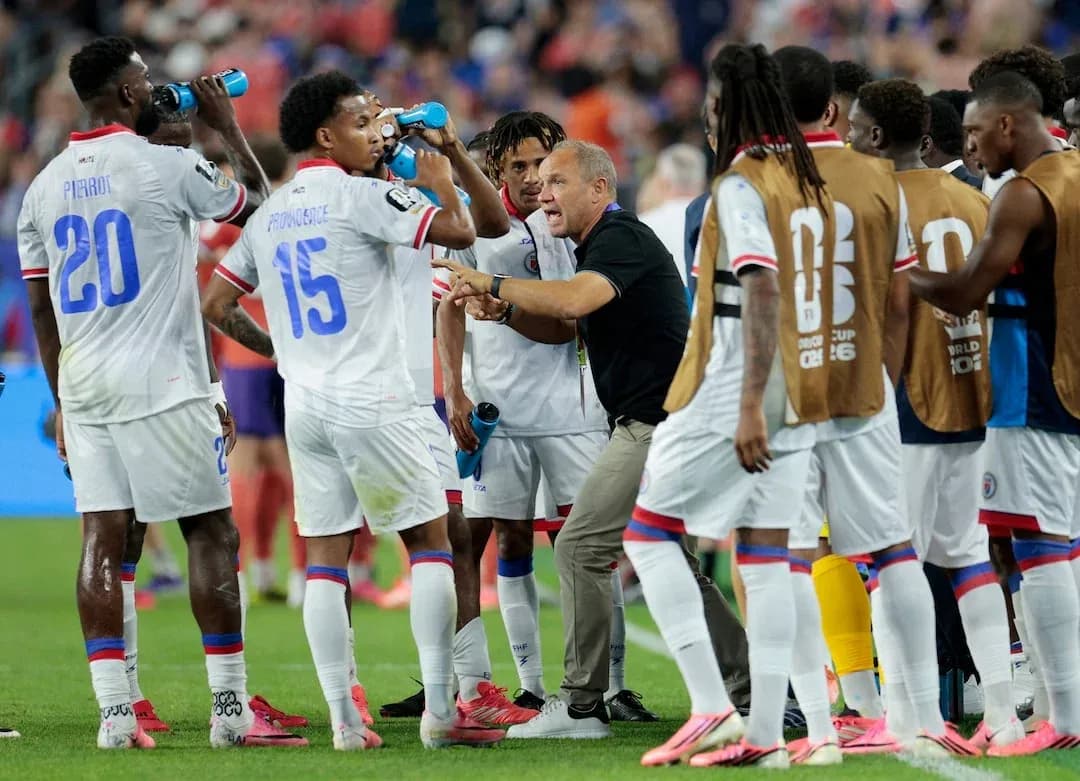
Scotland vs Haiti: World Cup Group C Match Analysis
Gillette Stadium, Boston. A cool June night, and Group C of the World Cup opened with a meeting of contrasts: Haiti’s first steps on this stage against a Scotland side determined to prove its maturity. Following this result, the table tells a simple story – Scotland top the group in 1st with 3 points and a goal difference of +1 after a 1-0 win, while Haiti sit 4th, pointless, their goal difference -1 after a narrow defeat. But the 90 minutes that produced those numbers were far more layered.
I. The Big Picture – Two 4-4-2s, two very different identities
Both coaches arrived with a 4-4-2, yet the shapes carried different intentions.
Sebastien Migne’s Haiti lined up with Johny Placide behind a back four of Carlens Arcus, Ricardo Adé, Hannes Delcroix and Martin Expérience. In front, a hard-working midfield band of Louicius Don Deedson, Danley Jean Jacques, Jean-Ricner Bellegarde and Ruben Providence was asked to compress space and spring quickly into transition. Up top, Frantzdy Pierrot and Wilson Isidor were the twin reference points, one a target, the other a runner.
Steve Clarke mirrored the structure, but not the mindset. Angus Gunn was protected by Aaron Hickey, Grant Hanley, Jack Hendry and Andy Robertson – a back four with clear ball-playing ambitions down both flanks. The midfield line of Ben Gannon-Doak, Scott McTominay, Lewis Ferguson and John McGinn was built to control rhythm and win second balls, while Lawrence Shankland and Che Adams led the line, combining penalty-box presence with link play.
Heading into this game, Haiti’s season profile in the World Cup was a blank canvas: just 1 match played, 0 goals scored in total, 1 conceded, and no clean sheets. Scotland’s, by contrast, now reads as the picture of efficiency: 1 match played on their travels, 1 win, 1 goal scored away, 0 conceded overall, and a clean sheet banked. The 1-0 scoreline felt like a natural extension of those early-season identities – Haiti honest but blunt, Scotland economical and controlled.
II. Tactical Voids and Discipline – Edges at the margins
There were no listed absentees, so both managers had their full squads at their disposal. That made the tactical voids less about missing names and more about missing connections.
For Haiti, the main gap appeared between midfield and attack. The 4-4-2 block was compact without the ball, but when possession was won, the distances from Jean Jacques and Bellegarde into Pierrot and Isidor were often too big. Without a natural deep-lying playmaker, Haiti struggled to progress centrally, forced instead to rely on wide surges from Don Deedson and Providence that Scotland’s full-backs largely contained.
Discipline became another subtle dividing line. Haiti’s season card profile shows a single yellow card, and tellingly it arrived between 31-45 minutes – a 100.00% concentration of their cautions in that pre-interval window. It reflected the tension of a side battling to stay in the contest as Scotland turned the screw before half-time.
Scotland’s card map was more spread and more revealing of game management. Their yellows are clustered in two periods: 46-60 minutes (1 card, 33.33% of their total yellows) and 91-105 minutes (2 cards, 66.67%). In other words, Scotland’s indiscipline coincided with the phases where the match needed locking down – just after the restart, and deep into added time. Players like Aaron Hickey, Kenny McLean and Findlay Curtis, all shown yellow in this campaign, illustrate a willingness to take tactical fouls to preserve the clean sheet rather than structural indiscipline.
III. Key Matchups – Hunter vs Shield, and the Engine Room
Hunter vs Shield: Pierrot & Isidor vs Hanley & Hendry
On paper, Haiti’s “hunters” were Pierrot and Isidor. Pierrot’s physicality and Isidor’s mobility were designed to unsettle Scotland’s central pairing of Hanley and Hendry. But with Haiti having failed to score in total this World Cup campaign and averaging 0.0 goals at home, the burden on those two was immense.
Hanley and Hendry, protected by McTominay dropping in, formed a tight shield. Scotland have yet to concede in total – 0 goals against across their 1 match – and that defensive record was underlined here. Haiti’s front two were often forced to receive with their backs to goal, isolated, with little support from the second line. When long balls came, Hanley attacked the first contact, Hendry swept, and the full-backs tucked in intelligently. The hunter never really got a clear sight of the shield.
Engine Room: Bellegarde & Jean Jacques vs McTominay & Ferguson
The real battle of the night was in the centre circle. Haiti’s engine was driven by Jean-Ricner Bellegarde’s energy and Danley Jean Jacques’ screening. Their job: disrupt Scotland’s passing lanes and feed quick counters to the front two.
Opposite them, Scott McTominay and Lewis Ferguson offered a blend of physicality and control. McTominay patrolled in front of the defence, breaking up play and stepping forward when space opened, while Ferguson connected with McGinn and Gannon-Doak between the lines. The effect was cumulative: Haiti spent long stretches defending, and when they did win the ball, Scotland’s counter-press, led by that central pair, often forced hurried clearances rather than composed build-up.
On the flanks, two mini-battles shaped the narrative. Don Deedson and Providence tried to drive at Hickey and Robertson, but the Scottish full-backs – Hickey in particular, who has already shown himself capable of duelling aggressively and drawing fouls – largely kept them at arm’s length. That limited Haiti’s ability to change the angle of attack and left Pierrot and Isidor feeding on scraps.
IV. Statistical Prognosis – What this result suggests going forward
Following this result, Haiti’s statistical profile is stark. In total this campaign: 1 match, 0 goals scored, 1 conceded, an average of 0.0 goals for and 1.0 against at home, 0 clean sheets, and 1 match where they failed to score. The numbers confirm what the eye saw: a side with honest defensive structure but too little incision in the final third.
Scotland’s numbers, by contrast, sketch the outline of a pragmatic tournament side. On their travels they have played 1, won 1, scored 1. Their total average is 1.0 goal for and 0.0 against, with 1 clean sheet and no failures to score. Even without explicit xG data, the pattern is clear: Clarke’s team are not chasing chaos; they are managing margins.
The disciplinary trends reinforce that reading. Haiti’s single yellow in the 31-45 window hints at a team stretched just before half-time. Scotland’s concentration of cards between 46-60 and 91-105 suggests deliberate, game-state-driven fouling – especially from players like Hickey, McLean and Curtis – to disrupt rhythm and protect a narrow lead.
In tactical terms, the prognosis is that Haiti must find a way to connect their midfield to Pierrot and Isidor more consistently, perhaps by dropping Bellegarde closer to the build-up or encouraging one full-back, especially Arcus, to be braver in overlapping. Without adding that extra passing lane, their 4-4-2 risks becoming a purely reactive shell.
For Scotland, the challenge is different: to layer more attacking threat onto a solid base. The 4-4-2 here delivered control and a clean sheet, but progression in a World Cup group will eventually demand more than 1-0 margins. Integrating the bench – options like Ryan Christie, Lyndon Dykes or Findlay Curtis – gives Clarke flexibility to tilt this structure into a 4-2-3-1 or 4-3-3 when chasing a game, without sacrificing the defensive reliability that has defined their opening night.
At Gillette Stadium, the story was written in fine margins and one decisive Scottish strike. The table records it as a simple 1-0, but the tactical subtext is clear: Scotland have announced themselves as a disciplined, tournament-ready unit; Haiti have announced their resilience, but must now find their voice in the final third before the group stage closes its grip.
Related News

Thomas Tuchel Reflects on England's 10-Man World Cup Triumph and a Surprising Regret

Robert Moreno Takes Over as Interim South Korea Coach After World Cup Setback

Jude Bellingham Returns to Form with Real Madrid After World Cup Success

Chloe Kelly, Beth Mead & 13 Lionesses Who Must Shine in the Upcoming WSL Season for England’s 2027 World Cup Bid
Barcelona Cancels World Cup Tribute Amid Political Tensions
Messi Breaks Record for Most Penalties Taken and Missed in FIFA World Cup History