
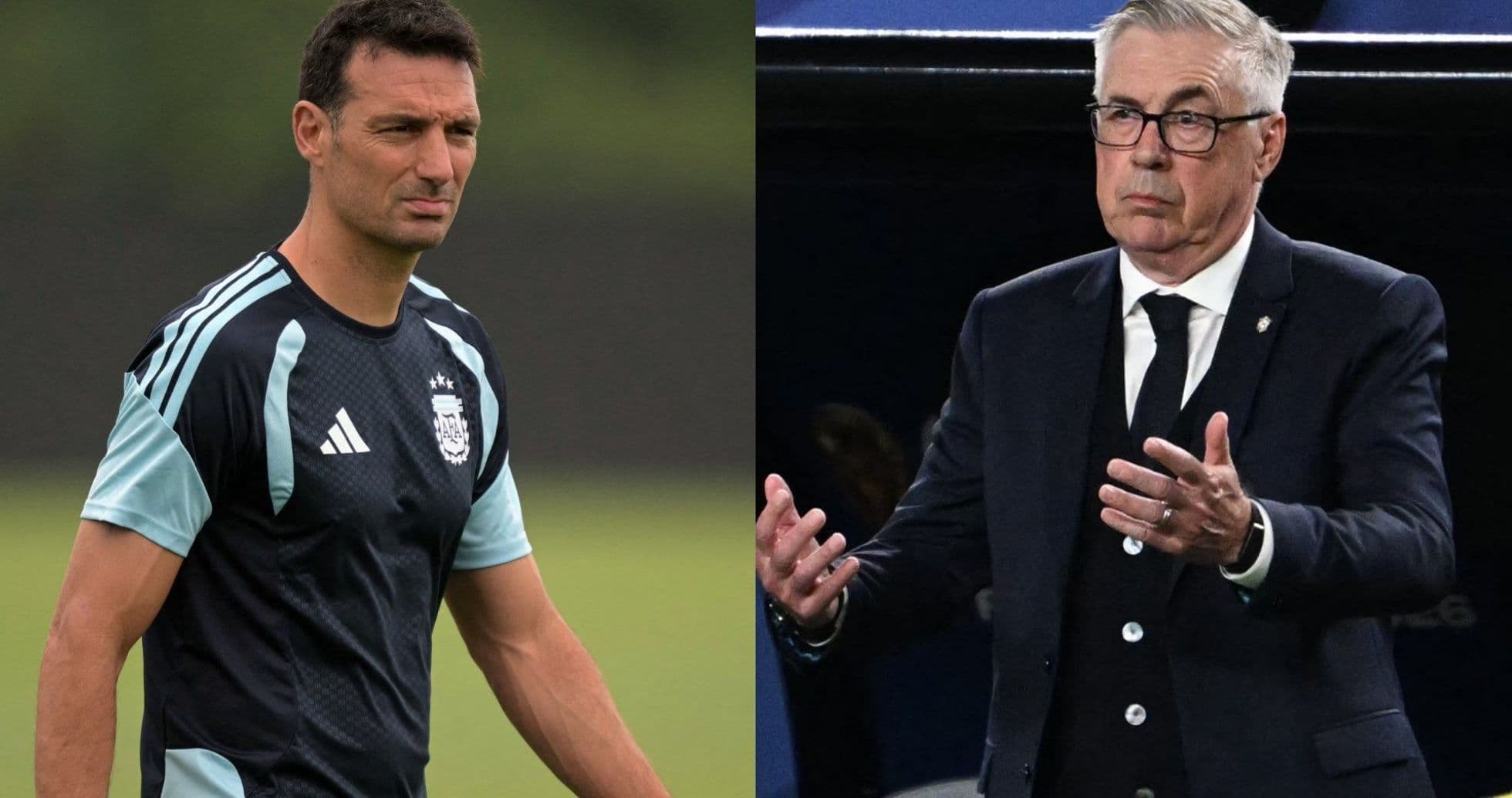
Scaloni's Tactical Philosophy Ahead of Argentina vs Austria Clash
In the heavy Texas heat, with Argentina tuning up for a decisive Group J clash in Dallas, Lionel Scaloni brushed aside a brewing tactical debate with the same calm his team shows in tight knockout games.
The subject? Carlo Ancelotti’s view of the world champions.
The Italian had suggested Argentina are not a side built on relentless pressing or all-out physical frenzy, a comment that sparked questions about the Albiceleste’s intensity without the ball. Scaloni, though, refused to turn it into a feud.
“I take it in a good way. He spoke highly of us, he didn't speak badly,” Scaloni said, smiling off the supposed slight. Ancelotti had mixed Spanish, Italian and Portuguese in his remarks, and Scaloni argued the nuance may have been lost in translation. “I understood it as a compliment and not a criticism. I'm very sure of that.”
No war of words. Just a coach defending his footballing idea.
Scaloni’s idea of intensity
Scaloni used the moment to push back against a modern obsession: the belief that a team must press furiously, everywhere, all the time, to be considered intense.
“You have to see what is understood by intensity,” he pointed out. For him, intensity is not simply measured by sprints and high presses. It’s about what happens when the ball is lost, about how a team closes space and limits damage.
“When you don't have the ball, you have to try to ensure they don't hurt you,” he said. That, in his view, is where the real battle lies. He noted that there are few teams who genuinely press high and man-to-man over 90 minutes. At the top level, most sides now look to be compact and dominant in the middle third, where matches are increasingly decided.
The shape is secondary. Three forwards or five at the back, it makes little difference if the team’s reaction in transition is sharp. “Whether you win with three forwards or defend with three or five at the back, the reaction when losing the ball is what matters,” Scaloni insisted.
Control over chaos. That is the core of his world champions.
A new layer to the world champions
More than three years on from lifting the trophy in Qatar, this is not a frozen, nostalgic Argentina. Scaloni stressed how the squad has evolved, pointing to younger names like Nico Paz and Giuliano Simeone as examples of fresh energy and different profiles added to the group.
The idea is clear: maintain the competitive edge that carried them to the summit, but add weapons that can change the rhythm of a game. With players like Paz and Simeone, Scaloni has options for a more direct, vertical approach when the match demands it.
“The team is on the right track even though three and a half years have passed,” he said. “They haven't shown signs of taking their foot off the gas and that’s why they are here.” The schedule is brutal, the number of club games enormous, and he admitted it is “very difficult for everyone to arrive at 100 per cent.” Yet he underlined one key detail: all 26 players are fit and ready to play.
For a coach who prizes collective reaction over individual fireworks, that depth matters.
Austria next, and no room for error
All of this theory now meets a very real test. Argentina head into a crucial meeting with an impressive Austria side, both teams locked on three points in Group J. The stakes are straightforward: a win would likely secure top spot for the defending champions and ease their path through the bracket.
There will be no hiding place in midfield, exactly the zone Scaloni believes decides everything. Austria have shown they can match opponents physically and tactically. Argentina will try to show that control, not chaos, still wins the day.
On the other side of the draw, Brazil have already bought themselves a little comfort. Ancelotti’s team swept past Haiti 3-0, a performance that gives them margin for error. They now need only a draw against Scotland to seal a place in the round of 32.
The narrative writes itself: Ancelotti’s Brazil cruising, Scaloni’s Argentina grinding through a tougher path, two footballing philosophies circling each other from opposite sides of the bracket.
For now, Scaloni is not interested in the noise around pressing metrics or stylistic labels. His gaze is fixed on Austria, on the middle of the pitch in Dallas, and on a group of players who, in his words, still refuse to take their foot off the gas.
Related News
Raphinha’s Hat-Trick Powers Barcelona to 7-2 Victory Over Racing Santander
Carabao Cup Fourth Round Draw: Liverpool Set to Clash with Chelsea, Arsenal to Face Fleetwood Town
Key Football Matches to Watch in Azerbaijan This Autumn
Raphinha's Hat-Trick Drives Barcelona to 7-2 Triumph Over Racing Santander
Hansi Flick Leads Barcelona to Record-Breaking Seven Wins in a Row
Gavi Reflects on Injury Return as Barcelona Dominate Racing Santander 7-2