
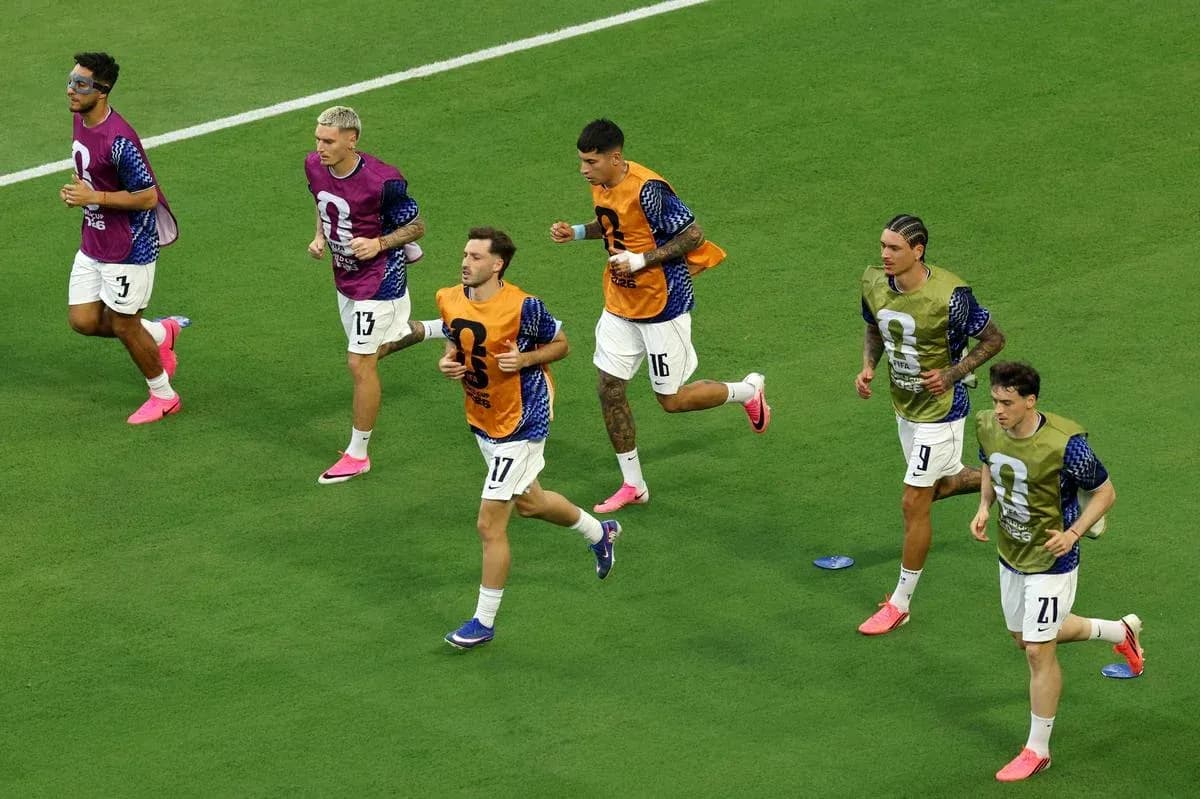
Saudi Arabia vs Uruguay: World Cup 2026 Draw Analysis
Under the Miami lights at Hard Rock Stadium, Saudi Arabia and Uruguay opened their World Cup 2026 campaigns with a 1–1 draw that felt less like a settled verdict and more like the opening chapter of a tactical chess match. Following this result, both sides sit on 1 point in Group H, Uruguay ranked 1st and Saudi Arabia 2nd, separated only by the thin margins of group tiebreakers and expectation.
I. The Big Picture – Two Identities, One Stalemate
Saudi Arabia arrived with a clear structural statement: a 4-4-2 under Georgios Donis, compact and orthodox, built around clear lines and collective discipline. Their group record now reads 1 draw from 1 match, with 1 goal scored and 1 conceded overall. At home in this tournament, they have played 1, drawn 1, with averages of 1.0 goal for and 1.0 goal against at home.
Across from them, Marcelo Bielsa’s Uruguay stepped into familiar territory: a 4-2-3-1 that promises verticality and aggression. On their travels in this World Cup, Uruguay have played 1 match, drawn 1, scoring 1 and conceding 1, with away averages of 1.0 goal for and 1.0 goal against. Both teams, in total this campaign, mirror each other perfectly: 1 played, 0 wins, 1 draw, 0 losses, 1–1 goals and a goal difference of 0 for each.
The scoreline at half-time – Saudi Arabia 1, Uruguay 0 – told a story of Saudi precision and resilience. The full-time 1–1 reset the narrative: Uruguay’s structural pressure eventually broke through, but not enough to tilt the group.
II. Tactical Voids and Discipline – A Controlled Opener
There are no listed injuries or suspensions in the data, so the tactical voids here are less about absentees and more about choices. Donis trusted his 4-4-2 to the letter, with M. Al Owais in goal behind a back four of S. Abdulhamid, A. Al Amri, H. Tambakti and M. Al Harbi. In front, a flat but hard-working midfield of M. Abu Al Shamat, M. Kanno, A. Al Khaibari and S. Al Dawsari was tasked with compressing central lanes, while F. Al Buraikan and M. Al Juwayr led the line.
For Uruguay, Bielsa’s XI was built for territorial dominance: F. Muslera in goal; a back four of G. Varela, S. Caceres, M. Olivera and M. Vina; the double pivot of M. Ugarte and R. Bentancur; a three of F. Valverde, F. Vinas and M. Araujo behind the lone forward D. Nunez. It is a structure designed to swarm the ball and flood the half-spaces.
Disciplinary data underlines how controlled this opener was. Heading into this game, Saudi Arabia had collected their only yellow card in the 31–45 minute window, with 100.00% of their cautions arriving in that period. Uruguay, by contrast, had no yellow or red cards recorded in any minute range. That pattern fits the visual of the match: Saudi Arabia living on the edge in short, intense spells of pressure, Uruguay aggressive in shape but clean in challenge.
III. Key Matchups – Hunter vs Shield, Engine Room vs Engine Room
Hunter vs Shield
For Saudi Arabia, the “hunter” role was shared between F. Al Buraikan and M. Al Juwayr. In a 4-4-2 that often sank into a mid-block, their job was as much about triggering counter-presses and stretching Uruguay’s centre-backs as it was about finishing. They operated against a Uruguayan defensive line anchored by S. Caceres and M. Olivera, with M. Ugarte frequently dropping to form a situational back three in build-up.
Heading into this game, Saudi Arabia’s attack at home averaged 1.0 goal for and 1.0 against, which is exactly what unfolded again: they remain a side whose margin for error is razor-thin. The shield, in their case, was the central pairing of A. Al Amri and H. Tambakti, protected by A. Al Khaibari and M. Kanno. The fact they held Uruguay to 1 goal, despite the South Americans’ structural superiority in the final third, speaks to their organisation.
For Uruguay, D. Nunez was the spearhead, supported by the late-arriving threat of F. Valverde and the creative pockets occupied by F. Vinas and M. Araujo. Uruguay’s away average of 1.0 goal for and 1.0 against underlines a side that creates, but also leaves space to be attacked in transition. Here, Saudi Arabia’s front two repeatedly tried to pin the Uruguayan centre-backs and exploit the space behind the advancing full-backs, especially on the side of M. Vina.
Engine Room – Playmakers and Enforcers
The true battleground lay in midfield. For Saudi Arabia, M. Kanno and A. Al Khaibari formed the spine of the side. Kanno’s role as a tempo-setter and press-resistor was vital: he was the pivot through which Saudi Arabia tried to escape Uruguay’s press and find S. Al Dawsari between the lines. Al Khaibari, more conservative, acted as the screen in front of the defence, tracking Nunez’s drops and Valverde’s surges.
On the other side, M. Ugarte and R. Bentancur were Bielsa’s enforcers and metronomes. Ugarte hunted the ball high, often stepping past the first line to suffocate Saudi build-up. Bentancur offered progression with his passing range, finding Valverde and Vinas in the half-spaces. F. Valverde, notionally a midfielder in the “4” band, was Uruguay’s hybrid: part playmaker, part second striker, constantly testing the Saudi block with late runs and long-range attempts.
Without explicit xG numbers, the flow of the match and the structural choices suggest Uruguay shaded the Expected Goals battle through volume and territory, while Saudi Arabia maximised the quality of their fewer attacks.
IV. Statistical Prognosis – What This Draw Really Says
Following this result, both teams share an identical statistical profile in total this campaign: 1 match played, 1 draw, 1.0 goal scored per game, 1.0 conceded, 0 clean sheets, and 0 failed-to-score outings. Neither side has taken or missed a penalty; both show a penalty record of 0 taken, 0 scored, 0 missed, so there is no early shootout edge to infer.
For Saudi Arabia, the prognosis is of a team whose 4-4-2 is stable but will need an extra layer of attacking invention. Their single yellow card coming in the 31–45 window hints at a pattern: intensity spikes late in the first half, when legs tire and concentration wavers. Managing that phase will be crucial in tighter group games.
For Uruguay, the numbers confirm what the eye suggests: a side that will likely dominate xG across the group but must convert that into wins. Their away average of 1.0 goal for and 1.0 against, combined with a clean disciplinary slate, paints them as controlled aggressors rather than reckless pressers.
If this match is a tactical preview of their group trajectories, expect Saudi Arabia to lean on structure, compactness and set moments of quality from players like S. Al Dawsari and M. Kanno. Uruguay, meanwhile, will continue to trust the Bielsa blueprint: Ugarte and Bentancur enforcing the middle, Valverde and Nunez driving the xG curve upward.
The 1–1 in Miami is, statistically and tactically, a draw that flatters neither and condemns neither. It simply raises the stakes for what comes next.
Related News

Thomas Tuchel Reflects on England's 10-Man World Cup Triumph and a Surprising Regret

Robert Moreno Takes Over as Interim South Korea Coach After World Cup Setback

Jude Bellingham Returns to Form with Real Madrid After World Cup Success

Chloe Kelly, Beth Mead & 13 Lionesses Who Must Shine in the Upcoming WSL Season for England’s 2027 World Cup Bid

Barcelona Cancels World Cup Tribute Amid Political Tensions
Messi Breaks Record for Most Penalties Taken and Missed in FIFA World Cup History