
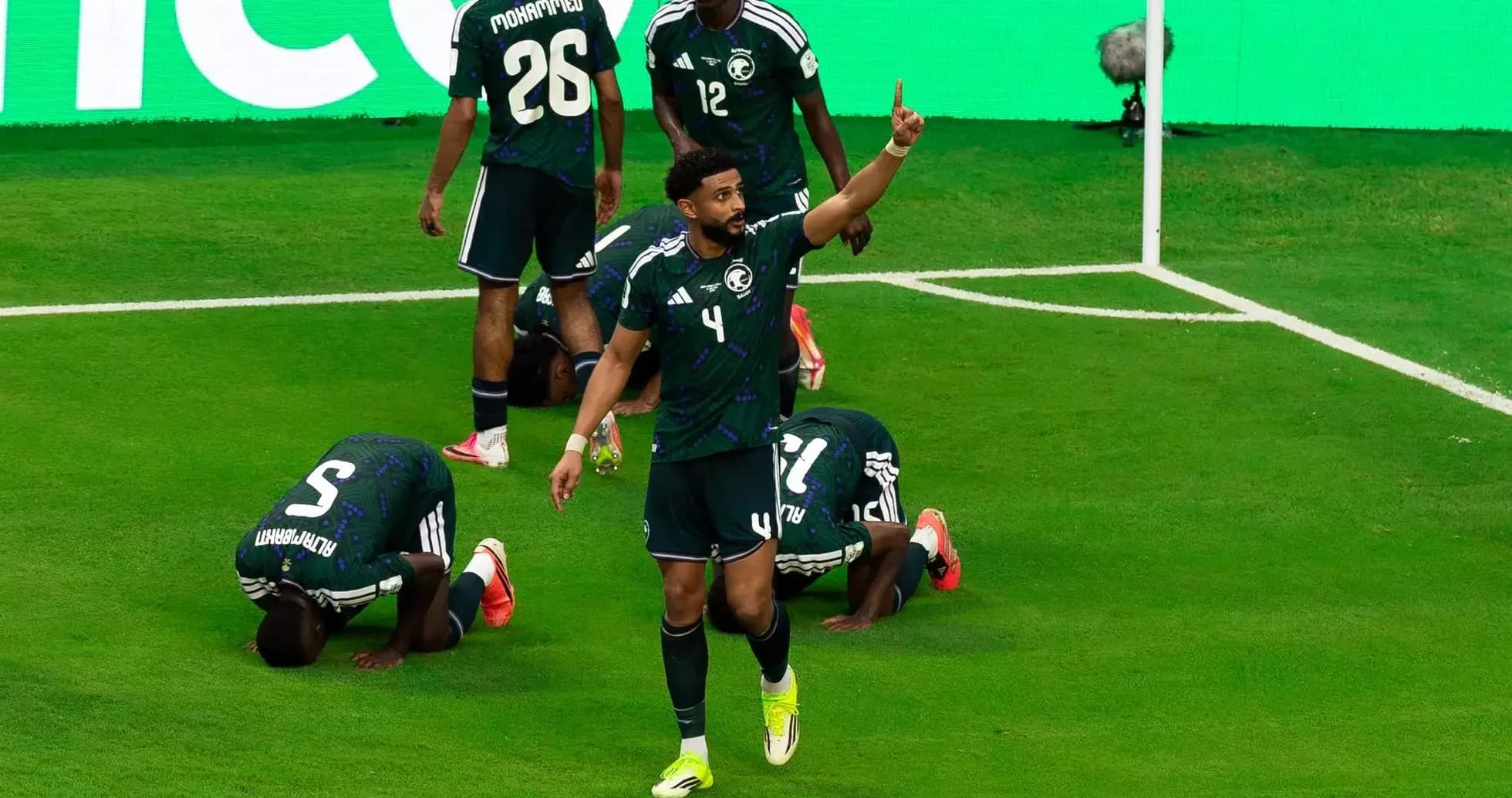
Saudi Arabia and Uruguay's Tactical Battle Ends in Draw
Saudi Arabia’s 1-1 draw with Uruguay at Hard Rock Stadium was a classic clash of control versus compactness, with the numbers underlining just how extreme the territorial imbalance was and how deliberate Saudi Arabia’s game plan had to be to survive it.
Saudi Arabia set up in a 4-4-2 under Georgios Donis, clearly geared towards low-block resistance and fast, vertical outlets. The front pair of Firas Al-Buraikan and Musab Al Juwayr were often left isolated, dropping towards the half-spaces primarily to screen Uruguay’s pivots rather than to combine. The midfield four, anchored by Abdullah Al-Khaibari and Mohamed Kanno, stayed narrow and deep, inviting Uruguay to circulate the ball in front of them but aggressively collapsing on central entries.
This approach was reflected in the possession split: Saudi Arabia had just 33% of the ball and completed 236 accurate passes from 322 total (73%). Their passing was more about survival and clearance than construction, with little emphasis on long, multi-pass sequences. The back four, particularly the central pairing of Abdulelah Al-Amri and Hassan Altambakti, defended extremely close to their own box. Saudi Arabia allowed 27 total shots, 16 of them inside the box, and conceded 14 corners, underscoring how deep they were forced to defend for long stretches.
Within that context, Al-Amri’s contribution was double-edged but central to the tactical story. His 41st-minute goal, a “Normal Goal” from a set attacking phase, was emblematic of Saudi Arabia’s offensive model: capitalize on rare incursions and dead-ball situations rather than sustained pressure. Just three minutes later, his yellow card for “Foul” at 44' highlighted the cost of Saudi Arabia’s aggressive last-line interventions once Uruguay broke through the first two lines of pressure. That booking further constrained his ability to step out, pushing Saudi Arabia even deeper in the second half.
In goal, Mohammed Al-Owais (Saudi Arabia) was the structural pillar of the game plan. He faced a barrage that produced 10 shots on goal for Uruguay and was officially credited with 9 goalkeeper saves. That volume, combined with Uruguay’s xG of 1.72, indicates repeated high-quality chances repelled from close range. The goals prevented metric for Saudi Arabia stood at -0.35, suggesting that, relative to the quality of the shots faced, at least one of the conceded or saved efforts did not outperform the model, but the raw save count makes clear that the defensive design was heavily reliant on his shot-stopping and positioning.
Saudi Arabia’s defensive block allowed only 7 blocked shots, which is modest given Uruguay’s 27 attempts; this implies that many Uruguayan efforts were getting through to the goalkeeper rather than being smothered at source. The foul count—11 for Saudi Arabia versus 6 for Uruguay—also fits the picture of a team under pressure, frequently forced into interventions to break rhythm and slow transitions after losing the ball.
Marcelo Bielsa’s Uruguay, by contrast, operated from a 4-2-3-1 that functioned in practice as a very aggressive, possession-dominant 2-3-5 in the attacking phase. With 67% possession and 540 accurate passes out of 612 (88%), Uruguay controlled the tempo and location of the game. Manuel Ugarte and Rodrigo Bentancur provided the double pivot base, allowing full-backs Guillermo Varela and Matías Viña to advance and pin Saudi Arabia’s wide midfielders back. Federico Valverde’s positioning between the lines and Darwin Núñez’s depth runs continually stretched Saudi Arabia’s compact 4-4-2, creating the shooting volume that the raw numbers reflect.
The shot map profile inferred from the data is consistent with a classic Bielsa siege: 27 total shots, 10 on goal, 16 from inside the box and 11 from outside. The 7 blocked shots show that Saudi Arabia did manage to get bodies in front of some efforts, but Uruguay’s ability to work the ball into the area repeatedly was the defining pattern. The 14 corner kicks Uruguay earned further underline how often they pinned Saudi Arabia in and forced last-ditch interventions or deflections behind.
Uruguay’s equaliser in the 80th minute, a “Normal Goal” by Maximiliano Araújo, arrived after a sequence of sustained pressure that had been building throughout the second half, especially following Bielsa’s substitutions. The introduction of Agustín Canobbio for Darwin Núñez at 46' and Juan Sanabria for Matías Viña at 46' reshaped Uruguay’s attacking width and pressing angles, increasing the volume of wide overloads and crosses. Later, Nicolás de la Cruz replacing Manuel Ugarte at 72' added more vertical passing and creativity from deeper zones, contributing to the wave of attacks that finally broke Saudi Arabia’s resistance.
Defensively, Uruguay were rarely stretched, which is reflected in the modest figure of 2 goalkeeper saves for Fernando Muslera (Uruguay). Saudi Arabia managed just 7 total shots, 3 on goal, with 4 inside the box and 3 from outside. Their xG of 0.66 illustrates that beyond Al-Amri’s goal, they created very limited danger. Uruguay’s 7 blocked shots show a proactive back line and midfield stepping out to smother the rare Saudi forays before they could fully develop.
The disciplinary and offside data complete the tactical picture. Uruguay were caught offside 6 times, a by-product of constant attempts to attack the space behind Saudi Arabia’s deep line, while the home side registered 0 offsides, consistent with a low block and cautious transitions. Saudi Arabia’s single yellow card, to Al-Amri for “Foul”, and Uruguay’s clean sheet in disciplinary terms reflect a game where most of the aggression was defensive and reactive from the side under siege.
From a statistical verdict, Uruguay’s 1.72 xG to Saudi Arabia’s 0.66, their dominance in possession (67% to 33%), and their massive shot advantage (27-7) all point towards a game they controlled comprehensively. Yet the final 1-1 scoreline, combined with the 9 saves by Al-Owais (Saudi Arabia) and Saudi Arabia’s ability to convert one of their few meaningful attacks, underlines the effectiveness of a deep, risk-averse 4-4-2 when executed with concentration and strong goalkeeping. Uruguay’s goals prevented figure of -0.35 and just 2 saves for Muslera (Uruguay) suggest that their defensive structure was rarely tested, but their inability to turn territorial and statistical dominance into a second goal leaves the group-stage opener feeling like two points dropped rather than one gained.
Related News

Thomas Tuchel Reflects on England's 10-Man World Cup Triumph and a Surprising Regret

Robert Moreno Takes Over as Interim South Korea Coach After World Cup Setback

Jude Bellingham Returns to Form with Real Madrid After World Cup Success

Chloe Kelly, Beth Mead & 13 Lionesses Who Must Shine in the Upcoming WSL Season for England’s 2027 World Cup Bid
Barcelona Cancels World Cup Tribute Amid Political Tensions
Messi Breaks Record for Most Penalties Taken and Missed in FIFA World Cup History