
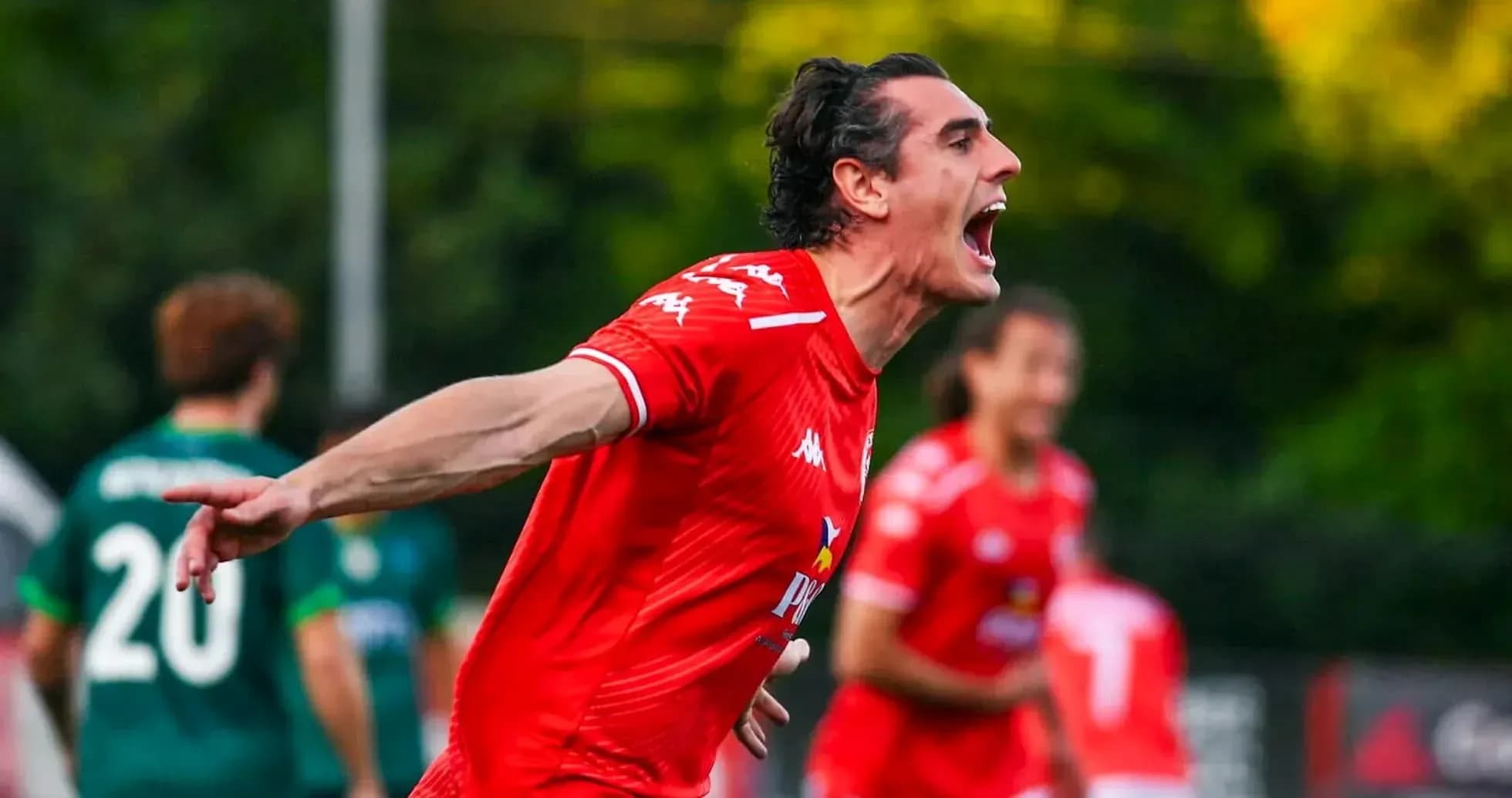
Saburtalo's Tactical Superiority in 2–1 Extra Time Win Over Larne
Saburtalo’s 2–1 after-extra-time win over Larne at Mikheil Meskhi Stadium was built on territorial domination, structural control in a 4-3-3, and sustained pressure that eventually broke a tiring opponent. Across 120 minutes, Saburtalo owned 68% possession, generated 5 shots on goal and 8 blocked efforts, and forced 11 corners to Larne’s single flag kick. Larne’s game plan was clear: a compact 4-3-3 that often flattened into a low block, accepting just 32% of the ball and producing only 1 shot on goal and 2 off target, while committing 27 fouls to disrupt rhythm and slow the tempo.
From the outset, Andriy Demchenko’s 4-3-3 was designed to pin Larne back. The back four of J. Jinjolava, A. Amisulashvili, G. Kobuladze and V. Selimovic held an aggressive line, with the three-man midfield—N. Dadiani deepest, G. Kutsia and B. Kardava ahead—tasked with circulating possession and compressing the pitch. High territorial control is reflected in the 68% possession and the sheer volume of blocked shots: Saburtalo consistently worked shooting positions around the edge and inside the box, only to see Larne’s defenders throw bodies in the way eight times.
In the front line, V. Bedoshvili, Z. Natchkebia and N. Sikharulashvili operated with heavy positional rotation. Bedoshvili frequently drifted inside from the left half-space, allowing Jinjolava to advance on the overlap and add width. Sikharulashvili, starting from the right, functioned as a hybrid wide midfielder/inside forward, stepping into central pockets to overload Larne’s midfield three. This overload was central to Saburtalo’s control: with Dadiani anchoring and Kardava pushing between the lines, Saburtalo often had a 4v3 or even 5v3 centrally, forcing Larne’s wingers to retreat and turning their 4-3-3 into a 4-5-1 without the ball.
Larne’s response under Gary Haveron was unapologetically pragmatic. The back four of A. Donnelly, D. Bent, M. Ridley and T. Cosgrove stayed narrow, prioritising central compactness over wide pressure. In midfield, C. Gallagher and R. Doherty shielded the zone in front of the centre-backs, while S. Graham dropped from his listed defensive role to help double up in wide areas when Saburtalo overloaded the flanks. Up front, M. Gibson and M. Lusty were largely isolated, asked to chase long clearances and press selectively rather than as part of a high, coordinated press.
The statistical contrast in corners—11 for Saburtalo, 1 for Larne—captures the territorial pattern. Saburtalo’s repeated ability to reach the byline or force blocks in the box hemmed Larne deep. Many of Saburtalo’s attacks ended with deflected shots and last-ditch interventions, hence the high blocked-shot count. Larne, by contrast, rarely sustained attacks long enough to win set-pieces in the final third.
Tactical Changes
Tactically, the key turning point came with Demchenko’s substitutions and the re-energising of the front line. At 65', G. Kutsia (OUT) was replaced by A. Bartishvili (IN), adding fresh legs and more vertical running from midfield. Shortly after, once V. Bedoshvili had put Saburtalo ahead and Larne equalised, Demchenko reshaped his attack: V. Bedoshvili (OUT) made way for A. Dzagania (IN) and B. Kardava (OUT) for I. Alhassan (IN) at 77'. Dzagania provided a more direct, penalty-box presence, while Alhassan offered ball-carrying and dribbling from midfield, helping Saburtalo maintain pressure despite the physical toll of the second half.
Larne’s bench management was primarily reactive. At 65', M. Gibson (OUT) for P. O'Neill (IN) and R. Doherty (OUT) for J. Simpson (IN) were aimed at refreshing the front and midfield lines without altering the underlying structure. Later changes—M. Lusty (OUT) for J. Ukek (IN), D. Sloan (OUT) for J. McEneff (IN), T. Cosgrove (OUT) for L. Wallace (IN), and S. Graham (OUT) for C. McKendry (IN)—incrementally added fresh legs but did not fundamentally change the low-block, counter-attacking model. The single shot on goal across 120 minutes shows how limited Larne’s attacking transitions remained, even with these changes.
Extra time magnified the tactical trends already visible. Saburtalo’s ball dominance and physical freshness in key creative zones, particularly through Dadiani and Sikharulashvili, finally told. The decisive goal in extra time came from a pattern Saburtalo had been working all night: midfield progression through Dadiani and a wide-to-inside run from Sikharulashvili. Once ahead in extra time, Demchenko managed the game with further changes: G. Kobuladze (OUT) for N. Bochorishvili (IN) at 91' to keep the back line fresh, then Sikharulashvili (OUT) for S. Ende (IN) and Z. Natchkebia (OUT) for E. Kuliyev (IN) at 115' to preserve defensive structure and pressing intensity from the front.
Discipline also reveals tactical intent. Saburtalo committed 19 fouls and took 4 yellow cards, while Larne’s 27 fouls and 3 yellows underline a strategy of repeated disruption. The higher foul count and bookings for Larne aligned with their need to break up Saburtalo’s rhythm whenever central combinations or wide overloads threatened to break their line.
From a statistical verdict, Saburtalo’s victory after extra time aligns closely with the underlying data. They controlled possession (68% to 32%), out-shot Larne on goal (5 to 1), and forced far more defensive actions in and around Larne’s box, as evidenced by 8 blocked shots and 11 corners. Larne’s resistance was rooted in defensive organisation and sheer work rate, but with only 1 effort on target and minimal attacking territory, their equaliser in regular time was more an outlier than a reflection of sustained threat. Over 120 minutes, Saburtalo’s structural superiority, bench impact, and constant territorial pressure made the 2–1 aggregate scoreline a logical tactical outcome.
Related News
Francesco Totti Reveals Offers from Top European Leagues at Age 48
Benfica Dominates AC Milan in UEFA Europa League Opener
Levski Sofia vs Red Bull Salzburg: Europa League Defeat Analysis
Five Europa League Players to Watch in the 2026/27 Season
Celje vs Red Bull Salzburg Predicted Lineups and Team News

Anderlecht vs Red Bull Salzburg Predicted Lineups and Team News