
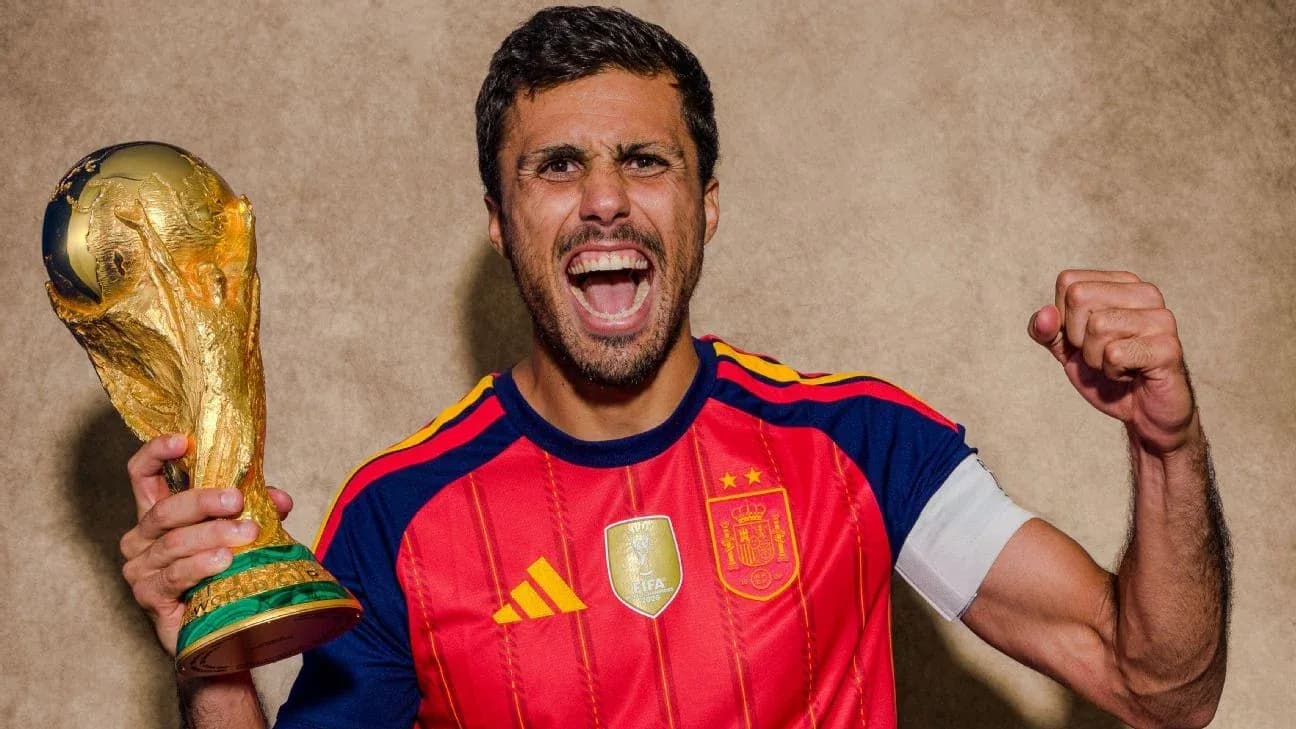
Rodri's World Cup Win Ignites Transfer Battle
Rodri’s World Cup coronation has done more than complete his medal collection. It has blown open the transfer market.
The Manchester City midfielder, fresh from lifting the FIFA World Cup with Spain and taking the Golden Ball as the tournament’s outstanding player, is now at the centre of a tug-of-war that stretches from Barcelona to Madrid and back to Manchester. One year left on his contract. Thirteen trophies with City. A Ballon d’Or already in his cabinet. The timing could hardly be more explosive.
Spain’s captain did not just guide La Roja past Lionel Messi’s Argentina in the final, adding to the European Championship he won two years earlier; he dominated the biggest stage in a way that made his status as the game’s premier holding midfielder impossible to dispute. For Barcelona and Real Madrid, this is not just a signing. It is a statement about who controls the heart of Spanish football for the next five years.
Barcelona: the Busquets heir finally within reach
Barcelona have dreamt of Rodri for years. In the corridors of the club, he has long been spoken of as the only true heir to Sergio Busquets: same calm, same brain, same ability to bend a game to his rhythm. But this summer was not supposed to be about him.
Hansi Flick arrived with other priorities. The squad, fresh from back-to-back LaLiga titles, looked stacked in midfield with Pedri, Gavi, Marc Bernal, Fermín López and Dani Olmo. Then Frenkie de Jong went down injured, and the equation changed.
As whispers grew that a deal for Rodri might actually be possible, excitement inside the club spiked. Flick liked what he saw: a metronome who could also break lines, a player who could anchor his pressing game and still dictate with the ball. Sporting director Deco saw an opportunity that might not come again.
The turning point came last week. Barcelona learned that Rodri, given a straight choice, would now prioritise them over Real Madrid. That alone would have sounded fanciful a year ago. His return to Spain had always been assumed to end in white, not blaugrana.
But the World Cup shifted the landscape. Rodri had just won the trophy alongside eight Barcelona players. He had thrived in a style of play that mirrors Flick’s ideas. On top of that, a stream of Catalans who have passed through Manchester City over the past decade had painted a vivid picture of life at Barça. Gradually, his compass swung towards Catalonia.
Club sources say there is already a loose agreement over personal terms. Rodri is on board. Now the hard part: persuading City. Barcelona have had an opening offer rejected, but talks continue over a package that could climb to around €70 million.
Inside the club, belief is growing that they will get it done. They see Rodri as the piece that can drag their European performances up to the level of their domestic dominance, a player to turn LaLiga titles into a serious assault on the Champions League for the first time since 2015.
The knock-on effect is obvious. What happens to De Jong when he returns? That debate is already raging internally. Yet the hierarchy have made their choice. Rodri has been prioritised over signing a centre-back, even if a defender has not been completely ruled out. For Flick, the prospect is tantalising: a midfield built around Rodri, with Pedri and Gavi orbiting him, looks like a platform built for deep runs in Europe.
For Barcelona, this is not just about replacing Busquets. It is about resetting the club’s identity with a Spaniard at the core again, and doing it at Madrid’s expense.
Real Madrid: from cool distance to losing the race
Real Madrid’s relationship with Rodri has been a slow burn that suddenly caught fire, then fizzled out almost as quickly.
For months, the line from the Bernabéu was consistent: Rodri was not on the summer agenda. On paper, that sounded strange. Here was the world’s best in his role, born in Madrid, entering the final year of his contract and offering an instant solution to several structural issues in their midfield.
Inside the club, doubts persisted. President Florentino Pérez, sources say, had concerns about his recent injury record. José Mourinho, back in charge and reshaping the squad in his image, wanted a different type of midfielder. Renewing Aurélien Tchouaméni’s contract signalled faith in the Frenchman as the long-term anchor, not an invitation to bring in direct competition.
Then came the World Cup. Rodri didn’t just survive the tournament; he owned it. Any lingering questions about his form or fitness evaporated. Suddenly, director general José Ángel Sánchez and chief scout Juni Calafat were open to the idea. The internal mood shifted.
Confidence grew quietly. By late July, some at Madrid felt optimistic. Rodri wanted to come home, and the club believed City could be worn down once they lined up a replacement. There was still no agreement with the Premier League champions on a fee, but no sense of panic either. Madrid had other fires to tend: talks for Yan Diomande, negotiations over Vinícius Júnior’s renewal. Rodri could wait.
Then the calm snapped.
On a Wednesday night, word filtered through: Barcelona were in. Not just lurking, but serious. Some inside Madrid put it at 50-50 between the two Spanish giants. Rodri, they were told, was open to both.
Twenty-four hours later, the mood darkened. Madrid felt they were slipping out of the race. The message from the player’s camp, according to some sources, was blunt: those early doubts from Madrid had left a mark. Mourinho’s coolness had not gone unnoticed. Flick, by contrast, had picked up the phone and laid out exactly how he saw Rodri in his system.
Madrid prepared one last push, but privately accepted it might be too late. The player’s mind, they believed, was largely made up. His entourage were unimpressed that Madrid, with all their power and resources, had not moved decisively when the window first opened.
Barring a dramatic late twist, Rodri is off the table for them. That leaves a clear decision. Do they pivot to another target — with reports suggesting Mourinho could push Bernardo Silva into a central role alongside Tchouaméni or Federico Valverde — or double down on what they already have?
For a club that has spent the last decade hoarding the world’s best midfielders, watching Spain’s captain walk into the Camp Nou instead of the Bernabéu would sting.
Manchester City: control, but not all the power
At Manchester City, the public message is simple and unwavering. Enzo Maresca wants Rodri to stay. The club want him to sign a new contract. He is central to everything they do.
Behind closed doors, the picture is more nuanced.
City have known for years that Rodri would eventually want to go back to Spain. It was one of the reasons they moved for Kalvin Phillips in 2022, an attempt to prepare for a future without their midfield pillar. That plan collapsed, but the long-term concern remained.
The club’s transfer policy is clear: they do not like to keep players against their will. Age, injury history and contract length all feed into the calculation. Rodri is 30, has had some recent fitness issues and will be out of contract next summer. Lose him now and there is a big fee. Lose him in a year and he walks for nothing.
City are not at the negotiating table yet, but they know the numbers. If Barcelona or Real Madrid arrive with an offer north of €70 million, the conversation changes. They will not sanction a cut-price exit. They also cannot afford to be caught short in midfield.
Tijjani Reijnders and Nico González both face uncertain futures. Elliot Anderson has already arrived from Nottingham Forest, and talks continue with Lille over Ayyoub Bouaddi, Morocco’s breakout World Cup star. Those are pieces, not a full rebuild. If Rodri leaves, the entire structure of Maresca’s midfield needs rethinking.
That is the tightrope City are walking. They are entering a season of transition after a decade under Pep Guardiola. Maresca needs stability in the one area of the pitch Guardiola always built around: the holding midfielder. Letting Rodri go without a watertight plan would be a huge risk.
For now, City can wait. No acceptable bid has landed. They are running checks on potential replacements, modelling scenarios, trying to stay ahead of a market that could turn on a single phone call from Barcelona.
There is, however, a growing feeling at the Etihad that this might be the end of the road. The World Cup win, the Ballon d’Or, the chance to go home as a national hero and anchor a Spanish giant — all of it pulls in the same direction.
The question is no longer whether Rodri has earned that move. It is whether Barcelona can find the money, and whether City are ready to live without the man who has quietly dictated their era.
Related News
Carlos Alcaraz Urges Tennis Organizers to Stop Matches Finishing in the Early Morning
Carlos Alcaraz Frustrated by 3:30 a.m. US Open Finish: 'Too Much'
Jannik Sinner Set for ATP 500 Return in Beijing with Novak Djokovic Also Competing
Meet Iva Jovic: The Rising American Tennis Talent
Flavio Cobolli Shares Insights on Training with Jannik Sinner Ahead of His Tennis Return
Till vs Romero: Fight Details, Undercard, and Viewing Info for This Weekend