
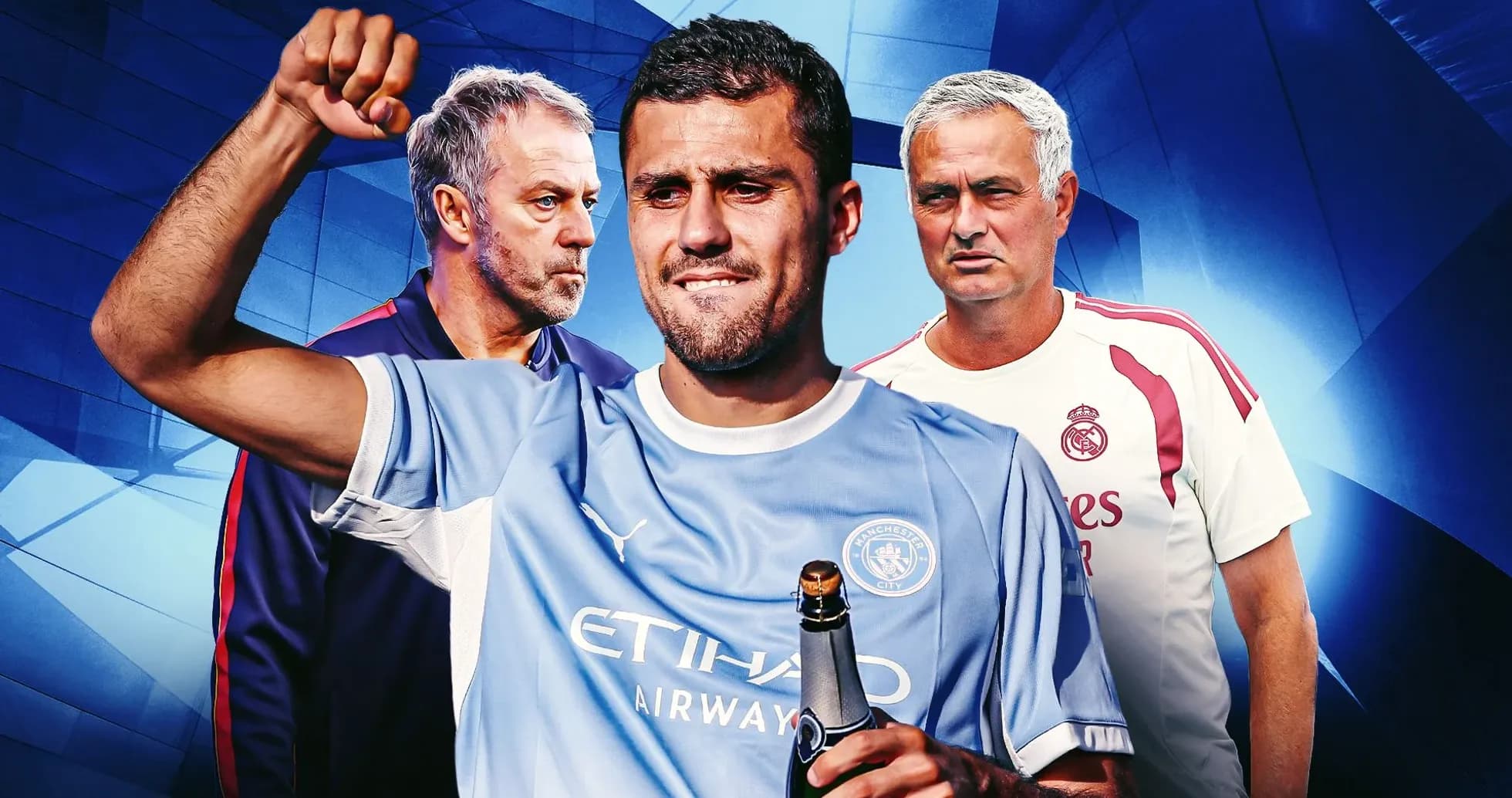
Rodri's Transfer: Barcelona Poised to Sign Top Midfielder
Landing the best defensive midfielder on the planet does not come around often. Landing him for a cut-price fee, at the peak of his powers, and from a direct Champions League rival? That almost never happens.
Yet that is exactly the scenario now engulfing Spain’s two great superclubs, with Rodri standing calmly at the centre of the storm.
A £60m fault line in European football
Manchester City’s position is brutally simple. Rodri, fresh from winning the 2024 Ballon d'Or and the Golden Ball at the World Cup, has entered the final 12 months of his contract. The club that built an era around his control of midfield is suddenly willing to listen to offers as low as £60 million ($81m).
For a player of his status, that is not a transfer fee. It is a provocation.
City’s hand has been weakened by time and by change. Pep Guardiola has gone, taking with him the certainty and structure that persuaded Rodri to commit his prime years to Manchester. John Stones and Bernardo Silva have already been linked with exits; Rodri, now 30, looks at the shifting landscape and sees a natural moment to walk away.
At his age, he knows he has two, maybe three years left at the absolute summit if his body holds and his brain continues to run games at its usual, metronomic speed. Those years will define his legacy. He intends to spend them in Spain.
Real in pole, Barca on the blindside
Initially, the script felt familiar. Real Madrid, long-time admirers, moved first. His World Cup performances, which dragged Spain to glory and earned him the Golden Ball, only hardened their conviction that he was the missing piece at the base of their midfield.
On paper, it made perfect sense. Rodri had spoken openly during the March international break of his desire to return to La Liga, even flirting publicly with the idea of Madrid.
“Would I like to play in Spain again, in La Liga, in Madrid? I would like to return, yes, obviously,” he told reporters. On Real specifically, he added: “You can't turn down one of the world's best clubs.”
Madrid heard that as an invitation. So did everyone else.
Just when it seemed Los Blancos would close in, Barcelona arrived. Quietly at first, then decisively.
While Madrid wrestled with City over the fee and struggled to pin down personal terms, Barca moved with rare clarity. They spoke to the player. They opened lines with City. They sold him a project.
The context helped. Frenkie de Jong’s serious knee injury — a torn medial collateral ligament suffered on his return from the World Cup, with an absence of around four months and the possibility of surgery — has left a gaping hole in Barcelona’s midfield. Rodri’s sudden availability turned a problem into an opportunity.
The fit, stylistically, is obvious. Hansi Flick wants a ball-playing, possession-heavy side. Rodri is built for that kind of football. So was Sergio Busquets, the man he has been compared to for years. The idea of Rodri as the new metronome at Camp Nou almost writes itself.
It also helps that he would walk into a dressing room full of Spain team-mates. Familiar faces, familiar patterns, a familiar language. For a player weighing up the final big move of his career, those details matter.
“His decision is to join Barca”
The decisive twist came not from a leak or a whisper, but from the player’s own camp.
Pablo Barquero, Rodri’s agent, went on Cadena SER and removed any lingering ambiguity. “Out of respect for Madrid, as they have been class, Rodri informed them that his decision is to join Barca,” he said.
With that, the temperature in Spain shot up.
The Madrid press and the Barcelona press went to war with competing versions of the same story. One claim insisted Real had reached an agreement with City, only to try and shave the price at the last minute, stalling the entire operation. Another line suggested Rodri simply grew tired of waiting for Real to formalise their interest and switched his focus to Barca, with reports that Madrid would only go up to £34m ($46m).
There were more dramatic theories. Some insisted Rodri never truly wanted Real at all, and had used their pursuit as leverage to draw out Barcelona. Others claimed he had an identical proposal from the capital and still chose Catalonia.
The most explosive suggestion? That City and Barca are effectively working in tandem, using the spectre of a Catalan deal to drag Madrid into a bidding war.
None of it has been definitively proven. All of it speaks to the chaos that erupts when a generational midfielder chooses one half of Spain over the other.
Mourinho’s fury and Madrid’s missed moment
Inside Real Madrid, the fallout has been fierce. Reports in Spain say José Mourinho, back in charge and expecting a statement signing at the base of his midfield, is furious at how the chase has unravelled.
The story goes that Mourinho unleashed a furious phone call at chief scout Juni Calafat, the man who has built his reputation on landing elite talent before anyone else. Calafat, it is said, has now told the coach he must make do with what he has.
On a purely footballing level, that stings. Rodri would have been a transformative upgrade on Aurelien Tchouameni and Eduardo Camavinga in the holding role, not because they lack quality, but because nobody in that position sees and shapes a game quite like the City man.
In a title race that has grown increasingly fine at the margins, he could have been the difference between Madrid reclaiming La Liga or finishing second to Barca yet again.
Instead, he is poised to become the cornerstone of Barcelona’s next cycle.
Barca’s new Busquets – at a bargain
From Barcelona’s perspective, this is not just a signing. It is a coup.
They are on the brink of landing arguably the best midfielder in the world, for what looks like a bargain fee, from a club that has dominated Europe, and from under the nose of their greatest rival.
The first bid has been rejected, but the numbers on the table and City’s contractual reality point in one direction. The Catalans sense it. So does the rest of Europe.
On the pitch, the implications are stark. Drop Rodri behind Pedri, De Jong and Gavi and you have a midfield capable of suffocating games, at home and abroad. He has already shown with City and Spain that he can orchestrate title runs almost single-handedly from the base of midfield.
His arrival would tilt La Liga. It would give Barca a formidable platform to chase a third straight league crown and, more ominously for the rest of Europe, inject real substance into their long, frustrating pursuit of a first Champions League title since 2015.
A bruise to Madrid’s ego
The damage for Real is not only tactical. It is psychological.
This is a club that rarely loses in the transfer market, especially when it comes to Spanish stars at the peak of their careers. To be beaten by Barcelona to a player they had courted, who had spoken warmly about Madrid, and who is available at a price that looks like daylight robbery, cuts deep.
It comes on the back of a bruising Clasico defeat in May that cost them the league title and dented their sense of superiority. Now, as they watch Rodri edge closer to Camp Nou, that wound opens again.
They know exactly what he could have been in white. They are about to find out what he will become in blaugrana.
And if he does, indeed, anchor Barcelona to another era of dominance, the question in Madrid will not be how they stop him.
It will be how they ever let this one get away.
Related News
Carlos Alcaraz Urges Tennis Organizers to Stop Matches Finishing in the Early Morning
Carlos Alcaraz Frustrated by 3:30 a.m. US Open Finish: 'Too Much'
Jannik Sinner Set for ATP 500 Return in Beijing with Novak Djokovic Also Competing
Meet Iva Jovic: The Rising American Tennis Talent
Flavio Cobolli Shares Insights on Training with Jannik Sinner Ahead of His Tennis Return
Till vs Romero: Fight Details, Undercard, and Viewing Info for This Weekend