
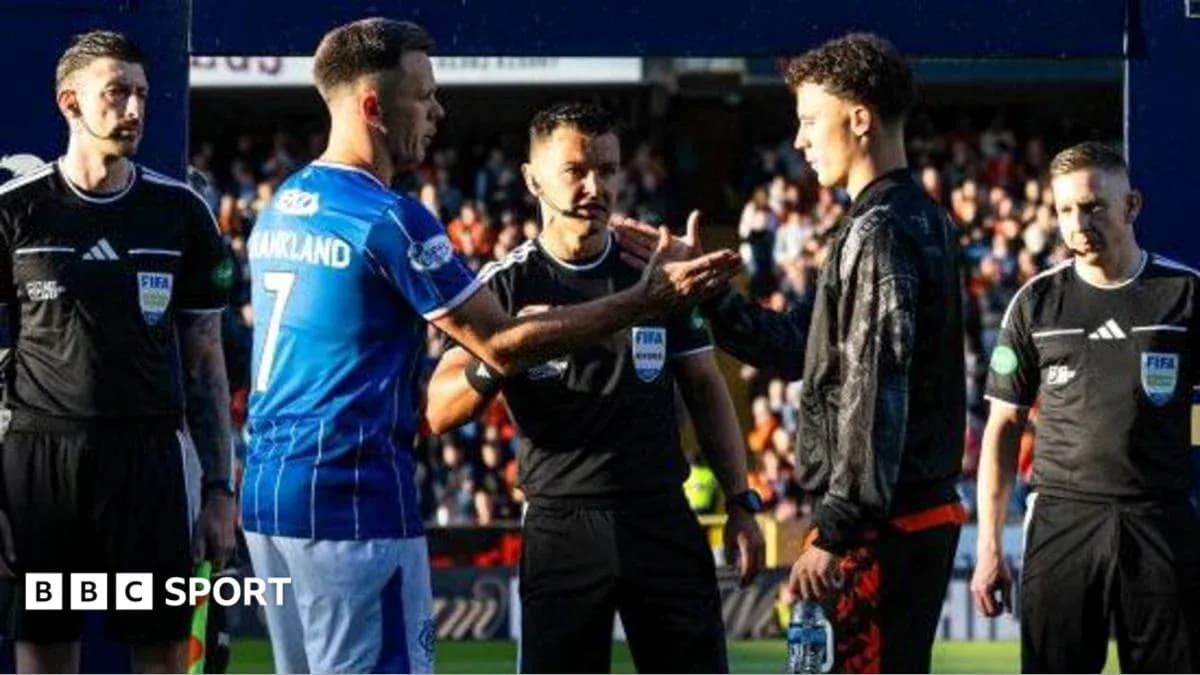
Robbie Ure: A Cautionary Tale for Scottish Football
Robbie Ure’s story begins with a goal and a goodbye.
He was 18 when he stepped onto the Ibrox pitch for the first time, a fresh-faced striker thrown into a League Cup tie against Queen of the South in August 2022. He scored. For most clubs, for most fanbases, that’s the kind of debut that sparks a campaign: give the kid another run, see what he’s got, maybe build something.
Rangers didn’t. Not really.
After that bright opening, Ure’s league career in Govan amounted to two Premiership cameos, each just a single minute, six months apart – one against St Mirren in November, another against Hibs in May. Two minutes, two appearances, and a door that never truly opened.
For a teenager desperate to play, it wasn’t a pathway. It was a cul-de-sac.
Rangers were struggling at the time, searching for answers, reshaping squads, changing managers. Yet even in that turbulence, Ure’s chances stayed microscopic. In his position, the club spent £6m on Danilo – closer to £10m once wages are rolled in – and £3.5m on Sam Lammers, north of £4m with salary. The message to the academy striker was written in capital letters: not now, probably not ever.
So he left. No fee, no fanfare. First to Anderlecht, then on to IK Sirius in Sweden. A young forward looking for a pitch that would actually have him.
At Sirius, something clicked.
He’s 22 now and scoring like a man who’s been waiting years to be taken seriously: 15 goals in 15 games, 10 of them in his last six outings. On Sunday, as Rangers were losing 2-1 at home to Hibs, news dropped that Sevilla want him. The talk is of a deal close to £8m.
The timing could hardly have been crueller for Ibrox.
On one side of Europe, Rangers fans watched their team lose at home. On another, they saw headlines about a former academy forward they let walk for nothing being lined up by one of Spain’s most decorated clubs in a multi-million pound move. Whatever the nuance, it stings.
It also lands right in the middle of a debate Scottish football has been ducking for years.
A forum, a warning, and a familiar story
Next month, in St Andrews, the Scottish FA will gather the owners and chief executives of the country’s senior clubs for what it is calling a “critically important” forum. The event is titled ‘Made In Scotland?’ – the question mark doing a lot of heavy lifting.
SFA chief executive Ian Maxwell and his chief football officer, Craig Mulholland, will lead the presentation. At its heart sits a simple plea dressed up in slides, data and case studies: trust your own.
If they were inclined to twist the knife – and they won’t, at least not publicly – they could walk into that room, flash up a picture of Robbie Ure, and ask one brutal question: what if?
What if Rangers had given him real minutes instead of crumbs? What if they’d trusted their academy, saved themselves millions in transfer and wage outlay, and ended up with a homegrown striker they could sell on for a fortune? One decision, two fortunes – one avoided, one banked.
Football is never that neat. Ure might not have shown then what he’s showing now. Development isn’t linear, and hindsight is always 20-20. Still, it’s hard to imagine Rangers looking at his rise in Sweden, the Sevilla interest, and feeling anything other than regret.
Celtic know the feeling. Ben Doak – now Gannon-Doak – barely got a look-in before heading to England and a far bigger stage. Another multi-million pound talent that slipped through Scottish fingers after barely scratching the surface at home.
These are not isolated hard-luck tales. They’re symptoms.
The numbers that shame a league
You don’t need a spreadsheet to sense the problem in the Premiership. But the numbers from the opening two rounds of the season strip away any room for self-delusion.
Only 31% of the players who featured were Scottish. Just 5% were Scots aged 21 or under. Across two weekends, 46 different nationalities appeared in the top flight, but young Scottish players were almost an endangered species.
Some examples are stark. Dundee United, across their first two games, used just one Scottish player – Dylan Tait. One. At a club that has long prided itself on producing its own.
Ask any chairman, chief executive or manager if they want local talent in the first team and the answer will be emphatic: of course. They’ll talk about identity, connection with fans, the romance of a kid from down the road making it big.
Then comes the caveat. Or, more accurately, the list.
They’ll talk about the pressure to stay up or chase Europe, the need for “ready-made” players, the risk of blooding youngsters, the financial stakes. Some of those arguments carry weight. Others sound more like excuses.
Because while clubs lament the lack of pathways, they’re also watching those pathways being dug up from the other end.
The exodus before the breakthrough
Dundee United can point to the investment they’ve poured into their academy, then to the empty space where Kai Hutchison used to be before the promising 16-year-old was tempted away by Everton. He’s just one of dozens of young Scots who have headed south in the post-Brexit landscape.
Celtic can list Dara Jikiemi (Liverpool) and Daniel Cummings (West Ham). Rangers can mention Cameron Scott (Burnley) and Chris Eadie (Sheffield United). Hearts have Boyd Fraser (Nottingham Forest) and Keir McMeekin (Man City). Hibs can point to Ben Vickery (Man City) and Josh Landers (West Ham).
And those are only the names that have floated to the surface.
Yes, money talks. English academies can offer bigger wages, shinier facilities, the lure of the Premier League. But that’s not the whole story. Ambition is part of it. So is opportunity.
These players and their parents are looking at Scotland and asking a blunt question: where’s the route to the first team?
At too many of the country’s biggest clubs, the answer is unclear at best. There are very few recent poster boys who can stand up and say: I came through the academy here, I was trusted, I played, I kicked on.
Instead, teenagers watch the dressing room fill up with short-term signings, stop-gaps and imports with modest CVs. Journeymen who block the road.
What does a talented 17-year-old think when yet another squad player arrives with a dubious pedigree and a one- or two-year deal? Stay and risk stagnation, or leave and hope?
Selling the future to people who live in the present
This is the audience Maxwell and Mulholland must win over in St Andrews. They will get the room. The question is whether they’ll get the room to listen.
Appealing to national pride won’t be enough. Every owner and chief executive present will know the benefits to Scotland if more young players break through. More options for the national team, more depth, more competition.
But their first responsibility is not to Hampden. It’s to their own balance sheets and league positions.
Some clubs lower down the ladder already get it. They lean heavily on their academies, give kids real minutes, accept the bumps, and reap the rewards when players are sold on. For them, developing talent isn’t a side project. It’s the business model.
For others, the logic runs differently. If they think the answer to their problems lies in scouring Europe – or beyond – they’ll keep doing it. Their job, as they see it, is to protect their own patch, not solve Scottish football’s identity crisis.
So if you’re asking those clubs to give more game time to kids, you’d better arrive armed with more than idealism.
You need to prove it makes them richer. Stronger. More competitive. Not in 15 years. Now.
The reports that gathered dust
The frustration for those at the SFA is that this argument has already been made. At length.
In August 2024, the governing body published its Transition report. One hundred and fourteen pages, put together by then chief football officer Andy Gould and former head of men’s elite football strategy Chris Docherty.
It was not a vague manifesto. It was a forensic assault on the old myths.
Global player data. Case studies. Interviews. Evidence from leagues and clubs across Europe. It dismantled the idea that “kids win you nothing” and replaced it with a blunt conclusion: clubs that trust their academies don’t just survive, they profit.
The report laid out the vast transfer income earned by teams who nurture, play and then sell young players. It highlighted the paltry number of senior minutes given to academy products in Scotland compared with other successful football nations.
The message was crystal clear: give young Scots more game time and everybody benefits. The football improves, the finances improve, the national team improves.
Some recommendations were adopted. But the core instruction – be bold – largely bounced off.
A year later, in October 2025, the SFA went again. Another report, this time 133 pages, again led by Gould and Docherty. More data, more ideas, more examples of what works elsewhere.
Both men have since left Hampden. You don’t need to be inside the building to sense why. There are only so many times you can run headfirst into the same brick wall.
A bunker, a ball, and a choice
Now comes another attempt. Another room. Another audience of decision-makers who hold the future of the domestic game in their hands.
Just outside that room in St Andrews sits one of the most famous hazards in golf – the Road Hole bunker on the 17th at the Old Course. It has ruined the rounds of countless great players.
Holing out from that sand might feel like child’s play compared to what Maxwell and Mulholland are trying to do.
They must persuade owners who live in the here and now that the next Robbie Ure is worth backing before he leaves, not after he’s scoring for someone else and attracting bids from Sevilla.
Scottish football has seen what happens when you don’t. The question, as they walk into that room, is whether anyone is finally ready to change – or whether another generation of talent will be allowed to slip away, one minute at a time.
Related News
Carlos Alcaraz Urges Tennis Organizers to Stop Matches Finishing in the Early Morning
Carlos Alcaraz Frustrated by 3:30 a.m. US Open Finish: 'Too Much'
Jannik Sinner Set for ATP 500 Return in Beijing with Novak Djokovic Also Competing

Meet Iva Jovic: The Rising American Tennis Talent
Flavio Cobolli Shares Insights on Training with Jannik Sinner Ahead of His Tennis Return

Till vs Romero: Fight Details, Undercard, and Viewing Info for This Weekend