
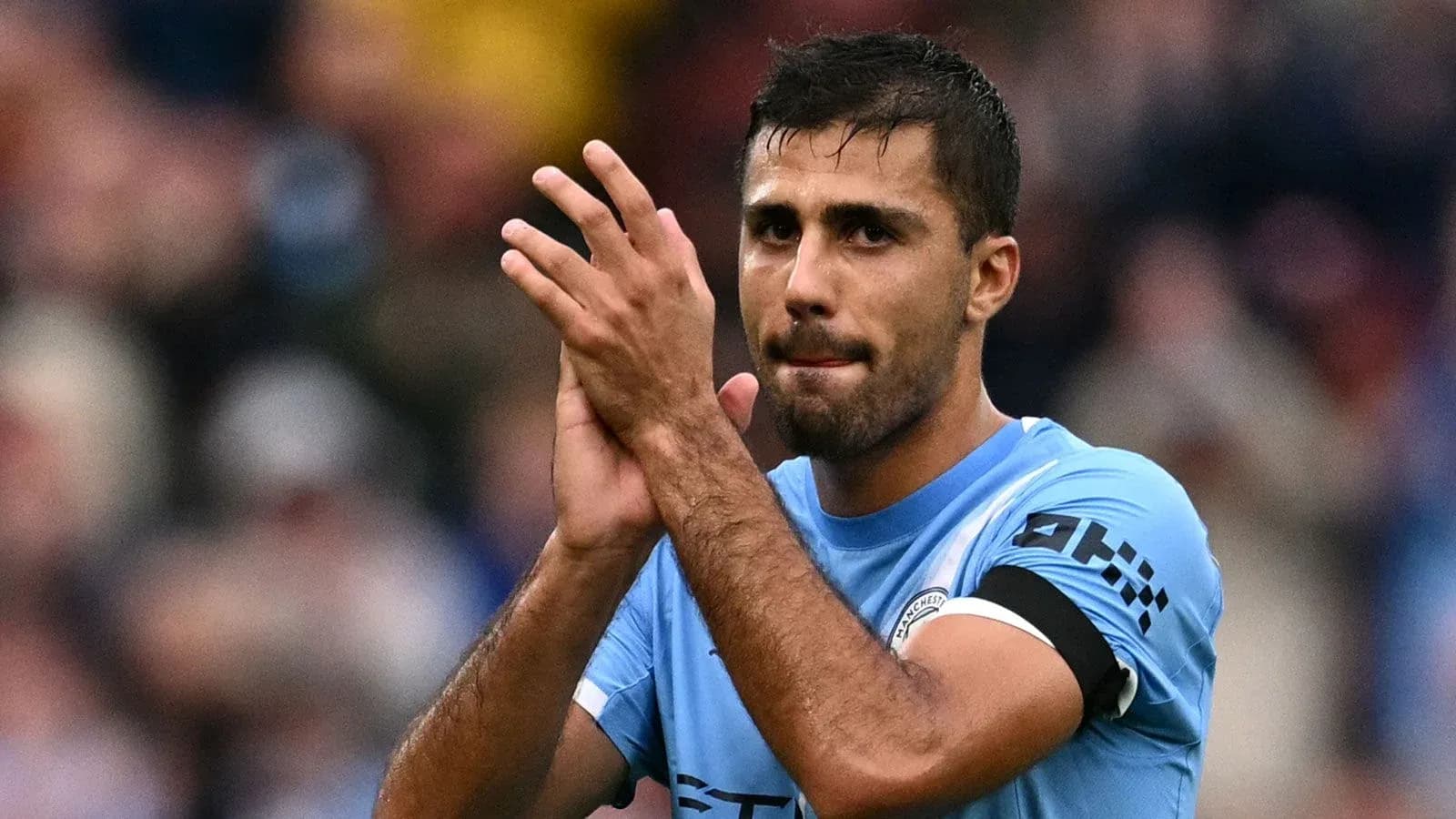
Real Madrid's Transfer Misfire: The Rodri Saga
Florentino Pérez promised fireworks. He has delivered smoke.
A little over two months ago, in the heat of the Real Madrid presidential race, Pérez stood in front of the cameras and teased a transfer of seismic proportions – “a player of the calibre of Cristiano Ronaldo or Kaká.” A bid of at least €150 million, he said, would soon be on the table.
The money never landed where everyone expected.
Michael Olise did not arrive from Bayern Munich. The officially confirmed €150m offer for Atlético Madrid striker Julián Álvarez went nowhere. Instead, Real sank €125m into Yan Diomande from RB Leipzig – another forward for a squad already brimming with attacking glamour.
The pattern is impossible to ignore: Olise, Álvarez, Diomande. All forwards. All fun. None of them what Madrid have actually needed for two years.
Since the break-up of the legendary Kroos–Modric–Casemiro axis, the club has been crying out for one thing: a world-class holding midfielder. A player to sit in front of the back line, to dictate, to steady, to suffocate counterattacks before they start. The kind of player who changes the geometry of big games.
That player was supposed to be Rodri.
Rodri slips away – and heads to the enemy
The plan looked almost perfect. Madrid-born, tactically immaculate, the best player at the World Cup and the heartbeat of Manchester City. Rodri had already opened the door in the spring, making it clear his past at Atlético would not block a move to the Bernabéu. Others had crossed that divide before. He could too.
Real believed him. Inside the club, there was a quiet conviction that Rodri would be the centrepiece of José Mourinho’s new era, the antidote to a titleless season and the missing piece behind a frontline of Kylian Mbappé, Vinícius Júnior and Diomande.
Then came the twist that cuts deepest in Madrid: Rodri said no.
His agent, Pablo Barquero, has now made it clear – Rodri rejected Real’s offer. All signs point instead to a move from Manchester City to Barcelona. From Madrid’s great hope to their greatest irritation in a single decision.
For Real, it is more than a failed transfer. It is a bitter public defeat. The club that had built its summer around the idea of a new midfield general now finds itself staring at the same old problem.
Real’s hole in midfield, Barça’s coup
As things stand, Mourinho will go into the season with Aurelien Tchouameni and Fede Valverde asked to do what they have already shown they cannot: orchestrate the game from deep on a consistent, elite level. Both are outstanding players. Neither is a natural conductor.
Behind Mbappé, Vinícius and Diomande, there is still no true organiser. No one to knit the lines together. No one to control the tempo in the way Kroos did, or to offer the defensive security Casemiro guaranteed.
Barcelona, by contrast, are on the verge of landing exactly that profile – and in the most politically charged way imaginable.
Hansi Flick’s side, who have humiliated Real twice in a row in the league, are about to secure the long-term replacement they have been desperate for, with Frenkie de Jong again facing a lengthy spell on the sidelines. Rodri will walk into a dressing room full of familiar faces, surrounded by the Spanish core with whom he just became world champion.
It is a sporting coup, yes. But in Spain, transfers between these two giants are never just sporting.
This is another front in a war that never really cools.
Another flashpoint in a poisoned rivalry
The Rodri saga drops into a rivalry already running close to toxic.
The memory of Luis Figo’s move from Barcelona to Madrid at the start of the 2000s still frames every major clash between the clubs. The stakes around each transfer, each refereeing decision, each award have only risen since.
The Negreira scandal has hung over Spanish football since early 2023, shaking public trust in refereeing across LaLiga. Real Madrid formally joined the criminal proceedings against Barcelona as a private prosecutor. From that moment on, every contentious whistle in a Clásico has been dissected through the lens of that case.
The institutional fallout was brutal. Joan Laporta hit back by labelling Real the “club of the regime”, accusing them of being historically favoured by officials and still enjoying that privilege today. The relationship between the two giants, once complicated but functional, snapped.
Pérez and Laporta had been allies in the Super League project, working closely in the shadows. That alliance is now rubble. The traditional pre-Clásico presidents’ lunch disappeared. Real have, on several occasions, refused Barcelona the customary place of honour in the VIP box at the Bernabéu.
Rodri’s expected arrival at Camp Nou lands right in the middle of that storm.
From Álvarez to the Ballon d’Or – and back to Rodri
This summer’s transfer skirmishes were already laced with spite.
After Pérez publicly promised a record deal, Real issued a statement confirming they had offered Atlético €150m for Julián Álvarez. Atlético rejected it. Álvarez stayed put. The move, though, had collateral damage: Barcelona, long seen as serious contenders for the Argentine, were left looking flat-footed and exposed.
By going public, Real also likely inflated Álvarez’s market price, complicating any future move. It was hard not to see that as deliberate.
Then there was the 2024 Ballon d’Or row. Real boycotted the gala, furious that Rodri beat Vinícius Júnior to the award. In Madrid, the City midfielder became a symbol of perceived injustice.
Now that same player – the one they refused to applaud on world football’s biggest individual stage – is on his way to their greatest rivals. The irony will not be lost on anyone in the Spanish capital.
For Madrid, it feels like a slap. For Barcelona, it feels like payback.
What now for Mourinho and Madrid?
So where does this leave Real?
On the pitch, they still have a glaring structural weakness. The attack is terrifying on paper, but the foundation behind it remains fragile. Without a true holding midfielder, Mourinho’s side risks becoming exactly what its critics accuse it of being: spectacular going forward, vulnerable when the game tilts the other way.
In the boardroom, Pérez faces a question he has not had to confront often in his long reign: has he misread the market, and the moment? The club still has time before the window closes, still has money to spend, still has its pull. But the ideal candidate, the one they believed was already halfway through the door, has chosen the other side of the divide.
Barcelona, meanwhile, are about to add the world champion who turned them into Ballon d’Or winners’ territory and now looks set to become the axis of Flick’s team for years.
The next Clásico will not just be Mbappé versus Lamine Yamal, Vinícius against Ronald Araújo, or Mourinho against Flick. It will be shadowed by the image of Rodri in blaugrana, dictating the tempo that Real so desperately wanted him to control in white.
The rivalry has found its next chapter. The only unknown is whether Madrid can find an answer in time – or whether this missed midfielder will define their season before a ball has even been kicked.
Related News
Carlos Alcaraz Urges Tennis Organizers to Stop Matches Finishing in the Early Morning
Carlos Alcaraz Frustrated by 3:30 a.m. US Open Finish: 'Too Much'
Jannik Sinner Set for ATP 500 Return in Beijing with Novak Djokovic Also Competing
Meet Iva Jovic: The Rising American Tennis Talent
Flavio Cobolli Shares Insights on Training with Jannik Sinner Ahead of His Tennis Return
Till vs Romero: Fight Details, Undercard, and Viewing Info for This Weekend