
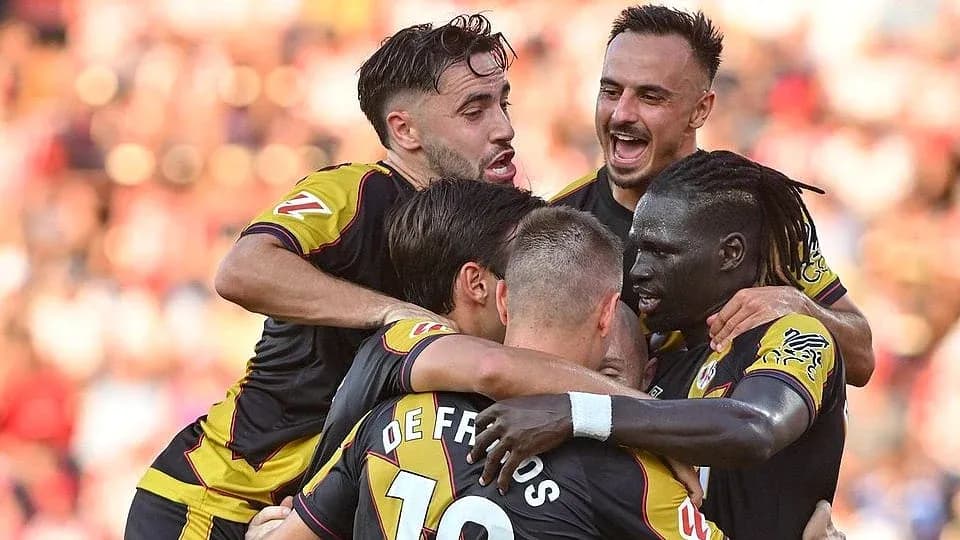
Rayo Vallecano vs Girona: A Tactical Analysis of La Liga Draw
The night at Campo de Futbol de Vallecas ended with the scoreboard frozen at 1–1, but the story beneath the result was far richer: a meeting of a secure mid‑table side and a team still staring at the trapdoor, each revealing exactly who they have been across this La Liga season.
I. The Big Picture – Two Different Seasons Collide
Following this result, Rayo Vallecano remain the archetype of a stubborn mid‑table outfit. They sit 10th with 43 points, their goal difference at -6, perfectly mirroring a campaign built on defensive control more than attacking flair. Overall this season they have played 35 league matches, winning 10, drawing 13 and losing 12, scoring 36 and conceding 42. At home, Vallecas has been a fortress of attrition: 18 games, 6 wins, 10 draws, only 2 defeats, with 22 goals scored and just 15 conceded.
Girona, by contrast, leave Madrid still in the relegation zone. They stand 18th with 39 points and a goal difference of -15, having played 35 matches in total (9 wins, 12 draws, 14 defeats, 37 scored and 52 conceded). On their travels they have been awkward but fragile: 18 away fixtures, 3 wins, 8 draws, 7 losses, 18 goals for and 27 against. The 1–1 draw fits that pattern—competitive, combative, but never quite in control.
Tactically, the formations told their own tale. Rayo stepped away from their more usual 4‑2‑3‑1 and leaned into a 4‑3‑3 under Inigo Perez, a shape designed to compensate for key absences and lean on width and work‑rate. Girona, true to their season’s identity, lined up in a 4‑2‑3‑1 under Michel, a system that has been their default (19 league games in that shape) and the framework for their attempts to play through the thirds even under pressure.
II. Tactical Voids – Suspensions, Injuries and Discipline
The absentees framed the contest before a ball was kicked. Rayo were without I. Akhomach (muscle injury), Luiz Felipe (injury), D. Mendez (knee injury) and, crucially, I. Palazon, suspended after a red card. Palazon is not just any missing piece: he leads the league’s yellow‑card charts for Rayo with 10 yellows and 1 red, and his profile—3 goals, 3 assists, 39 key passes, 48 dribble attempts—embodies their creative edge and emotional volatility. His absence stripped Rayo of their natural right‑sided playmaker and set‑piece specialist, forcing the front line to be more direct and less intricate.
Girona arrived even more depleted. B. Gil (yellow‑card suspension), Juan Carlos, Portu and V. Vanat were all ruled out by injury, while D. van de Beek and even M. ter Stegen appeared on a lengthy injury list. For a side whose overall defensive record is brittle—52 goals conceded in total at an average of 1.5 per match both home and away—losing depth and experience further narrowed Michel’s options, particularly in rotating his back line and wide creativity.
Disciplinary trends also shaped the rhythm. Rayo’s yellow cards are spread across the match, but there is a noticeable rise from 46‑60 minutes (18 yellows, 18.37%) through 61‑75 (19, 19.39%) and into 76‑90 (15, 15.31%), reflecting how their intensity often boils over as games stretch. Girona, though, are a different animal: an extraordinary 39.19% of their yellow cards arrive between 76‑90 minutes, with another 17.57% in added time (91‑105). This late‑game indiscipline has repeatedly turned manageable situations into crises, and in a tight contest like this one it hung over them like a storm cloud.
III. Key Matchups – Hunter vs Shield, and the Engine Room
With Palazon suspended, the attacking mantle for Rayo fell squarely on Jorge de Frutos. The winger, one of La Liga’s more underrated forwards, has 10 goals and 1 assist in 33 appearances, from 47 shots (26 on target). He is a classic “Hunter” profile: direct, aggressive in duels (248 contested, 106 won), and willing to carry the ball (53 dribbles attempted, 26 successful). In this 4‑3‑3 he started from the right of the front three, tasked with cutting inside and attacking Girona’s left‑sided channel.
Opposite him, Girona’s “Shield” was Vitor Reis, the 19‑year‑old centre‑back who has quietly put together a standout season. Across 33 appearances he has produced 38 successful blocks and 30 interceptions, winning 154 of his 266 duels, and passing with 91% accuracy. Vitor Reis blocked 38 shots this season, an elite number that underpins Girona’s last‑ditch defending. Here, his positioning and timing were vital in narrowing the angles for de Frutos and covering the space behind A. Moreno at left‑back.
This duel—de Frutos attacking the inside‑right channel, Vitor Reis sliding across to meet him—became one of the game’s recurring tactical images. Whenever Rayo tried to break beyond Girona’s first line, the outcome often hinged on whether de Frutos could isolate a full‑back or whether Vitor Reis could step out to engage without leaving gaps.
In midfield, the “Engine Room” clash pitted Rayo’s blend of graft and control against Girona’s double pivot. P. Diaz, O. Valentin and U. Lopez formed Rayo’s trio, tasked with compensating for the lack of a natural No.10. Diaz sat deepest, screening in front of F. Lejeune and P. Ciss, while Valentin and Lopez shuttled to press and support wide. On the other side, A. Witsel and F. Beltran anchored Girona’s 4‑2‑3‑1. Witsel’s calm distribution and Beltran’s energy were designed to beat Rayo’s press and feed the advanced trio of V. Tsygankov, T. Lemar and J. Roca behind A. Ounahi.
The presence of P. Ciss at centre‑back for Rayo added another layer. Naturally a midfielder, he brings line‑breaking passing and aggression to the back line. His season numbers—49 tackles, 32 interceptions, 14 successful blocks—explain why Perez trusts him to step out and compress the space between lines, even at the risk of leaving room in behind.
IV. Statistical Prognosis – xG, Trends and What the Draw Tells Us
Even without explicit xG data, the season numbers provide a strong proxy for how this 1–1 fits the broader pattern. Heading into this game, Rayo’s attack at home averaged 1.2 goals per match, with 0.8 conceded. Girona’s away attack averaged 1.0, with 1.5 conceded. A single goal apiece sits right on the expected offensive output for both sides, and Rayo’s failure to turn home dominance into victory is consistent with their 10 home draws in 18 matches.
Defensively, Rayo’s overall concession rate of 1.2 goals per game, against Girona’s 1.1 goals scored per game in total, suggested the visitors would need efficiency rather than volume to score—and so it proved. Girona’s season‑long vulnerability, especially late on, was again visible in their need to protect the result as the match entered its final quarter, a phase where 39.19% of their yellow cards have been shown. Rayo’s own late‑game card spikes (19.39% of yellows from 61‑75, 15.31% from 76‑90) ensured the closing stages were as tense as expected.
From a penalty perspective, neither side carries a psychological scar this season: Rayo have scored all 3 of their penalties (0 missed), while Girona have converted all 7 (0 missed). The deadlock from open play and set‑pieces, therefore, was never likely to be broken by spot‑kick nerves.
In narrative terms, this 1–1 is almost a statistical distillation of both campaigns. Rayo, with 11 clean sheets overall and a habit of failing to score (12 matches without a goal), once again balanced solidity with just enough attacking incision. Girona, with only 6 clean sheets and a leaky defence, managed to find a goal but could not close the door.
For Rayo, the draw consolidates a season of controlled survival, underpinned by a robust home record and standout individuals like de Frutos, Ciss and the suspended Palazon. For Girona, it is another step in a precarious dance above the abyss: competitive in structure, reliant on the excellence of Vitor Reis at the back, but still living on a defensive edge that leaves every point hard‑earned and every lead fragile.
Related News

LaLiga 2026-27 Season Schedule Released: Kickoff on August 15, Clásico on October 25

Atletico Madrid vs Real Madrid: Head-to-head Stats and Past Meetings
Real Madrid Dominates Rayo Vallecano in La Liga Clash
Atletico Madrid Dominates Real Sociedad 3-0 at Reale Arena
Barcelona Dominates Levante in High-Scoring Clash

Sevilla vs Barcelona Stats: Head-to-Head Record and Past Meetings