
Portugal’s Tactical Control vs Croatia’s Transition Threat
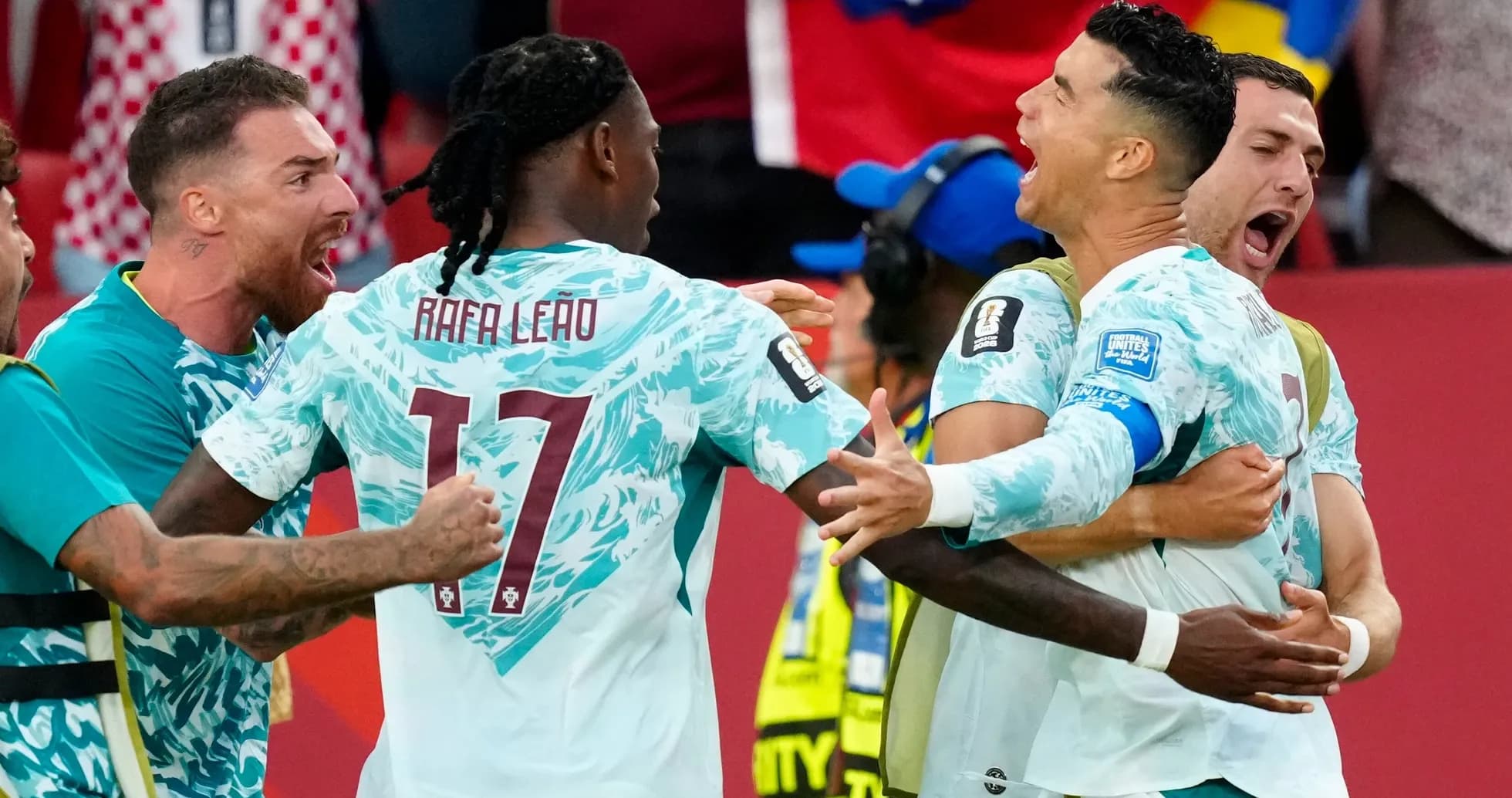
Portugal’s 2-1 victory over Croatia at BMO Field in the World Cup Round of 32 was defined by structural control versus transition threat. Both sides lined up in a 4-2-3-1, but the way they occupied and manipulated space was markedly different, and the underlying numbers – 61% possession, 584 passes at 91% accuracy for Portugal against Croatia’s 39% and 368 passes at 85% – underline a contest of territorial dominance against situational punch.
Roberto Martinez’s Portugal used the 4-2-3-1 as a high-possession, field-tilting platform. João Neves and Vitinha operated as a double pivot that constantly dropped behind Croatia’s first line, creating a 2+2 base with Rúben Dias and Renato Veiga. This gave Portugal stable circulation and allowed the full-backs, João Cancelo and Nuno Mendes, to push high and wide, effectively pinning Croatia’s wide midfielders. The result was a sustained presence in the attacking half: 15 total shots, 10 from inside the box, and 9 corners.
The attacking structure revolved around Bruno Fernandes in the central pocket, with Pedro Neto and Rafael Leão narrowing inside to overload the half-spaces while still threatening depth. Cristiano Ronaldo stayed high on the last line, mostly occupying the centre-backs and opening lanes for Leão’s diagonal runs. Portugal’s shot profile – 3 shots on goal from 15 attempts, plus an xG of 2.18 – suggests that while they consistently reached good zones, their final execution was slightly below the quality of chances created.
Out of possession, Portugal’s 4-2-3-1 morphed into a compact 4-4-2, with Fernandes stepping alongside Ronaldo. The press was more about control than all-out aggression: they limited Croatia to 13 shots and only 3 from outside the box, forcing Zlatko Dalic’s side to rely on quick transitions rather than sustained possession. The low foul count (6) reflects a controlled defensive performance, with Rúben Dias’ early yellow card for “Elbowing” at 17' the only disciplinary blemish for Portugal, yet it did not destabilize their back line.
Croatia, also in a 4-2-3-1, leaned heavily on Luka Modrić and Mateo Kovačić to break Portugal’s press and launch attacks. With Martin Baturina and Nikola Vlašić starting as advanced midfielders and Ivan Perišić nominally at left-back but aggressively stepping into higher zones, Croatia’s main danger came when they could bypass Portugal’s first block and attack the back four at speed. Their 6 shots on goal from 13 attempts and xG of 1.34 show that, despite having less of the ball, they generated a relatively efficient attacking threat when they did progress.
A key tactical hinge was the penalty incident and the VAR interventions. Portugal’s structure and sustained pressure forced Croatia deeper and increased the volume of box entries, culminating in the penalty converted by Ronaldo. Croatia, in response, introduced Mario Pašalić and later Andrej Kramarić to add vertical running and penalty-box presence, shifting towards a more aggressive, risk-taking posture. This coincided with a series of disallowed goals via VAR, reflecting how Croatia increasingly committed numbers forward and played on the edge of Portugal’s defensive line.
On the flanks, the duel between Portugal’s advanced full-backs and Croatia’s wide players was decisive. Nuno Mendes’ high starting position, combined with Leão’s inside drifting, repeatedly stretched Josip Stanišić and opened the channel that eventually allowed Gonçalo Ramos to score deep into added time, assisted by Leão. On the opposite side, Cancelo’s forward surges forced Perišić to constantly manage the trade-off between defending deep and joining attacks; his goal for Croatia came when he was able to break that leash and arrive in advanced areas, but the cumulative defensive load told late on.
In terms of goalkeeping dynamics, Diogo Costa (Portugal) and Dominik Livaković (Croatia) had very different workloads relative to their team’s game plans. Portugal allowed 6 shots on goal and Diogo Costa (Portugal) made 5 saves, a figure that, combined with Croatia’s xG of 1.34, suggests he was repeatedly called upon to protect a high line that occasionally left space in behind. His performance was central to preserving Portugal’s platform for the late winner, even if the “goals prevented” figure of -0.45 indicates that, on balance, Croatia might feel they could have been more clinical.
At the other end, Dominik Livaković (Croatia) faced 3 shots on goal and made 2 saves. With Portugal generating an xG of 2.18, his “goals prevented” value of -0.45 points to a night where the defence in front of him allowed too many high-quality looks, particularly from central zones. Croatia’s back four, often stretched by Portugal’s width and rotations between the lines, were forced into recovery defending rather than holding a stable block, which reduced Livaković’s ability to control the penalty area and command crosses, especially under a 9–5 corner deficit.
Discipline also shaped the tactical rhythm. Croatia’s 12 fouls and 2 yellow cards – Modrić for “Tripping” at 59' and Perišić for “Unsportsmanlike conduct” at 90+8' – reflected a team increasingly forced into emergency defending and emotional reactions as the game tilted against them late on. Portugal’s single yellow, combined with their superior pass accuracy and lower foul count, underlined a more controlled, less chaotic approach.
Statistically, Portugal’s superiority in possession, passing volume, and box entries translated broadly in line with expectations: 2.18 xG to Croatia’s 1.34, 15 shots to 13, and a 61%-39% possession split. The blocked shot count (4 for Portugal, 2 for Croatia) shows Portugal more willing and able to shoot through traffic, while Croatia’s lower volume but higher shots-on-goal ratio points to a more selective, transition-based shot profile.
In synthesis, this was a match where Portugal’s structural dominance, ball circulation, and late-game bench impact eventually overpowered Croatia’s intermittent but dangerous transition play. The goalkeepers’ numbers, the xG gap, and the passing data all converge on the same conclusion: Croatia were competitive in moments, but Portugal’s tactical control and depth made a narrow scoreline feel strategically deserved.
Related News
Thomas Tuchel Reflects on England's 10-Man World Cup Triumph and a Surprising Regret

Robert Moreno Takes Over as Interim South Korea Coach After World Cup Setback

Jude Bellingham Returns to Form with Real Madrid After World Cup Success

Chloe Kelly, Beth Mead & 13 Lionesses Who Must Shine in the Upcoming WSL Season for England’s 2027 World Cup Bid
Barcelona Cancels World Cup Tribute Amid Political Tensions
Messi Breaks Record for Most Penalties Taken and Missed in FIFA World Cup History