
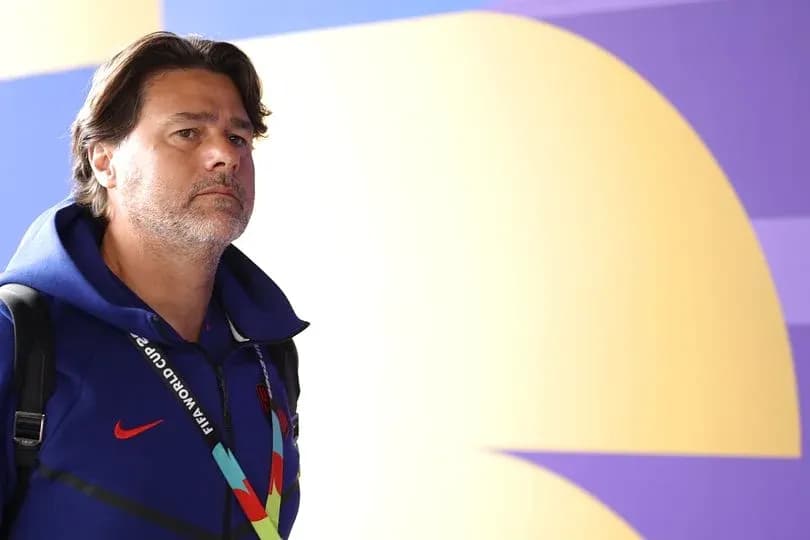
Pochettino Balances Loyalty as USMNT Faces Australia in World Cup
Mauricio Pochettino will lead the U.S. Men’s National Team into a pivotal World Cup night in Seattle with the Stars and Stripes on his chest – and Argentina still in his heart.
On the eve of the USMNT’s second Group D clash against Australia at Lumen Field, the 54-year-old coach cut a thoughtful figure. This is his first World Cup in charge of the United States, yet the conversation inevitably drifted back to home, to Argentina, and to a former player who remains the game’s defining figure: Lionel Messi.
Pochettino’s divided heart
Pochettino didn’t pretend otherwise. He is an Argentinian leading America at a World Cup while his country of birth, the reigning champions, stride through the tournament with Messi once again at the center of it all.
“I am Argentinian, and I really enjoy the performance of Argentina, but I'm going to give my life for the USA,” he said, laying out the split in simple, unmistakable terms.
There was no attempt to downplay his admiration for the team he grew up with. He called Argentina “an amazing team,” reminded everyone they are arriving as defending world champions, and praised a group in which “every single player is a world champion.” Lionel Scaloni, he said, is “for me the best coach today in this World Cup,” backed by a staff he knows well and a fanbase that travels the world in full voice.
And then, of course, there is Messi – “their cherry [on top],” as Pochettino put it. A final flourish that turns a strong side into a terrifying one.
A message for Messi
This World Cup has already delivered one of its most emotional images: Messi in tears after scoring the first of his three goals in Argentina’s 3–0 win over Algeria. The outpouring sparked a wave of speculation about his father Jorge’s health, with rumors racing far ahead of facts.
The Messi family moved to shut that down on Thursday with a detailed statement. They confirmed that Jorge is dealing with a health issue, is under medical monitoring, and is “recovering and evolving favorably within the condition he is presenting.” They condemned the “lack of sensitivity, respect, and scruples” shown by those who treated a “strictly private and family situation” as fodder for speculation, and stressed that only the closest family members hold “real and accurate information” about his condition.
They asked for “responsibility, prudence, and humanity,” and made it clear that anything not coming directly from the family or its official channels “should not be considered valid or truthful.” Privacy, they insisted, must be preserved. Any meaningful update will come from them, and only them.
Pochettino, who coached Messi at Paris Saint-Germain and maintains a relationship with the family, chose his words carefully when asked about the situation. But the feeling behind them was unmistakable.
“I think it was amazing to see him,” he said of Messi’s performances. “I want to send all my support because it's a difficult situation, family situation. I want to give my support. I know him from Paris and his family. I want to show and send my best wishes for his family.”
No embellishment. Just a former coach speaking about a player he still clearly holds in deep regard, and a family going through a private battle in the harshest public glare.
Respect for a giant, focus on the job
Pochettino’s respect for Messi runs long and deep. When asked to define the 38-year-old’s legacy, he barely paused.
“I think it's difficult to describe Messi. Six World Cups, all that he achieved in his career, in different clubs, collectively and individually. He's the best. For sure, yes.”
Six World Cups. Titles in Europe and beyond. Records in Barcelona colors, in Paris, now in the United States with Inter Miami. The résumé is almost absurd, yet Pochettino delivered the verdict with the calm of someone who has long since made his mind up.
That admiration extends to the current Argentina setup. The coach, the players, the staff, the fans – he sees a complete, coherent unit, sharpened by the experience of lifting the trophy four years ago and now rearmed with a veteran Messi leading another charge.
“With their cherry on top with Messi,” he said, “it's a difficult combination to play against.”
But that is someone else’s problem at this tournament. His job is here, with the United States, in a group that leaves no room for emotional drift.
“I'm going to give everything that I have”
For all the nostalgia and affection, Pochettino kept dragging the conversation back to the present. To the USA. To the work in front of him.
“The most important thing is being genuine and honest,” he said. That honesty includes admitting he still enjoys watching Argentina, still feels pride in their performances. Yet it also includes a blunt promise.
“I'm going to give my life for the USA,” he repeated. “Now I am Argentinian, but I am defending the USA, and I'm going to give everything that I have, we have, to make great memories here.”
That last line matters. This World Cup is not just another tournament for the United States; it is a chance to reshape how the team is seen, at home and abroad. Pochettino knows that. His players know that. Nights like the one coming against Australia, in a charged Lumen Field, are where those memories are forged.
He will walk out in red, white, and blue. He will coach with the intensity that marked his club career in Europe. Somewhere, thousands of miles away, Argentina will march on with Messi at the helm and a nation behind them, while his own countrymen watch him try to build something new with a different flag.
Two worlds, one tournament. And a coach determined to prove that his loyalty to the present can be every bit as fierce as his love for the past.
Related News
Raphinha’s Hat-Trick Powers Barcelona to 7-2 Victory Over Racing Santander
Carabao Cup Fourth Round Draw: Liverpool Set to Clash with Chelsea, Arsenal to Face Fleetwood Town

Key Football Matches to Watch in Azerbaijan This Autumn
Raphinha's Hat-Trick Drives Barcelona to 7-2 Triumph Over Racing Santander
Hansi Flick Leads Barcelona to Record-Breaking Seven Wins in a Row
Gavi Reflects on Injury Return as Barcelona Dominate Racing Santander 7-2