
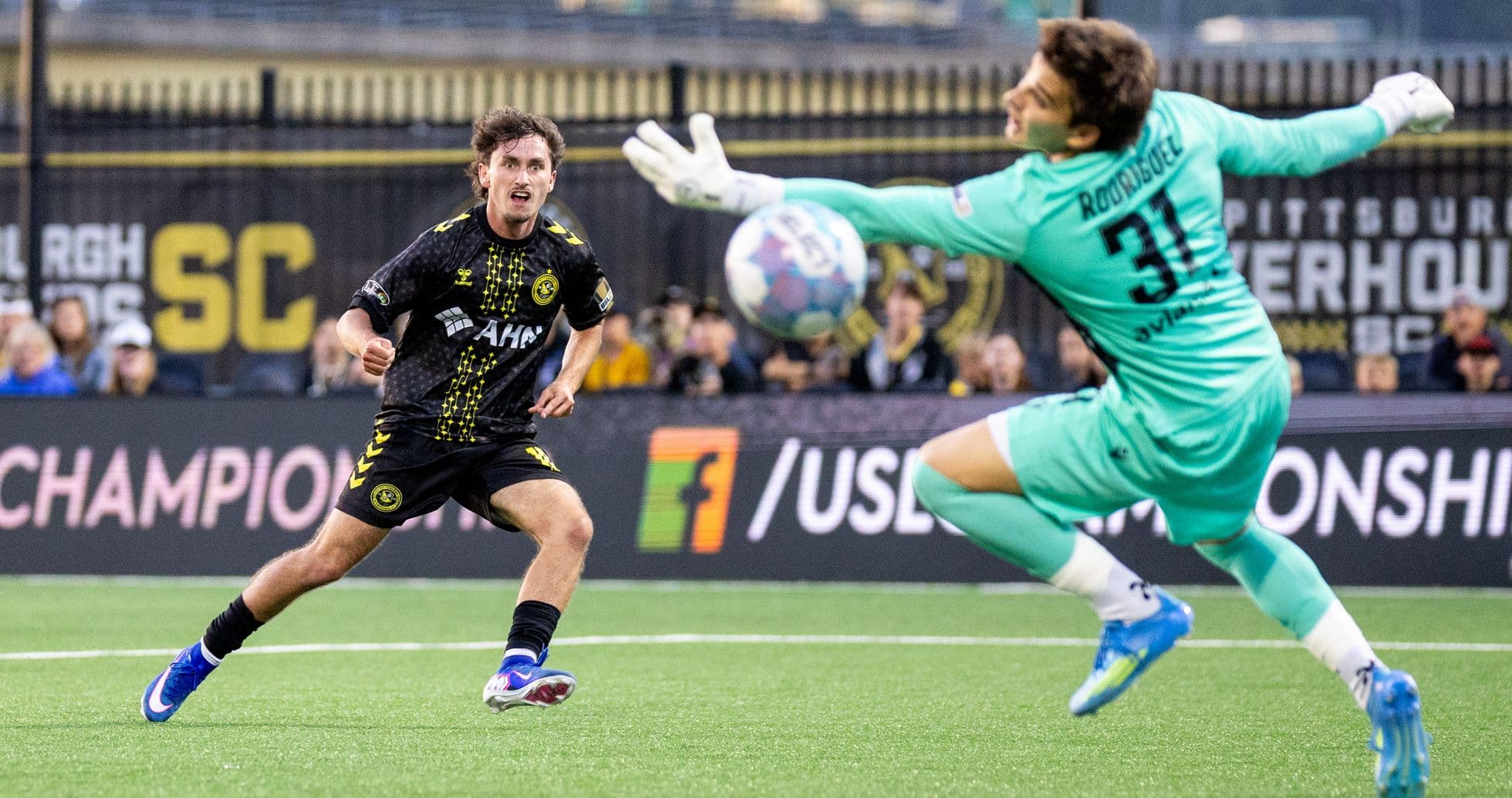
Pittsburgh Riverhounds Dominate Miami FC in USL Championship Clash
Under the Highmark Stadium lights, Pittsburgh Riverhounds’ 2–0 victory over Miami FC felt less like a routine group-stage result and more like a quiet statement of intent. In the USL Championship’s 2026 campaign, both sides arrived as playoff contenders – Pittsburgh fifth in the table, Miami seventh – but they left this fixture looking like teams on very different trajectories.
Heading into this game, Pittsburgh’s seasonal DNA was already clear: compact, pragmatic, and efficient. Overall they had taken 16 points from 10 matches, with a goal difference of 1, built on 14 goals scored and 13 conceded. At home they were particularly sharp, winning 3 of 4, scoring 7 and conceding only 4. The averages tell the same story: at home they were producing 1.8 goals for and allowing just 1.0 against per match, a profile of a side that knows how to control its own turf.
Miami, by contrast, were a paradox. Also on 16 points but from 12 games, they were more volatile: 15 goals scored, 19 conceded overall for a goal difference of -4. On their travels they were grinding rather than thriving – just 1 away win in 7, with 6 goals for and 10 against, an away average of 0.9 goals scored and 1.4 conceded. It is the statistical fingerprint of a team that can compete but rarely dictate.
I. The Big Picture: Control vs. Chaos
This match, finished in regular time under referee C. Rodriguez, followed the script of the numbers. Pittsburgh’s 2–0 full-time scoreline mirrored their biggest home win of the season (2–0) and extended a form line that had already begun to bend upward: LWLWDLWLWW. The Riverhounds’ season has been one of narrow margins and fine-tuned adjustments, and this performance fit neatly into that pattern.
Miami’s form – LWLDW heading into the fixture, but more jagged over the full campaign at LDWWDDLWDLWL – hinted at their inconsistency. Their overall defensive average of 1.6 goals conceded per match, and 1.4 away, left them perpetually walking a tightrope. Against a home side that rarely wastes their attacking phases, that rope finally snapped.
II. Tactical Voids: Discipline and the Edges of Control
With no formal list of absentees, both coaches leaned into their available cores. Rob Vincent’s Riverhounds XI was anchored by N. Campuzano in goal, a back line marshalled by the likes of P. Barnes, V. Souza, L. Kelp and O. Mikoy, and a spine shaped by D. Griffin and R. Mertz. Ahead of them, C. Ahl, E. Goldthorp, A. Dikwa and S. Bassett gave Pittsburgh multiple lines of pressure and counter-attacking options.
Gaston Maddoni’s Miami FC leaned on F. Rodriguez between the posts, with B. Ndiaye, D. Knutson and A. Calfo among those tasked with holding the line. In midfield and attack, A. Milesi, G. Diaz, R. Tori, J. Sonora, R. Da Costa, M. Ndongo and A. Rocha formed a technically capable but defensively vulnerable unit.
Discipline has been an undercurrent of both teams’ seasons. Heading into this game, Pittsburgh’s yellow-card distribution showed their aggression clustering at the end of each half: 25.00% of their cautions arriving between 31–45 minutes and another 25.00% between 76–90. They push the tempo as the clock ticks down, and with no red cards at all this season, they’ve walked that line without tumbling over it.
Miami’s profile was far more combustible. A late-game surge of yellow cards – 25.71% between 61–75 minutes and another 25.71% between 76–90 – pointed to a side that frays under pressure. Crucially, their only red card of the campaign had come in the 61–75 minute band, a sign that the emotional temperature often spikes just as legs begin to tire. Against a home side that thrives in those same windows, that was a tactical fault line waiting to be exposed.
III. Key Matchups: Hunter vs. Shield, Engine Room vs. Enforcer
Without individual scoring charts, the “Hunter vs. Shield” battle in this fixture was more collective than personal. For Pittsburgh, the attacking quartet of Ahl, Goldthorp, Dikwa and Bassett represented the “Hunter”: a unit reflecting the team’s home average of 1.8 goals per match. Their job was to probe a Miami defence that, away from home, had already shipped 10 goals in 7 games.
On the other side, Miami’s “Shield” was less a single figure than a stretched system. With an overall concession rate of 1.6 goals per match, and an away rate of 1.4, they were always likely to bend. Once Pittsburgh’s front line began to combine and run off the ball, that bend became a break. The 2–0 scoreline was a statistical inevitability made visible.
In the “Engine Room,” the contrast was just as stark. Pittsburgh’s midfield, shaped by Griffin and Mertz, was set up to manage tempo and protect transitions. Their season-long record of just 13 goals conceded in 10 games – an overall average of 1.3 – speaks to a unit that values structure. Miami’s central cohort, including Milesi, Diaz and Tori, carried more creative promise but far less defensive assurance, reflected in those 19 goals conceded overall.
IV. Statistical Prognosis: xG by Another Name
Even without explicit xG numbers, the underlying indicators sketch a clear expected-goals narrative. Heading into this game, Pittsburgh’s overall scoring average of 1.4 goals per match, inflated at home to 1.8, met a Miami defence conceding 1.4 away. A home output in the 1–2 goal band was the likeliest outcome; Pittsburgh hit the top of that range.
Defensively, Pittsburgh’s home average of 1.0 goal conceded collided with a Miami attack averaging just 0.9 away. The most probable outcome was Miami being held to 0 or 1; they landed on 0. Add in Miami’s tendency to lose their discipline late – those heavy yellow-card clusters from 61–90 minutes – against a Riverhounds side that also ramps up its intensity in the same windows, and the balance of late-game chances was always tilted toward the hosts.
Following this result, the numbers and the narrative finally align. Pittsburgh look every inch a playoff-calibre side: solid at home, measured in possession, ruthless enough in the decisive moments. Miami remain a team of fragments – flashes of quality, undermined by structural and disciplinary fragility, especially on their travels. In the cold language of averages, this was the match where probability simply played out on the pitch.
Related News
San Antonio Triumphs Over Colorado Springs in USL Championship Clash
Charleston Battery's Dominance Over Loudoun United: A Tactical Analysis
Orange County SC Triumphs 4-2 Over Miami FC in USL Showdown
Colorado Springs vs San Antonio Match Preview
Colorado Springs vs San Antonio: USL Championship Clash Preview
Miami FC vs Orange County SC Match Preview