
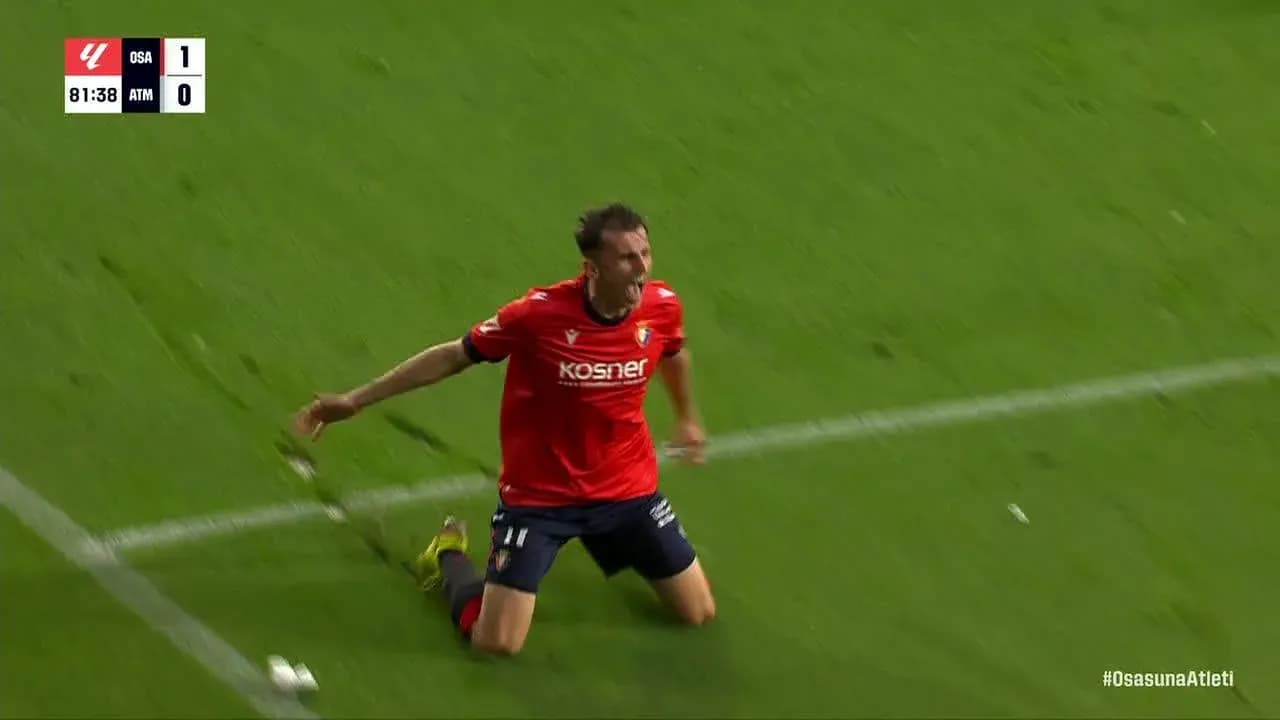
Osasuna vs Atletico Madrid: Tactical Analysis of the 2-1 Defeat
Osasuna’s 2-1 home defeat to Atletico Madrid at Estadio El Sadar was a classic case of territorial and chance dominance being undone by Atletico’s efficiency, game-state management, and a deep defensive block that bent but rarely broke. Across 90 minutes, Osasuna’s 58% possession, 23 total shots and 2.16 xG were not enough to overturn Atletico’s early control and then their compact survival mode after going 2-0 up and later down to ten men.
Alessio Lisci set Osasuna up in a 4-2-3-1 that was clearly designed to pin Atletico back. With Aitor Fernandez behind a back four of V. Rosier, Alejandro Catena, Enzo Boyomo and Javi Galán, the home side built patiently: L. Torro and J. Moncayola formed a double pivot, while Rubén García, M. Gomez and R. Moro supported Ante Budimir. The structure gave Osasuna strong central circulation – 477 passes, 415 accurate (87%) – and allowed them to keep Atletico in their own half for long spells, especially after the break.
Diego Simeone’s 4-4-2 had a different intention from the outset. J. Musso’s Atletico were more direct and vertical, accepting just 42% possession and only 5 total shots but extracting 1.64 xG and two goals. The back four of Marcos Llorente, Marc Pubill, D. Hancko and M. Ruggeri played relatively narrow, with Koke and R. Mendoza anchoring midfield and T. Almada and O. Vargas offering ball-carrying in the half-spaces. A. Griezmann and A. Lookman worked as split forwards, looking to exploit Osasuna’s high line.
Key Tactical Moments
The first key tactical hinge came early: at 13', VAR confirmed a penalty for Atletico involving Antoine Griezmann’s action, and at 15' Lookman converted. That sequence instantly tilted the game state: Atletico could drop ten yards, compress space, and invite Osasuna on. From that moment, Osasuna’s 4-2-3-1 became a territorial siege, but one that often lacked final-third clarity. Their 18 shots inside the box underline how well they reached dangerous zones, yet their shot selection and Atletico’s last-ditch defending limited the quality of those chances.
Simeone’s in-game management was ruthlessly pragmatic. At 18', R. Mendoza (OUT) made way for Robin Le Normand (IN), effectively adding another pure defender and sliding Atletico towards a more conservative block with extra aerial security against Budimir. The second major adjustment came at 46', when T. Almada (OUT) was replaced by A. Sorloth (IN). This shifted Atletico’s 4-4-2 into a more counter-punching setup with a stronger reference point up front, and it paid off when Sorloth, assisted by Marcos Llorente, scored the 71' second goal. That move encapsulated Atletico’s attacking plan: quick transition, early vertical pass, full-back stepping high to deliver, and a powerful runner attacking the box.
Osasuna’s response was to double down on width and attacking rotations. The 37' substitution saw R. Moro (OUT) replaced by Kike Barja (IN), injecting more direct dribbling from the flank. On 60', Rubén García (OUT) came off for R. Garcia (IN), and Javi Galán (OUT) for A. Bretones (IN), refreshing both the left side and the advanced midfield line. Later, at 72', L. Torro (OUT) was replaced by A. Oroz (IN) and M. Gomez (OUT) by A. Osambela (IN), effectively thinning the double pivot and loading the pitch with extra attackers. By then, Osasuna’s structure resembled a 4-1-4-1 or even a 3-3-4 in possession, with full-backs and advanced midfielders flooding Atletico’s box.
Disciplinary Actions
The disciplinary pattern also shaped the tactical tone. Osasuna accumulated six yellow cards, many for Argument, reflecting rising frustration with Atletico’s compact defence and the officiating. Atletico, meanwhile, saw Marcos Llorente booked for Argument at 52' and then for Foul at 79', immediately followed by a Red Card (Foul) in the same minute. That dismissal forced Simeone into a pure survival mode: the block dropped even deeper, lines compressed around the box, and the forwards’ primary task became defending the flanks and first passes out of defence.
At that point, Atletico’s defensive index – measured by their ability to limit clear shots and protect central zones – was impressive. Despite facing 23 shots, they allowed only 5 on target, with Musso making 4 saves and posting 0.32 goals prevented. Osasuna’s Aitor Fernandez, by contrast, faced just 4 shots on target, saving 2, and also registering 0.32 goals prevented. The parity in goals prevented despite the disparity in volume underlines how Atletico pushed Osasuna towards less efficient shooting positions, often wide or under pressure.
Osasuna’s late reward came at 90', when Kike Barja, assisted by R. Garcia, finally broke through to make it 1-2. Tactically, that goal was the logical outcome of their overload strategy: multiple attackers between the lines, quick combinations around a tiring, numerically reduced Atletico defence. Yet it arrived too late to change the overall pattern.
Statistically, Osasuna’s overall form in this match – heavy possession, high shot volume, superior pass accuracy – suggests a side structurally capable of controlling games. But their inability to convert 2.16 xG into more than one goal contrasts sharply with Atletico’s clinical 2 goals from 1.64 xG. Atletico’s defensive index, underscored by 4 blocks and disciplined compactness even after going down to ten men, aligned perfectly with Simeone’s game plan: take the lead, adjust personnel early (R. Mendoza for Robin Le Normand, Almada for Sorloth), and then defend the box with aggression and organisation.
In synthesis, this was a match where Osasuna’s tactical framework and attacking intent were largely sound but undermined by inefficiency and game-state setbacks, while Atletico Madrid’s tactical pragmatism, in-game adjustments, and penalty-plus-transition blueprint delivered a high-value away win despite inferior possession and passing metrics.
Related News

LaLiga 2026-27 Season Schedule Released: Kickoff on August 15, Clásico on October 25
Atletico Madrid vs Real Madrid: Head-to-head Stats and Past Meetings
Real Madrid Dominates Rayo Vallecano in La Liga Clash
Atletico Madrid Dominates Real Sociedad 3-0 at Reale Arena
Barcelona Dominates Levante in High-Scoring Clash

Sevilla vs Barcelona Stats: Head-to-Head Record and Past Meetings