
Netherlands and Japan Battle to 2-2 Draw in World Cup Opener
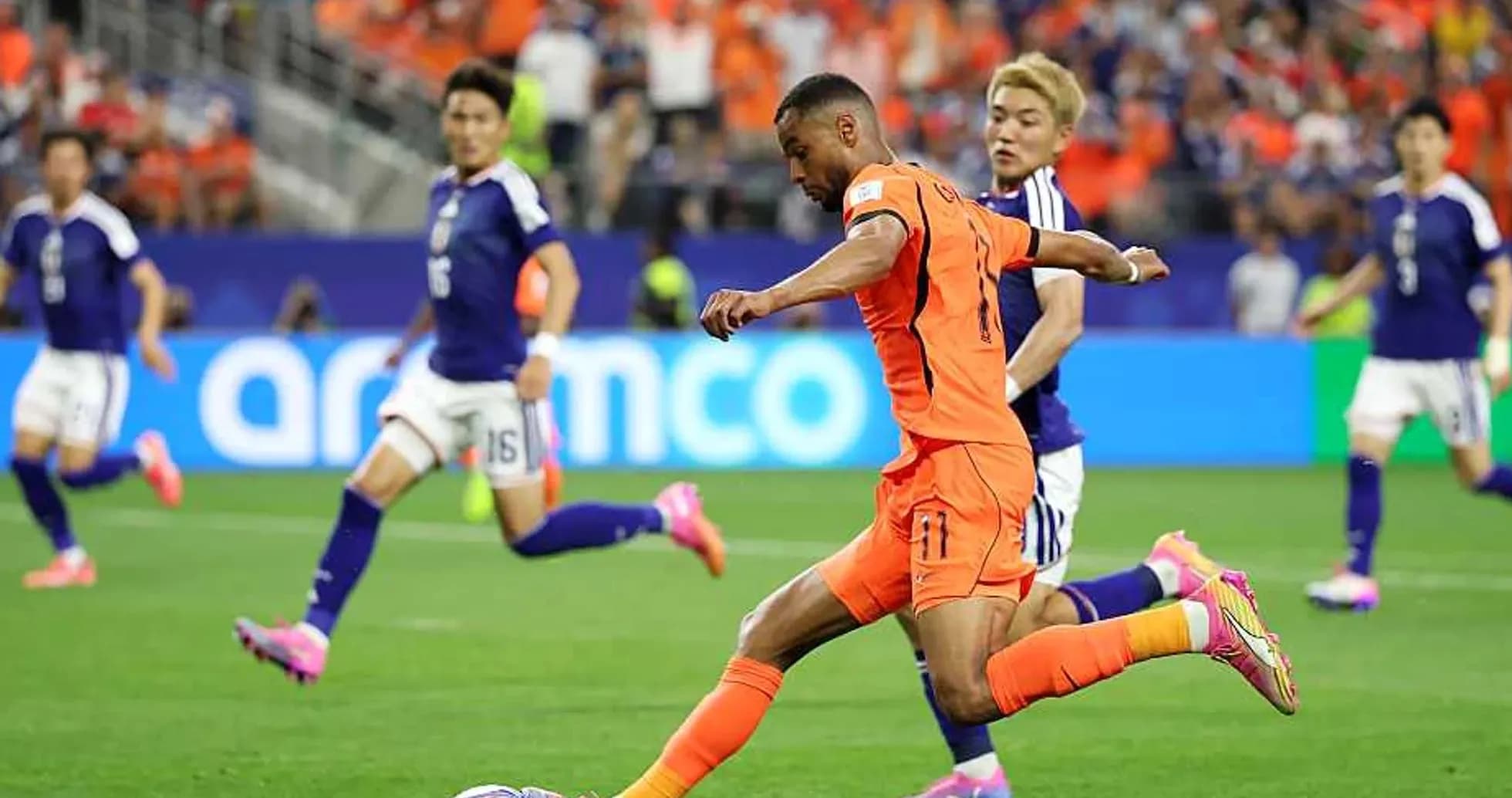
Netherlands and Japan opened their World Cup Group Stage campaigns at AT&T Stadium with a tactically rich 2-2 draw that showcased contrasting game models and in‑game adjustments. Ronald Koeman’s Netherlands imposed a 4-3-3 possession structure, while Hajime Moriyasu’s Japan countered with a compact 3-4-2-1 geared toward vertical breaks and late attacking changes. The statistical profile – 60% possession and 525 passes for Netherlands against Japan’s 40% and 342 passes – underlined Dutch territorial control, but Japan’s resilience and well-timed substitutions allowed them to claw back twice and leave with a point.
First Half
The first half, goalless at 0-0, was defined by Dutch circulation rather than penetration. With all 10 of Netherlands’ shots coming from inside the box and none from distance, their plan was clear: work patiently through the thirds and look for high‑value chances. The back four of Denzel Dumfries, Jan Paul van Hecke, Virgil van Dijk and Micky van de Ven built with width, allowing Frenkie de Jong to orchestrate as the central reference in midfield. Ryan Gravenberch and Tijjani Reijnders offered staggered positions ahead of him, creating a 2-3-5 structure in possession as the full-backs advanced and the front three of Crysencio Summerville, Donyell Malen and Cody Gakpo stretched Japan’s last line.
Japan’s 3-4-2-1 responded by compressing central lanes. Shogo Taniguchi anchored between Tsuyoshi Watanabe and Hiroki Itō, with wing-backs Ritsu Doan and Keito Nakamura dropping deep to form a back five without the ball. Central midfielders Kaishu Sano and Daichi Kamada screened passing lanes into De Jong and Gravenberch, accepting that Netherlands would dominate the ball but aiming to spring Takefusa Kubo, Daizen Maeda and Ayase Ueda on transition. The fact that Japan produced 10 shots from a more modest possession share shows that their counter-attacking triggers – particularly when Kubo received between the lines – were effective when they did manage to break Dutch pressure.
Second Half
The second half opened the game tactically and on the scoreboard. On 51 minutes, Virgil van Dijk attacked a delivery and scored for Netherlands, assisted by Ryan Gravenberch. The goal reflected Dutch superiority on set or semi‑set situations: Gravenberch’s delivery and Van Dijk’s timing exploited a brief lapse in Japan’s zonal and man‑oriented marking mix. At that point, Netherlands’ 5 corner kicks to Japan’s 4 also illustrated how often Koeman’s side pinned Japan back.
Japan’s response was immediate and instructive. In the 57th minute, Keito Nakamura equalised, assisted by Takefusa Kubo. That move crystallised Japan’s offensive blueprint: win the ball, find Kubo between Dutch lines, and then attack the space created by the advanced full-backs. Nakamura’s run from a wide or half-space position into the box took advantage of Netherlands’ aggressive positioning, particularly with Dumfries and Van de Ven often high and wide.
Discipline began to influence the rhythm. At 61', Crysencio Summerville (Netherlands) was booked — Foul. The caution did not blunt his attacking impact; three minutes later, in the 64th minute, Summerville restored the Dutch lead, again assisted by Gravenberch. That sequence highlighted Koeman’s right‑side bias: Dumfries’ high starting position, Summerville’s one‑v‑one threat, and Gravenberch’s ability to find the final ball created a recurring overload against Japan’s left flank.
Moriyasu then turned to his bench to change the attacking reference points. At 66', Junya Ito (IN) came on for Daizen Maeda (OUT), adding more direct running from wide areas. Koeman answered with a triple substitution on 70 minutes to refresh his structure and manage energy: Teun Koopmeiners (IN) came on for Tijjani Reijnders (OUT), Quinten Timber (IN) came on for Crysencio Summerville (OUT), and Memphis Depay (IN) came on for Donyell Malen (OUT). The changes shifted Netherlands slightly towards more control and protection of the lead, with Koopmeiners adding positional discipline in midfield and Depay offering a back‑to‑goal outlet.
Japan’s triple change on 75 minutes further altered the tactical landscape: Koki Ogawa (IN) came on for Takefusa Kubo (OUT), Takehiro Tomiyasu (IN) came on for Ritsu Doan (OUT), and Yukinari Sugawara (IN) came on for Tsuyoshi Watanabe (OUT). This rebalanced the back line and introduced a more traditional centre-forward profile in Ogawa, allowing Japan to attack earlier into the box and contest second balls. Netherlands then added defensive security at 81', when Nathan Aké (IN) came on for Ryan Gravenberch (OUT), effectively tilting the team towards a more conservative posture on the left side.
Discipline again played a role in the game’s tempo. At 83', Memphis Depay (Netherlands) received a yellow card — Foul. Japan’s final attacking reshapes came at 84', when Kento Shiogai (IN) came on for Ayase Ueda (OUT), and at 85', Brian Brobbey (IN) came on for Cody Gakpo (OUT) for Netherlands, further refreshing the Dutch front line.
Japan’s persistence was rewarded in the 89th minute, when Daichi Kamada equalised, assisted by Koki Ogawa. This late goal underlined the impact of Moriyasu’s substitutions: Ogawa’s presence in advanced areas created different reference points for Dutch defenders, and Kamada’s late runs from midfield into the box finally broke Dutch resistance. In added time, at 90+1', Micky van de Ven (Netherlands) was booked — Professional foul, reflecting a last-ditch intervention to prevent another Japanese break.
From a statistical perspective, Netherlands’ 0.79 xG against Japan’s 0.54 xG mirrors the narrative of slight Dutch edge in chance quality but not enough to kill the game. Netherlands’ passing structure was efficient: 525 passes, 464 accurate (88%), indicative of a well-rehearsed positional play that consistently advanced the ball but occasionally lacked incision. Japan’s 342 passes, 287 accurate (84%), show a more selective use of possession, prioritising verticality and quick combinations over long spells on the ball.
In terms of defensive output, each side registered 1 blocked shot, underscoring that many efforts reached the target or missed cleanly rather than being shut down at source. Netherlands produced 6 shots on goal to Japan’s 3, yet the final score remained level, reflecting both finishing variance and the role of the goalkeepers. Bart Verbruggen (Netherlands) made 1 save, while Zion Suzuki (Japan) made 4 saves, a disparity that aligns with Netherlands’ higher shot volume and Japan’s need for more last‑line interventions. The goals prevented metric at 0.62 for both teams suggests that each goalkeeper marginally outperformed the average expectation of the shots they faced.
Discipline was symmetrical in volume but not in timing or impact: Netherlands committed 7 fouls and collected 3 yellow cards, while Japan also committed 7 fouls but avoided bookings. That imbalance, combined with late Dutch cautions, subtly shifted psychological momentum towards Japan in the closing stages. Ultimately, the 2-2 draw accurately captures a match in which Netherlands’ structured dominance was repeatedly challenged by Japan’s adaptive substitutions and efficient exploitation of transitional moments.
Related News

Thomas Tuchel Reflects on England's 10-Man World Cup Triumph and a Surprising Regret

Robert Moreno Takes Over as Interim South Korea Coach After World Cup Setback

Jude Bellingham Returns to Form with Real Madrid After World Cup Success

Chloe Kelly, Beth Mead & 13 Lionesses Who Must Shine in the Upcoming WSL Season for England’s 2027 World Cup Bid
Barcelona Cancels World Cup Tribute Amid Political Tensions
Messi Breaks Record for Most Penalties Taken and Missed in FIFA World Cup History