
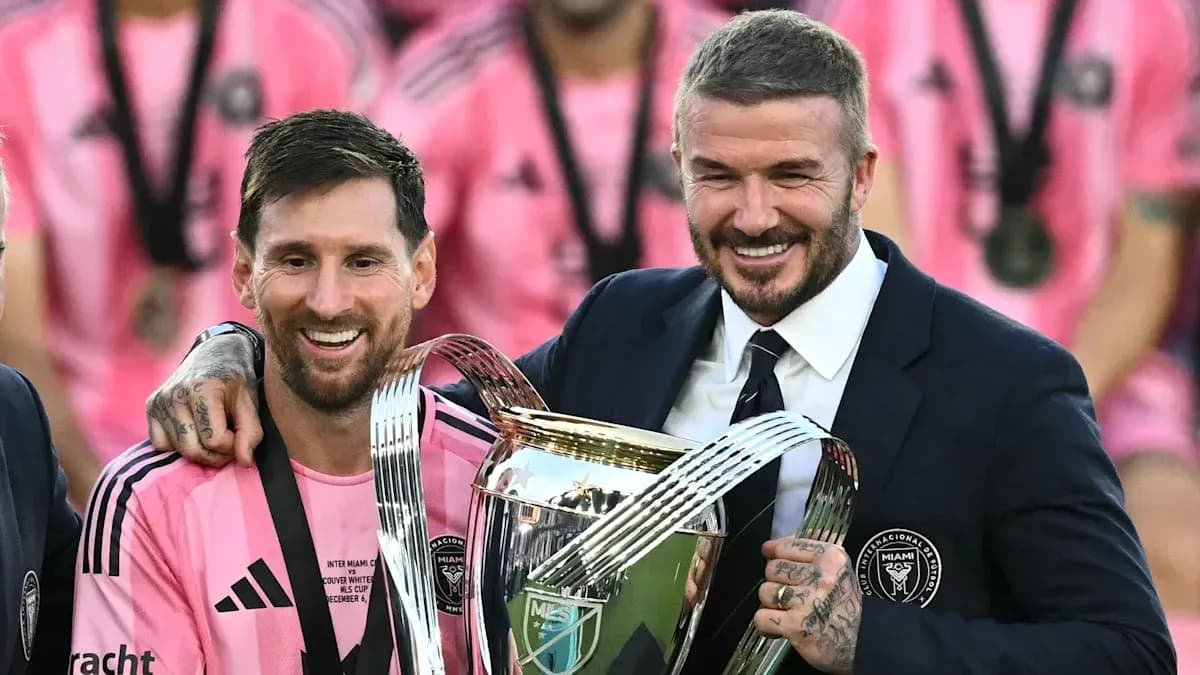
MLS Seizes World Cup Momentum for Growth
“Thanks world, we’ll take it from here.”
That’s the line, delivered by Lionel Messi, Son Heung-min, David Beckham and a cast of MLS faces, in a slick new campaign aimed squarely at the millions of Americans who have just fallen for the World Cup. The message is not subtle: you’ve had your taste of the global showpiece; now come and find the game in your own backyard.
The film rolls through World Cup stars now based in the US, inviting fans to follow them as the MLS regular season restarts. The league is even dangling free tickets for newcomers. This is not a league content to ride a passing wave. It wants to own it.
“The World Cup has now exposed millions of people to Major League Soccer,” says MLS executive vice-president Dan Courtemanche, who has been with the league since before a single ball was kicked in anger in 1996. “We’re going to continue to capitalise on that momentum.”
The question hangs over everything: could this World Cup be remembered as the moment MLS finally muscled into football’s elite?
From World Cup legacy to 30-club machine
MLS itself was born from a World Cup promise. When the United States won the right to host the 1994 tournament, Fifa demanded a professional league as part of the deal. Two years later, MLS kicked off with 10 teams and not a single purpose-built stadium.
Three decades on, that landscape looks unrecognisable. The league now boasts 30 clubs and almost as many football-specific grounds, concrete proof of a project that has outlived the sceptics who once saw it as a passing experiment.
This latest World Cup has pushed the sport deeper into the American mainstream. Predictions of half-empty stands because of high ticket prices were swept away by packed stadiums and noisy crowds. TV audiences followed.
The USA’s last-16 defeat by Belgium drew more than 33 million viewers on Fox, the most-watched football match on a single US network. England’s last-16 win over Mexico went even bigger: a combined 45 million viewers across English and Spanish on Fox and Telemundo, the most-watched football game in US history.
Those numbers nudge into NFL territory. They don’t yet threaten the Super Bowl, which in 2025 drew 127.7 million viewers across English and Spanish broadcasts and streaming in the US, with Kendrick Lamar on half-time duty. But football – the global version – is no longer whispering from the sidelines.
MLS, which has been on a steady upward curve since 1996, now talks openly about joining Europe’s heavyweights.
“I think we’re looked at as the top, one of the top leagues commercially,” says commissioner Don Garber. “We’ve cracked that code. Now we’ve got to crack the rest of it.”
Beyond the ‘retirement home’ tag
On some fronts, MLS is already rubbing shoulders with the game’s powerhouses. Forty-five MLS players featured at the 2026 World Cup, including two in the final for Argentina: Messi and Rodrigo de Paul.
For years, the league carried the reputation of a sun-soaked retirement plan for ageing superstars. Beckham, then Messi – legends arriving after their European peaks, cashing in and clocking out.
Courtemanche insists that image no longer fits. The average age of new international signings is now 23.8 years. These are players at the start or middle of their careers, many of them seeing MLS as a launchpad rather than a last stop, with Europe still the dream beyond the horizon.
The league is reshaping itself to match that ambition. In 2027, MLS will switch to a summer-to-spring calendar, mirroring Europe and smoothing the path for transfers in and out. It’s a structural change with a clear purpose: make movement easier, make the league more relevant in the global market.
Behind the first teams, clubs are pouring money and attention into youth development. Every MLS side now runs an academy. The scenes at an LA Galaxy viewing party for the USA’s win over Bosnia-Herzegovina tell their own story: while the match plays on a giant screen, dozens of kids ignore it and stage their own battles on three small pitches, sprinting over only when the roar of a goal cuts through the noise.
The skill level is high. Some of those children already wear MLS academy badges. Eight-year-old Landon – named after US great Landon Donovan – darts from goalkeeper to forward with obvious joy. His mother, Jen Wing, a coach, says her children attend MLS camps and play on travel teams back home in New Jersey.
Landon doesn’t hesitate when asked about his dream: he wants to play in MLS. “LAFC,” he says.
The pay-to-play problem
For all the progress, one issue refuses to go away. Critics insist MLS cannot truly compete with Europe until the United States dismantles its pay-to-play culture.
At the top, MLS academies train and develop their youth players for free, much like their European counterparts. The problem lies in the journey to that level. To reach the point where an MLS academy might notice a teenager, many families have already spent thousands of dollars on private coaching and travel teams – a familiar pattern across US sports.
League officials argue that the system is evolving, that development leagues are improving, and that every club offers scholarships to talented players who can’t afford the fees. Garber talks of a league constantly upgrading its ability to produce young talent, determined to feed “more and more to the men’s national team and just be better, bigger, stronger, faster, all those things that give you energy to think of a better future.”
The stakes are obvious. If MLS can widen the pathway, the raw material is there.
Messi, celebrity owners and serious money
For now, one name towers above the rest when it comes to drawing eyes: Messi. His presence in Miami has shifted global attention, and MLS knows it.
Yet the league’s celebrity pull runs far deeper than one superstar on the pitch. Ownership groups are stacked with familiar faces from film, music and sport. Will Ferrell is part of the LAFC setup. Reese Witherspoon has a stake in Nashville SC. Matthew McConaughey is tied to Austin FC. Magic Johnson is among the investors at LAFC.
The money is real, and it is multiplying. Drew Carey joined Seattle Sounders as an original owner in 2009, when the expansion fee was $30m. The club is now valued at more than $900m. Beckham’s 2007 LA Galaxy contract included an option to buy an expansion team for $25m. He exercised it and now owns Inter Miami CF, valued by experts at more than a billion dollars.
This is no longer a niche project. It’s a serious business with serious returns.
The cultural fight with Friday night lights
Yet MLS still battles a deeply ingrained sporting culture. For many Americans, the hierarchy remains clear: American football first, everything else behind.
Brian Udovich sees that tension up close. His 12-year-old son Croil plays in an MLS Next Level league in Southern California. He watches talented youngsters drift away from soccer in their teenage years, lured by the spectacle of high school American football.
On Friday nights, those players step into giant stadiums with their names in lights, marching bands blaring, cheerleaders on the sidelines and entire communities watching. Soccer, by contrast, tends to unfold on Saturday mornings, parents hunched on folding chairs at the touchline.
“It just means so much more to other cultures than us,” Udovich says.
Michael Bradley, now coach of the New York Red Bulls, recognises the difference but sees a shift. The United States, he says, doesn’t have the long, layered football history that defines countries in South America or Europe. For years, that absence bred an inferiority complex, a nagging doubt that football would never truly stick.
That mood has changed. The World Cup has left behind a different kind of confidence, a sense of belonging in the global game. As Bradley told the BBC, many more fans in the US now feel proud of their connection to football.
“I think we can all unequivocally say in 2026, football is not going anywhere.”
The question now is not whether it survives, but how far – and how fast – MLS can push from here.
Related News
Ilia Topuria Accuses Justin Gaethje After UFC Defeat
Tyson Fury vs Anthony Joshua Fight Date and Venue Confirmed
Switzerland Calls Up In-Form Sion Striker Winsley Boteli for Nations League
Bournemouth Secures Historic 2-1 Win Over Real Sociedad in Spain
Portugal Announces Squad for 2026 UEFA Nations League; Cristiano Ronaldo Expected to Play

Raphinha Channels Ronaldo Nazario as Barcelona's Leading Striker After Position Change