
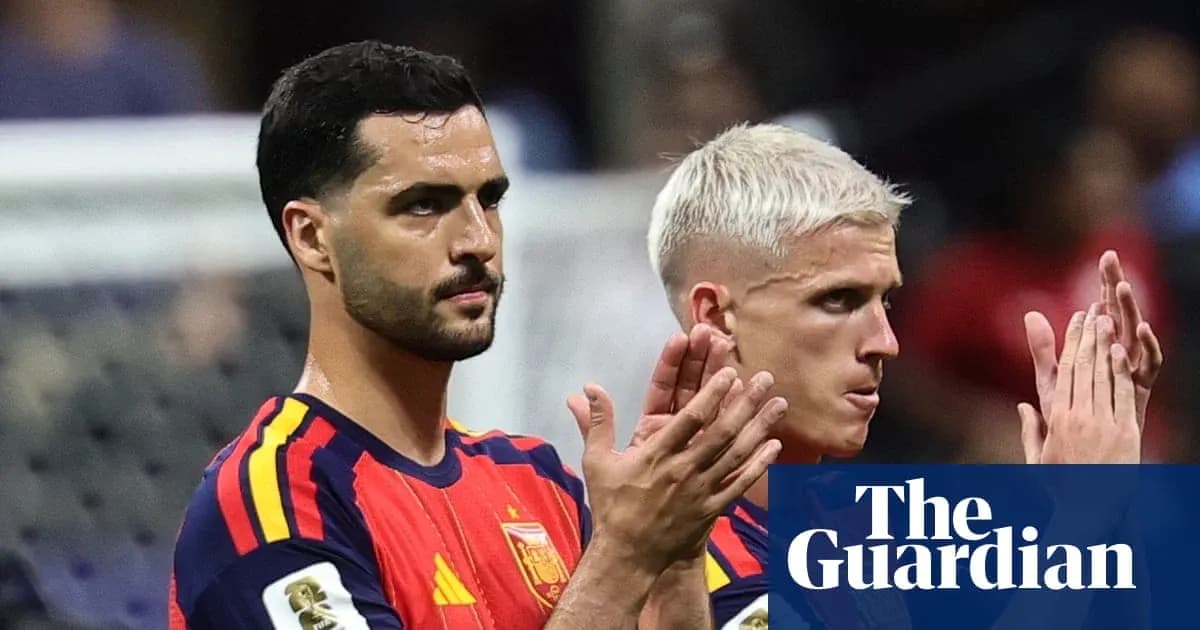
Mikel Merino on Mourning After Spain's Draw Against Cape Verde
The morning after felt heavy. Not because Spain had lost, but because it felt like they had.
A goalless draw against Cape Verde in their World Cup opener was not the script anyone in red had written in their head. The noise around them grew quickly, the questions louder than the cheers had been in Atlanta. By 11am the next day, every Spain player was back out on the grass at their Tennessee base.
Every player except one.
Mikel Merino, still in training kit but away from the drills, walked into the press room instead. Seven long desks of reporters waited for him, the hum of criticism and concern already thick in the air. If there was going to be an inquisition, he would stand in the dock.
“Mourning” after a draw
“The mourning after isn’t always easy,” Merino said. He spelled it out: mourning with a “u”. No one had died. No trophy had slipped through their fingers. It was a 0-0 in the first group game. On paper, nothing catastrophic.
On the inside, it felt different.
“Like every game that doesn’t go as you’d like, every player lives with that mourning,” he explained. Some players want to rewatch the match immediately, relive every decision, every miscontrol, every missed run. Others need to disconnect, talk about anything but football, pretend the game didn’t exist for a few hours. “You have to swallow the disappointment. We have to recover as soon as we can.”
He spoke with the clarity of someone who has already done the replay in his own head. Luis de la Fuente’s mantra echoed in his words: be better tomorrow, even when you win. After a setback, that demand becomes sharper, almost urgent.
Merino doesn’t see himself as the type to send messages to fans on social media. “I think the best message is the next game, turning it around with a win,” he said. The only reply that counts comes with a whistle and a scoreboard.
Family, ego and the reality of the selección
Yet there were messages in everything he said. Messages about the group, about how they plan to live with this stumble.
“It is easy to talk of ‘family’ but when things don’t go well, when they are difficult, is when you truly see that ‘family’ – and I see unity, enthusiasm and a will to play well,” Merino insisted.
He talked openly about ego, that dirty word that every elite dressing room actually needs. “It is important to have ego; as a footballer, with all the criticism from outside you need it to feel good on the pitch.” You need to believe you belong. You need to believe you’re the one who should be playing.
But there’s a line. “You also need the humility to know that this belongs to everyone. Players come to the national team because they are important [at their clubs] and find a new reality where only a few can play.”
That is where the word “family” gets tested. Not in the easy wins, but in the quiet fury of the ones left on the bench, in the silence of the forward who missed the chance, in the defender who knows his mistake triggered the storm.
“We have to be united, support each other in every moment. You can be annoyed, angry, but that energy has to be positive.”
Living with the “circus”
His metaphor of mourning was quickly seized upon. Was it too strong? Too dramatic for a draw?
“Maybe I didn’t express myself well,” Merino replied, then circled back to the same word. He knew exactly what he meant. “It was an attempt at a metaphor, a comparison. You’re so competitive that when it doesn’t go well, sometimes you go home and don’t even want to talk to your family. That’s why I say it’s like a mourning. Everyone deals with it differently.”
For him, the way through is straight ahead. “I like to face it and watch [games back] as soon as possible but that doesn’t mean it’s the best approach for everyone.”
The problem this time is that there is no game “straight away”. The expanded World Cup means gaps in the calendar, long days between fixtures. More time to train, yes, but also more time to think. To stew. To scroll.
“What you want after a bad game is to play again straight away to get the bad taste out of your mouth,” he said. Instead, they have six long days in Tennessee. “The risk is you have lots of time to go over it; it’s a mental challenge to deal with that, evade all that and be as free as you can mentally.”
And all of it unfolds in public. Every touch replayed. Every expression clipped. Every word dissected.
“That’s a reality; it’s part of the business, the reason we earn what we earn, why football is so big, so important: because you’re here to cover it, to create stories through which we explain things to fans,” Merino said, looking out at the room. “There are players who like it more, or like it less, but it’s part of the ‘circus’ and we have to accept it and live with it.”
He has learned, with time, not to drown in it. “I’m one of those that finds it hard to swallow a bad result but with time I’ve realised that it is best to [confront it] and start trying to turn it around as soon as possible. Four, five hours and you realise that this [World Cup] has just started, that there is time to fix it.”
Then the focus shifts outward, to the people around him. “Then you can focus on the group, on what helps them. Put a hand on the shoulder of whoever is hurt because they didn’t play, or missed a chance. Or know who needs space for that mourning.”
Echoes of 2010 and a reset
For all the angst, there was a small mercy. Saudi Arabia and Uruguay drew as well. The group, briefly skewed by Spain’s stalemate, seemed to level out again.
Merino admitted the relief. It felt, in his words, like they “start over”.
“I like to see the positive side,” he said. The history is there for anyone who wants it. “The last world champion started by losing to Saudi Arabia. In 2010 Spain lost the first game and there was lots of criticism and they turned it around; that is an example to follow from people who were idols.”
Back then, he was 14, watching a team that would define an era. “I often take inspiration from athletes who have lived my dreams before I did. That generation means so much for this one: we want to emulate them.”
Spain are not in crisis. Not yet. They are a heavyweight who fluffed their first combination, a contender who walked back to the corner to find more questions than answers waiting.
The mourning, as Merino calls it, has already begun. The only thing that matters now is what this “family” looks like when it ends.
Related News

Raphinha’s Hat-Trick Powers Barcelona to 7-2 Victory Over Racing Santander
Carabao Cup Fourth Round Draw: Liverpool Set to Clash with Chelsea, Arsenal to Face Fleetwood Town
Key Football Matches to Watch in Azerbaijan This Autumn
Raphinha's Hat-Trick Drives Barcelona to 7-2 Triumph Over Racing Santander
Hansi Flick Leads Barcelona to Record-Breaking Seven Wins in a Row
Gavi Reflects on Injury Return as Barcelona Dominate Racing Santander 7-2