
Mexico's Tactical Mastery in 2-0 Win Over South Africa
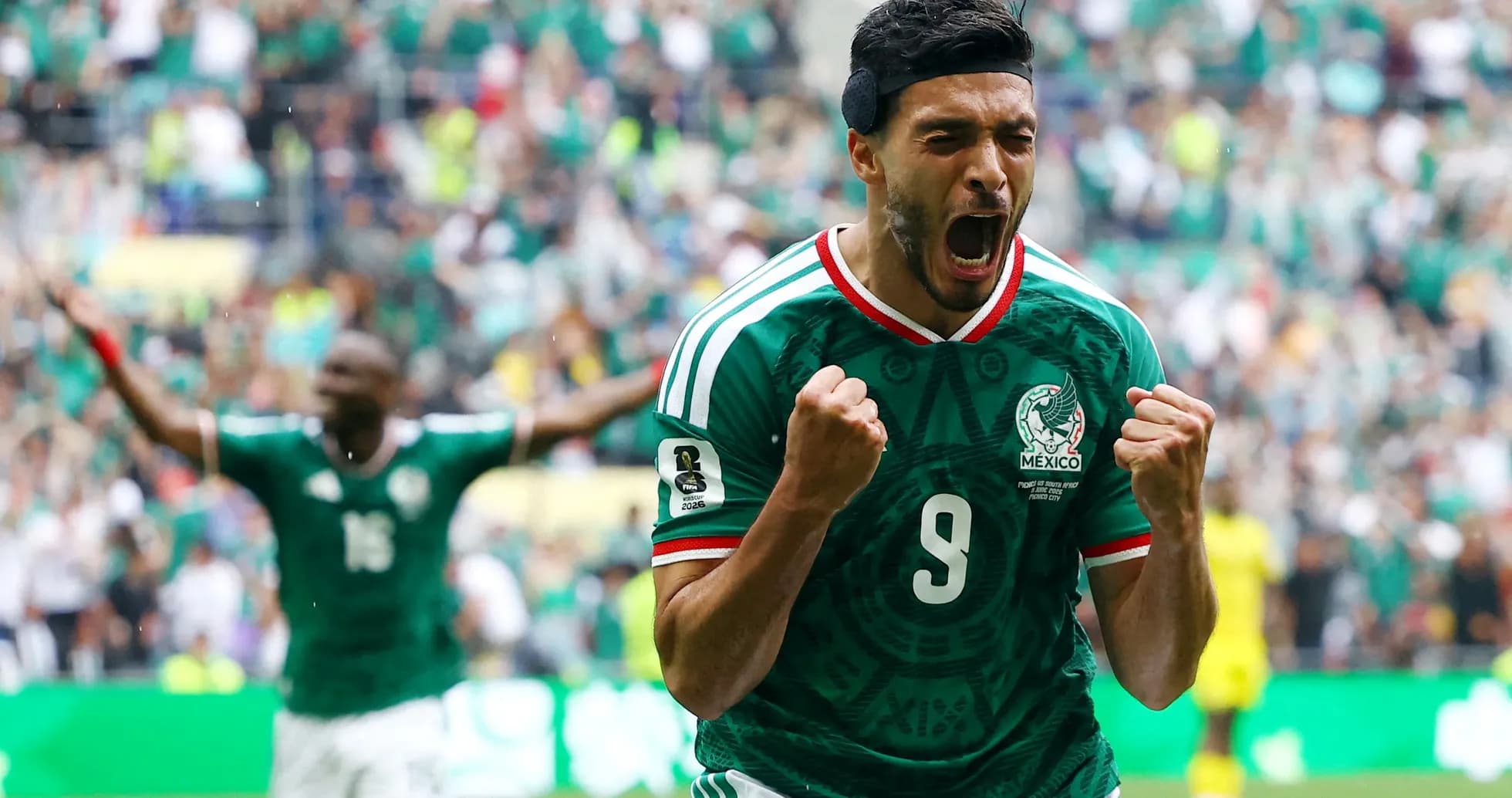
Mexico’s 2-0 win over South Africa at Estadio Azteca was a tactical demonstration of control, structure and game-state management, built on a clear contrast of approaches: Mexico’s 4-1-4-1 positional dominance against South Africa’s deep 5-3-2, which increasingly became survival mode once reduced to nine men.
Mexico’s 4-1-4-1, with Erik Lira as the single pivot, was designed to monopolise the ball and pin South Africa back. The numbers reflect that plan: 61% possession, 520 passes with 467 accurate (90%). Lira’s positioning between the centre-backs and just ahead of them allowed Mexico to create a 3v2 against South Africa’s front pair of Iqraam Rayners and Lyle Foster, quickly bypassing the first line of pressure. Full-backs Jesús Gallardo and Israel Reyes pushed high and wide, stretching the South African back five horizontally and creating interior lanes for Brian Gutiérrez, Roberto Alvarado and Julián Quiñones to receive between the lines.
The opening goal on 9 minutes came directly from that structure. With South Africa’s midfield three compressed centrally, Mexico circulated patiently until Lira could step into space and play forward. His assist to Quiñones was the payoff for that positional superiority: a central midfielder arriving in the half-space, attacking the last line with runners ahead and wide options pinning the wing-backs. The move was less about individual brilliance and more about the system repeatedly forcing South Africa’s block to shift, then breaking through once a seam appeared.
Out of possession, Mexico’s shape morphed into a 4-4-2/4-1-4-1 hybrid, with Raúl Jiménez leading the press and one of the advanced midfielders stepping up alongside him. The objective was to force South Africa long, and it worked: Hugo Broos’ side managed only 3 total shots, 1 inside the box, and an xG of just 0.07. The back line of César Montes and Johan Vásquez held a high starting position but rarely had to defend large spaces because the midfield screen, anchored by Lira, consistently disrupted South Africa’s build-up.
South Africa’s 5-3-2 was conservative from the outset, aiming to compress central zones and rely on transitions. With 39% possession and only 335 passes (272 accurate, 81%), their attacking plan was almost entirely dependent on quick outlets to Rayners and Foster. However, the wing-backs Khuliso Mudau and Aubrey Modiba were pinned deep by Mexico’s wide players, which meant counters rarely had the necessary width to unbalance Mexico’s rest defence. When South Africa did progress, they were typically forced into low-percentage efforts from distance, reflected in their 2 shots on goal from just 3 attempts overall and negligible xG.
The match’s tactical balance tilted further on 49 minutes when Siphephelo Sithole’s “Professional foul last man” red card left South Africa with ten men. Their 5-3-2 effectively became a 5-3-1, with one forward sacrificed in defensive work and the midfield line dropping closer to the back five. Mexico responded by increasing circulation rather than rushing attacks, prioritising control over chaos. The second goal on 67 minutes, finished by Jiménez and assisted by Alvarado, again stemmed from structured possession: rotations in the right half-space pulled a tiring, numerically inferior block out of shape, allowing Alvarado to find Jiménez in a favourable zone.
Substitutions from Javier Aguirre were tactically coherent and game-state driven. At 66 minutes, Gilberto Mora (IN) came on for Álvaro Fidalgo (OUT), refreshing the interior and maintaining the pressing intensity and passing rhythm. Simultaneously, Luis Chávez (IN) replaced Brian Gutiérrez (OUT), adding a left-footed distributor who could keep Mexico’s tempo high and threaten with switches of play. At 76 minutes, Armando González (IN) came on for Jiménez (OUT), a like-for-like centre-forward change to preserve vertical threat while managing minutes. Edson Álvarez (IN) replaced Lira (OUT) at the same moment, ensuring the single-pivot role remained secure defensively and clean in build-up. Finally, at 79 minutes, Alexis Vega (IN) came on for Quiñones (OUT), injecting fresh 1v1 threat against a deep, exhausted back line.
South Africa’s changes were more reactive and forced by the game state. At 56 minutes, Thalente Mbatha (IN) came on for Foster (OUT), a move that reduced direct running in behind but added legs in the middle and helped shield the back five. At 61 minutes, Themba Zwane (IN) replaced Jayden Adams (OUT), an attempt to introduce creativity between the lines, though the red card and lack of possession limited his influence. On 77 minutes, Oswin Appollis (IN) came on for Modiba (OUT), and Evidence Makgopa (IN) replaced Rayners (OUT), indicating a late shift towards a more direct outlet and fresh wide energy; but by then, Mexico’s control and the numerical deficit made sustained attacks unlikely.
The disciplinary events further shaped the tactical landscape. Teboho Mokoena’s early yellow card on 17 minutes for “Foul” constrained his aggression in midfield duels, while Gutiérrez’s caution on 23 minutes for “Foul” had less structural impact given Mexico’s dominance. Sithole’s dismissal fundamentally altered South Africa’s capacity to contest central spaces. Later, VAR intervened with a “Card upgrade” review on Themba Zwane at 82 minutes, culminating in his straight red card at 84 minutes for “Violent conduct”. Reduced to nine men, South Africa abandoned any realistic attacking ambition, collapsing into a compact, low block simply to limit damage. Mexico, already 2-0 up, chose to manage energy and avoid unnecessary risk rather than chase a heavier scoreline.
Even Mexico’s late setback — César Montes’ red card at 90+2 minutes for “Professional foul last man” — did not materially change the tactical story, arriving too late to alter the pattern. It did, however, briefly leave both sides with nine men and underlined how Mexico’s high line and aggressive rest defence occasionally walked a fine margin.
From a statistical perspective, Mexico’s 1.41 xG versus South Africa’s 0.07 confirms that the 2-0 scoreline was a fair reflection of chance quality. Mexico’s 16 total shots (4 on goal, 5 blocked) against South Africa’s 3, plus a 3-1 edge in corner kicks, illustrate territorial and attacking control. The foul count (Mexico 12, South Africa 11) was relatively balanced, but the card distribution was not: Mexico finished with 1 yellow and 1 red, South Africa with 2 yellows and 2 reds, a sign of how often their defenders and midfielders were forced into last-ditch or frustrated interventions inside their own half.
In goal, Raúl Rangel (Mexico) made 2 saves behind a defence that largely kept South Africa at arm’s length, while Ronwen Williams (South Africa) also recorded 2 saves but faced more sustained pressure and better-quality chances, as reflected in the xG and shot volume. The negative goals prevented figures for both sides underline that the finishing marginally outstripped the goalkeepers’ underlying shot-stopping metrics, but within a match where structure, not goalkeeping heroics, was decisive.
Overall, Mexico’s tactical framework — a controlled 4-1-4-1 with clear roles in possession and an organised press — translated directly into statistical dominance and a comfortable 2-0 result. South Africa’s 5-3-2, designed to be compact and transition-oriented, was undermined by red cards and an inability to escape territorial pressure, leaving them with minimal attacking output and a reactive, damage-limitation posture for much of the second half.
Related News

Thomas Tuchel Reflects on England's 10-Man World Cup Triumph and a Surprising Regret

Robert Moreno Takes Over as Interim South Korea Coach After World Cup Setback

Jude Bellingham Returns to Form with Real Madrid After World Cup Success

Chloe Kelly, Beth Mead & 13 Lionesses Who Must Shine in the Upcoming WSL Season for England’s 2027 World Cup Bid

Barcelona Cancels World Cup Tribute Amid Political Tensions
Messi Breaks Record for Most Penalties Taken and Missed in FIFA World Cup History