
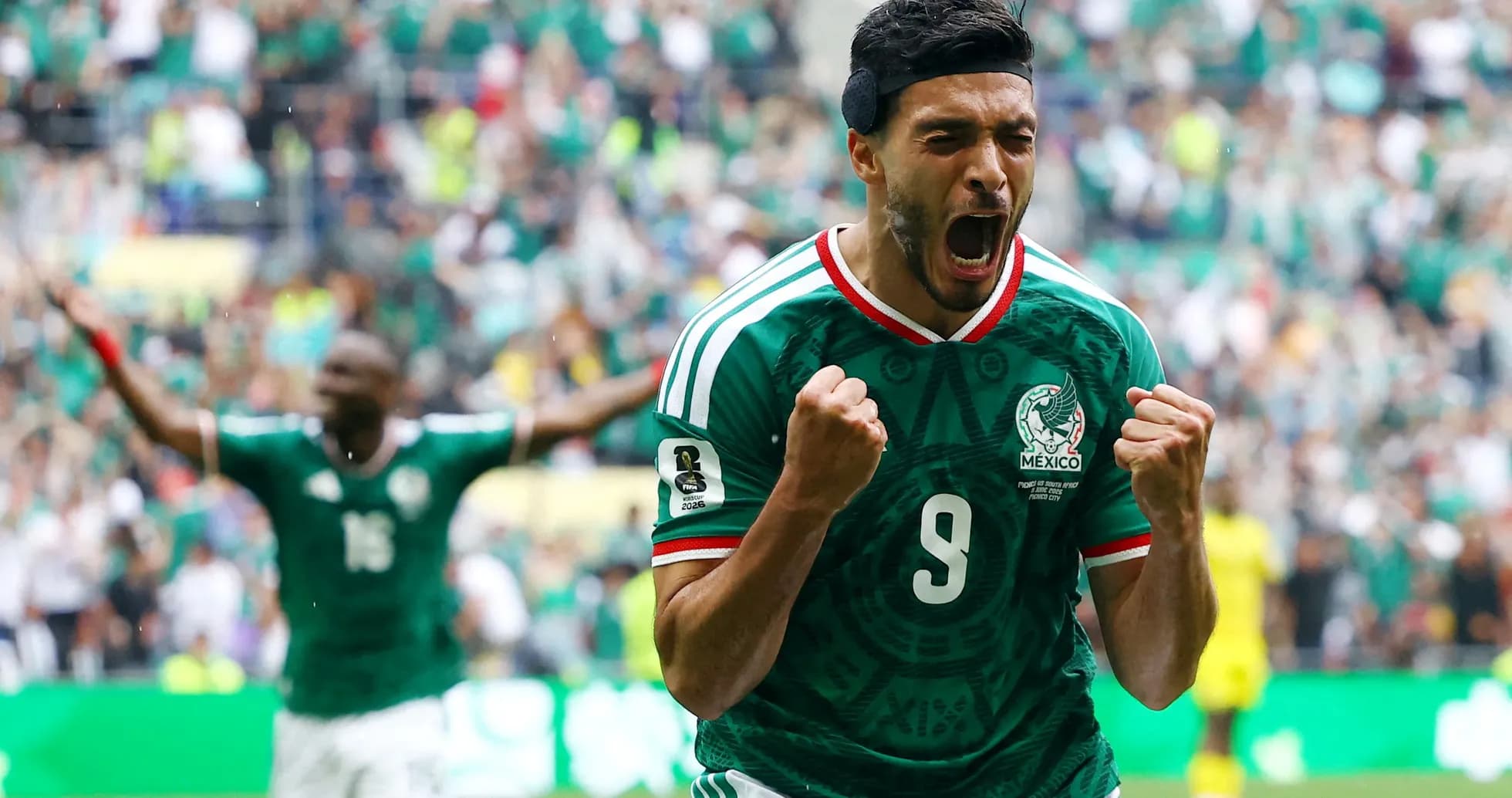
Mexico Dominates South Africa in 2026 World Cup Opener
Under the lights of Estadio Azteca, Mexico opened their 2026 World Cup campaign with a 2-0 win over South Africa that felt as much like a statement of identity as a simple three-point haul. Following this result, Mexico sit top of Group A with 3 points and a goal difference of 2, while South Africa are bottom with 0 points and a goal difference of -2. Across the tournament so far, Mexico have played 1 fixture in total, winning that single home game 2-0 and keeping a clean sheet; South Africa have played 1 away fixture in total and conceded 2 goals without scoring.
I. The Big Picture – Structure and Intent
Mexico’s 4-1-4-1 under Javier Aguirre looked purpose-built for a home World Cup: aggressive, technically secure, and with enough vertical threat to stretch any deep block. R. Rangel started in goal behind a back four of I. Reyes, C. Montes, J. Vasquez and J. Gallardo. In front of them, É. Lira anchored as the lone pivot, with a fluid band of four – R. Alvarado, B. Gutiérrez, A. Fidalgo and J. Quiñones – rotating around central striker R. Jiménez.
South Africa answered with a conservative 5-3-2 under Hugo Broos. R. Williams was protected by a back five of K. Mudau, N. Sibisi, I. Okon, M. Mbokazi and A. Modiba. The midfield trio of T. Mokoena, Y. Sithole and J. Adams sat relatively deep behind forwards I. Rayners and L. Foster, the idea clearly to compress central spaces and break in transition.
Over 90 minutes, the contrast in ambition was stark. Mexico’s overall goals-for average in total stands at 2.0 and goals-against at 0.0 after this match, a neat statistical mirror of their dominance. South Africa’s overall goals-for average in total is 0.0 and goals-against 2.0, underlining how often they were forced to absorb pressure.
II. Tactical Voids – Discipline and Depth
There were no pre-game absences flagged for either side, so the “voids” emerged from what happened on the pitch. For Mexico, the main concern is disciplinary rather than structural: their card profile this tournament already shows 1 yellow card in the 16-30 minute window (100.00% of their yellows so far) and 1 red card in the 91-105 minute window (100.00% of their reds). C. Montes is the headline here: he finished the match with a red card on his record in the wider tournament statistics, an early warning that Mexico’s aggression at the back can spill over.
South Africa’s disciplinary picture is more alarming. Their yellow cards so far are split evenly: 1 in the 16-30 minute range (50.00%) and 1 in the 61-75 range (50.00%). But it is the reds that reshape their tactical future: 1 red between 46-60 minutes (50.00%) and another between 76-90 (50.00%). Those belong to S. Sithole and T. Zwane respectively, both central figures in their midfield rotation. Sithole’s profile is particularly striking: in 49 minutes he committed 3 fouls, blocked 2 shots and made 1 interception before seeing red. Zwane’s dismissal after 23 minutes on the pitch further thinned an already under-pressure engine room.
These expulsions mean that, heading into the next group fixtures, South Africa’s midfield balance is compromised. Sithole had been their most combative presence between the lines, while Zwane is one of the few with the guile to link play. Mexico, by contrast, can rotate into depth: E. Álvarez, L. Chávez, G. Mora, A. Vega and A. González all logged minutes off the bench, showing Aguirre has options to manage load and game states.
III. Key Matchups – Hunter vs Shield, Engine Room vs Enforcer
Hunter vs Shield
The leading “hunter” in this story is R. Jiménez. In total this campaign he has 1 goal from 3 shots, 2 of them on target, with 19 passes at 78% accuracy and 2 key passes. He is not just a finisher but a reference point, winning 6 of 10 duels and dropping in to connect with midfield. Alongside him, J. Quiñones has emerged as a co-protagonist: 1 goal from 4 shots, 2 on target, 33 passes at 84% accuracy, 2 key passes and an outstanding 5 successful dribbles from 6 attempts. Together, they form a dual threat that can hurt in the box and between the lines.
Their “shield” was South Africa’s back five, with N. Sibisi at its heart. Sibisi completed 50 passes at 82% accuracy and made 1 interception, but was booked and often left defending large spaces as the wing-backs were pinned back by Alvarado and Quiñones. The statistics underline the imbalance: South Africa have yet to keep a clean sheet in total, and their biggest defeat away is already 2-0. Mexico’s biggest home win is that same 2-0, and they have 1 clean sheet in total from 1 match.
Heading into the remaining group games, the matchup tilts heavily toward Mexico’s forwards. Jiménez’s aerial presence and Quiñones’s 10 total duels (7 won) will test any back line that cannot compress space as effectively as South Africa tried – and ultimately failed – to do.
Engine Room – Playmaker vs Enforcer
In midfield, the contest was decided by control. For Mexico, É. Lira was the quiet conductor. Across the tournament he has 45 passes at 93% accuracy, 1 assist, 1 key pass, 1 tackle and 1 interception, winning all 4 of his duels in the top scorers data and all 5 in the top assists data. He is both shield and distributor, the hinge that allows the front four to play high.
Beside him, R. Alvarado was the two-way engine. With 35 passes at 91% accuracy, 2 key passes, 1 assist, 4–5 tackles depending on the statistical cut, and 8–9 duels won from 13–14, he knitted together right half-space and touchline, tracking back to help I. Reyes and surging forward to overload A. Modiba’s flank.
South Africa’s answer was T. Mokoena. He completed 42 passes at 92% accuracy, added 1 key pass and won 4 of 7 duels, but his yellow card and the lack of support once Sithole departed meant he was firefighting rather than dictating. Sithole’s 8 duels (1 won) and 3 fouls committed tell the story of a player overrun and overcommitted before his red card.
IV. Statistical Prognosis – Trajectories from xG Logic
The raw xG numbers are not provided, but the patterns are clear from the available metrics. Mexico’s total goals-for average of 2.0 and goals-against average of 0.0, combined with 1 clean sheet in total and no failed-to-score matches, describe a side turning territorial dominance into tangible returns. Their main creators – Lira, Alvarado, Quiñones and Jiménez – all post high pass accuracy and multiple key passes, suggesting a steady stream of high-quality final-third actions rather than speculative efforts.
South Africa, by contrast, have a total goals-for average of 0.0, have failed to score in their only match, and have conceded 2.0 goals on their travels on average. Their defensive line is not collapsing – Sibisi, Mokoena and Okon all show solid passing numbers – but the weight of pressure, combined with poor discipline, is likely inflating opponents’ xG against them.
Projecting forward, Mexico’s tactical profile is that of a side with a stable base (Lira, Montes, Vasquez), dynamic wide engines (Alvarado, Quiñones) and a central reference (Jiménez) capable of sustaining a 1.5–2.0 xG output per game against most opposition. South Africa’s current blend points to a lower offensive xG, reliant on sporadic transitions from Foster, Rayners, and later substitutes like E. Makgopa and O. Appollis, who did inject duels and work rate but not end product.
Following this result, the prognosis is clear: Mexico look built for a deep run, with structure, depth and numbers to back their ambition. South Africa, meanwhile, must repair their discipline and re-balance a midfield shorn of Sithole and Zwane if they are to turn honest defensive work into anything more than damage limitation in the remaining group fixtures.
Related News

Thomas Tuchel Reflects on England's 10-Man World Cup Triumph and a Surprising Regret

Robert Moreno Takes Over as Interim South Korea Coach After World Cup Setback

Jude Bellingham Returns to Form with Real Madrid After World Cup Success

Chloe Kelly, Beth Mead & 13 Lionesses Who Must Shine in the Upcoming WSL Season for England’s 2027 World Cup Bid
Barcelona Cancels World Cup Tribute Amid Political Tensions
Messi Breaks Record for Most Penalties Taken and Missed in FIFA World Cup History