
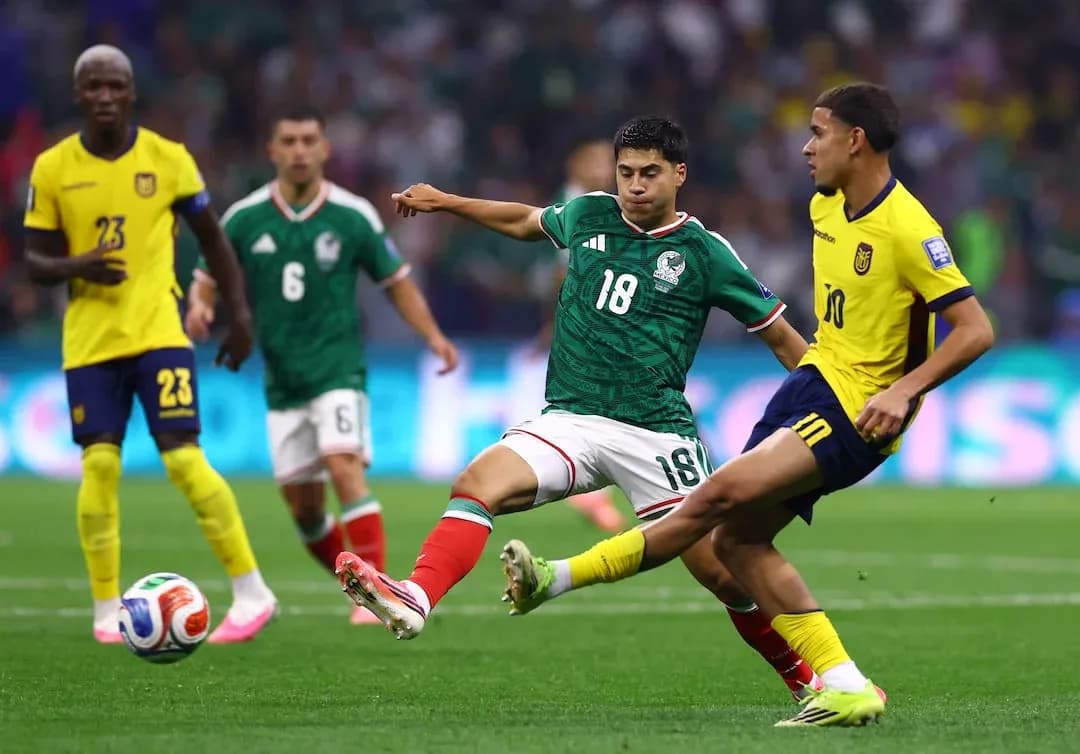
Mexico Dominates Ecuador 2-0 in Round of 32
Under the Mexico City lights at Estadio Banorte, the Round of 32 became a statement of intent. Mexico, the group winners from Group A, arrived with a perfect record and a defensive record untouched by a single goal. Ecuador, third in Group E but hardened by a mixed group campaign, came in as a dangerous underdog. Ninety minutes later, the scoreboard read 2–0 to Mexico, the full-time verdict matching the half-time margin, and confirming what the numbers had been hinting at all tournament: this Mexico side is built on control, structure and a ruthless efficiency in both boxes.
Mexico’s Seasonal DNA
Heading into this game, Mexico’s seasonal DNA was clear. Overall, they had played 4 matches, winning all 4, with 8 goals scored and none conceded. At home, they had played 3 fixtures, winning all 3, scoring 5 and conceding 0; on their travels, they had added 1 away win with 3 goals for and 0 against. The goal difference overall stood at +8, every minute of football reinforcing the idea of a team that doesn’t just attack, but suffocates games. Their most common blueprint was the 4-3-3, used 3 times before this tie, and Javier Aguirre doubled down on that identity again.
Ecuador’s Fragile Picture
Ecuador’s numbers painted a different, more fragile picture. Overall, they had played 4 matches, with 1 win, 1 draw and 2 defeats. At home they had been competitive, with 2 goals for and just 1 against, but on their travels they had failed to score in 2 away games and conceded 3. Their total goal difference sat at -2, with 2 goals scored and 4 conceded. The 4-4-2 had been their go-to structure, used in 3 of their 4 outings, and Sebastian Beccacece stuck with that shape here, hoping its compactness could smother Mexico’s fluid front line.
Tactical Plans
There were no reported absences to bend the tactical plans out of shape, so both coaches could lean into their strongest identities. For Mexico, that meant a back four of J. Gallardo, J. Vasquez, C. Montes and J. Sanchez in front of R. Rangel, with a midfield triangle of L. Romo, E. Lira and G. Mora tasked with controlling rhythm and counter-pressing. Up front, a dynamic trio of R. Alvarado, R. Jimenez and J. Quinones carried the attacking burden.
Ecuador’s defensive block was anchored by P. Hincapié and J. Ordonez centrally, flanked by P. Hincapié on the left and A. Franco on the right, with H. Galindez in goal. In front of them, a four-man midfield of N. Angulo, P. Vite, M. Caicedo and J. Yeboah was built to compress space, with G. Plata and E. Valencia as the twin threats in transition.
Disciplinary Subtext
The disciplinary subtext added an edge to the tactical chessboard. Mexico, across the tournament, had shown a relatively clean record but with a notable late-game flashpoint: their only red card had come in the 91–105 minute window, a reminder that their aggression can boil over in the closing stages. Ecuador’s profile was even more combustible. Their yellow cards were spread across the middle and late phases, with 25.00% of their cautions arriving between 31–45 minutes, another 25.00% between 46–60, and a further 25.00% from 91–105. They also carried a red card in that 91–105 band. With defenders like A. Franco (2 yellows, 7 fouls committed) and P. Hincapié (1 yellow, 1 red) already on disciplinary radars, Mexico’s wide players knew that persistent pressure on the flanks could force mistakes.
Quinones vs Ecuador’s Back Line
The “Hunter vs Shield” duel was embodied by J. Quinones against Ecuador’s back line. Quinones came into this knockout tie as one of the World Cup’s standout attackers: 3 goals and 1 assist in total, with 9 shots (5 on target), 106 passes at 80% accuracy and 6 successful dribbles from 8 attempts. Operating nominally from the left of the front three, his tendency to drift inside into the half-spaces asked constant questions of A. Franco and J. Ordonez. Franco’s defensive numbers — 8 tackles, 1 blocked shot, 4 interceptions, and 96% passing — show a player capable of reading danger, but his disciplinary record hinted at the risk: 2 yellows and a willingness to commit fouls to halt momentum.
Mexico’s Engine Room
Behind Quinones, Mexico’s “engine room” was defined by the interplay between R. Alvarado and the central trio. Alvarado entered the match as the competition’s leading creator for Mexico, with 3 assists, 10 key passes and 140 completed passes at 82% accuracy. From the right side of the 4-3-3, he floated inside to form overloads with L. Romo and G. Mora, dragging Ecuador’s midfield four out of shape. Opposite him, M. Caicedo was the Ecuadorian enforcer, the one tasked with snapping into duels and screening the back four. The contest between Alvarado’s subtle movements and Caicedo’s capacity to close space was central to whether Ecuador could keep their lines compact.
Mexico’s Defensive Shield
In defence, Mexico’s shield was uncompromising. Across the tournament, they had kept 4 clean sheets in 4 matches, with 3 at home and 1 away. C. Montes, who had already blocked 1 shot and made 1 interception while winning 13 of 23 duels, set the tone at the heart of the back line. His presence alongside J. Vasquez allowed the full-backs, especially Gallardo, to push on and pin back Ecuador’s wide midfielders, limiting the service into E. Valencia and G. Plata.
Ecuador’s own defensive leaders were under siege. P. Hincapié, with 12 tackles, 2 blocked shots and 4 interceptions in the tournament, is usually a proactive defender stepping out of the line to engage. But against a Mexico side averaging 2.0 goals per game overall, with 1.7 at home, his timing had to be perfect. Any mistimed challenge risked not only a card, given his 1 yellow and 1 red already, but also a set-piece situation where Mexico’s aerial strength could be decisive.
Statistical Prognosis
Statistically, the prognosis always leaned Mexico’s way. They arrived with an overall record of 4 wins from 4, 8 scored and 0 conceded, and a biggest away win of 0–3 underlining their threat in transition as well as in positional play. Ecuador, by contrast, had failed to score in 3 of their 4 matches overall and had not found the net in either away game, while conceding 1.5 goals per away match on average. Their only clean sheet had come at home; on neutral or away turf, their structure had been more porous.
Conclusion
In a knockout context, where margins tighten and nerves fray, the combination of Mexico’s impeccable defensive record, their dual creative and scoring threats in Alvarado and Quinones, and Ecuador’s disciplinary vulnerability tilted the balance. The 2–0 scoreline at full time did more than send Mexico into the next round; it confirmed that their statistical dominance was no illusion. In a World Cup where some favourites have wobbled, Mexico’s blend of tactical clarity, disciplined aggression and individual quality looks built to travel deep into the tournament.
Related News

Thomas Tuchel Reflects on England's 10-Man World Cup Triumph and a Surprising Regret

Robert Moreno Takes Over as Interim South Korea Coach After World Cup Setback

Jude Bellingham Returns to Form with Real Madrid After World Cup Success

Chloe Kelly, Beth Mead & 13 Lionesses Who Must Shine in the Upcoming WSL Season for England’s 2027 World Cup Bid
Barcelona Cancels World Cup Tribute Amid Political Tensions
Messi Breaks Record for Most Penalties Taken and Missed in FIFA World Cup History