
Mexico's Tactical Triumph: 2-0 Victory Over Ecuador in World Cup
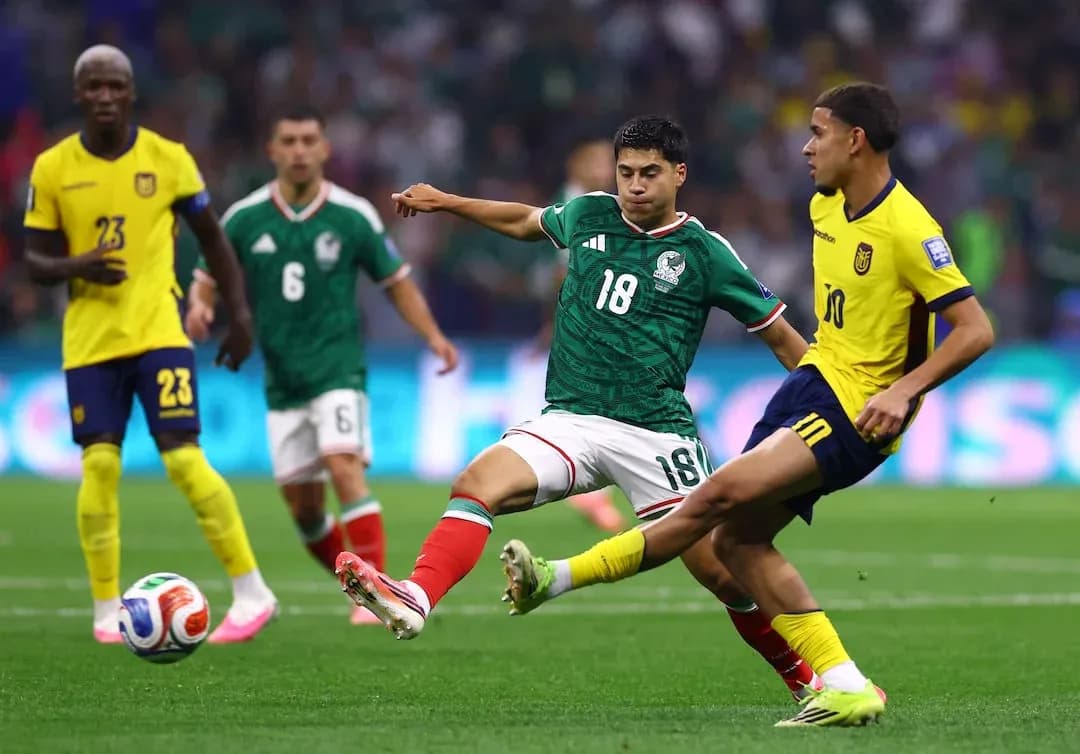
Mexico’s 2-0 win over Ecuador at Estadio Banorte in this World Cup Round of 32 tie was a classic case of early attacking clarity beating territorial dominance. Javier Aguirre’s Mexico imposed their 4-3-3 structure aggressively in the first half, struck twice in nine minutes, and then managed the game with controlled risk. Sebastian Beccacece’s Ecuador, in a 4-4-2 that morphed into a front-foot 4-2-4 in possession, had more of the ball (57% possession) but rarely converted that into clean looks, finishing with just one shot on goal and an xG of 0.73.
I. Executive Summary
Mexico’s approach hinged on verticality and direct combinations between the front three, accepting a possession deficit (43%) in exchange for higher shot volume and better chance quality. Fifteen total shots, ten from inside the box, underline how effectively they attacked Ecuador’s central channels and half-spaces. Ecuador’s plan to control the tempo through Moisés Caicedo and Pedro Vite produced territorial superiority and 407 passes at 84% accuracy, but their final-third patterns were predictable and well-contained by Mexico’s compact back four and industrious midfield screen.
II. Scoring Sequence & Disciplinary Log
The breakthrough came on 22 minutes: Julián Quiñones drifted in from the left, combining with Roberto Alvarado before finishing a well-constructed move for 1-0. The pattern encapsulated Mexico’s early strategy—quick switches to isolate full-backs, then direct penetration into the box. On 31 minutes, the roles reversed. Quiñones again attacked the left half-space and this time fed Raúl Jiménez, whose movement between the centre-backs created just enough separation to slot home for 2-0. With Mexico already at 10 shots by the break and leading 2-0 at half-time, the scoreboard matched their incisiveness.
Ecuador’s frustration began to surface right before the interval. At 45+1', Alan Franco collected a yellow card for “Tripping,” an early sign of the increasing strain on Ecuador’s defensive line as they tried to defend higher and more aggressively. The second half brought a flurry of substitutions aimed at changing the game’s rhythm, but the disciplinary story intensified in added time. At 90+3', Kendry Páez was booked for “Tripping” as Ecuador chased lost causes in midfield. Two minutes later, at 90+5', Piero Hincapié received a straight red card for “Unsportsmanlike conduct,” reducing Ecuador to ten and effectively ending any faint comeback hopes. Finally, at 90+9', Moisés Caicedo was shown a yellow card, again for “Tripping,” completing a disciplinary tally of three yellow cards and one red for Ecuador, with Mexico finishing without a card.
III. Tactical Breakdown & Personnel
Mexico’s 4-3-3 was built on a solid central spine and clear roles. Erik Lira operated as the primary pivot, with Gilberto Mora and Luis Romo as shuttlers, stepping out to press Ecuador’s double pivot and blocking vertical lanes into Enner Valencia. This allowed the back four—Jorge Sánchez, César Montes, Johan Vásquez, and Jesús Gallardo—to hold a relatively conservative line, compressing space between the lines and forcing Ecuador wide. The defensive block was designed to concede harmless possession in front of them, reflected in Ecuador’s higher pass count, while protecting the box; only five of Ecuador’s seven shots came from inside the area, and just one tested Raúl Rangel.
In goal, Raúl Rangel (Mexico) had a quiet but focused evening, officially making 1 save. The low save count is a testament to the defensive structure in front of him: Mexico allowed only one shot on target despite Ecuador’s territorial edge. By contrast, Hernán Galíndez (Ecuador) also recorded 1 save, but faced far more threatening situations. Mexico’s 15 shots and xG of 1.02 show that their best chances were often finished rather than saved, particularly the two first-half goals where the finishing and movement outstripped Ecuador’s last line.
The front three were central to Mexico’s tactical success. Quiñones, starting nominally on the left, repeatedly attacked the channel between right-back Alan Franco and right centre-back Joel Ordóñez. Alvarado, from the right, balanced between wide occupation and interior support, linking with Romo and Sánchez to create overloads. Jiménez acted as a classic reference nine, pinning centre-backs and opening lanes for underlaps and cutbacks. Their interplay is reflected in the direct goal involvement: Quiñones scoring the opener from an Alvarado assist, then assisting Jiménez for the second.
Aguirre’s substitutions on 58, 73, 74 and 80 minutes were clearly aimed at energy management and preserving structural integrity. Brian Gutiérrez (IN) came on for Gilberto Mora (OUT) to refresh the midfield press, Obed Vargas (IN) replaced Luis Romo (OUT) to maintain legs in the engine room, while Santiago Giménez (IN) for Raúl Jiménez (OUT) and Orbelín Pineda (IN) for Julián Quiñones (OUT) allowed Mexico to keep a vertical threat in transition without overtaxing starters. Israel Reyes (IN) for Roberto Alvarado (OUT) at 80' further solidified the right side as Mexico shifted subtly towards a more conservative 4-4-2 out of possession.
Ecuador’s 4-4-2, with John Yeboah and Nilson Angulo wide and Gonzalo Plata partnering Enner Valencia, struggled to disorganize Mexico centrally. Moisés Caicedo and Pedro Vite saw a lot of the ball but were often forced sideways. Beccacece’s triple substitution phase—Yaimar Medina (IN) for Alan Franco (OUT) and Ángelo Preciado (IN) for Joel Ordóñez (OUT) at 46', then Kevin Rodriguez (IN) for Enner Valencia (OUT) at 59', and later Jordy Caicedo (IN) for John Yeboah (OUT) and Kendry Páez (IN) for Nilson Angulo (OUT) at 79'—was an attempt to inject width, crossing threat and fresh pressing energy. However, Mexico’s compactness and control of central spaces meant Ecuador’s attacks became increasingly reliant on hopeful deliveries and second balls, which the Mexican centre-backs dealt with calmly.
IV. The Statistical Verdict
The numbers reinforce the tactical story. Ecuador led possession 57–43 and completed more passes (407 to Mexico’s 319) with higher accuracy (84% to 78%), indicating they dictated the tempo for long stretches. Yet Mexico translated their smaller share of the ball into higher attacking output: 15 total shots to 7, 10 from inside the box versus Ecuador’s 5, and a 3–1 edge in shots on goal. Mexico’s xG of 1.02 against Ecuador’s 0.73 suggests a marginal edge in chance quality, but the timing and execution of their two first-half strikes were decisive.
Defensively, Mexico committed fewer fouls (10 to 14) and avoided any bookings, reflecting controlled aggression and good positional play. Ecuador’s three yellow cards and one red card, all in moments of “Tripping” or “Unsportsmanlike conduct,” underline a side increasingly stretched and reactive as they chased the game. Corner counts (8 for Ecuador, 3 for Mexico) show Ecuador’s territorial presence, but Mexico’s ability to defend their box and limit clear looks made those set pieces largely sterile.
In sum, Mexico’s 2-0 victory was less about volume of possession and more about structure, clarity in attacking patterns, and game management once ahead. Ecuador’s control of the ball never translated into sustained threat, and their late disciplinary collapse mirrored a tactical plan that ran out of solutions against a compact, well-drilled Mexican side.
Related News

Thomas Tuchel Reflects on England's 10-Man World Cup Triumph and a Surprising Regret
Robert Moreno Takes Over as Interim South Korea Coach After World Cup Setback

Jude Bellingham Returns to Form with Real Madrid After World Cup Success

Chloe Kelly, Beth Mead & 13 Lionesses Who Must Shine in the Upcoming WSL Season for England’s 2027 World Cup Bid
Barcelona Cancels World Cup Tribute Amid Political Tensions
Messi Breaks Record for Most Penalties Taken and Missed in FIFA World Cup History