
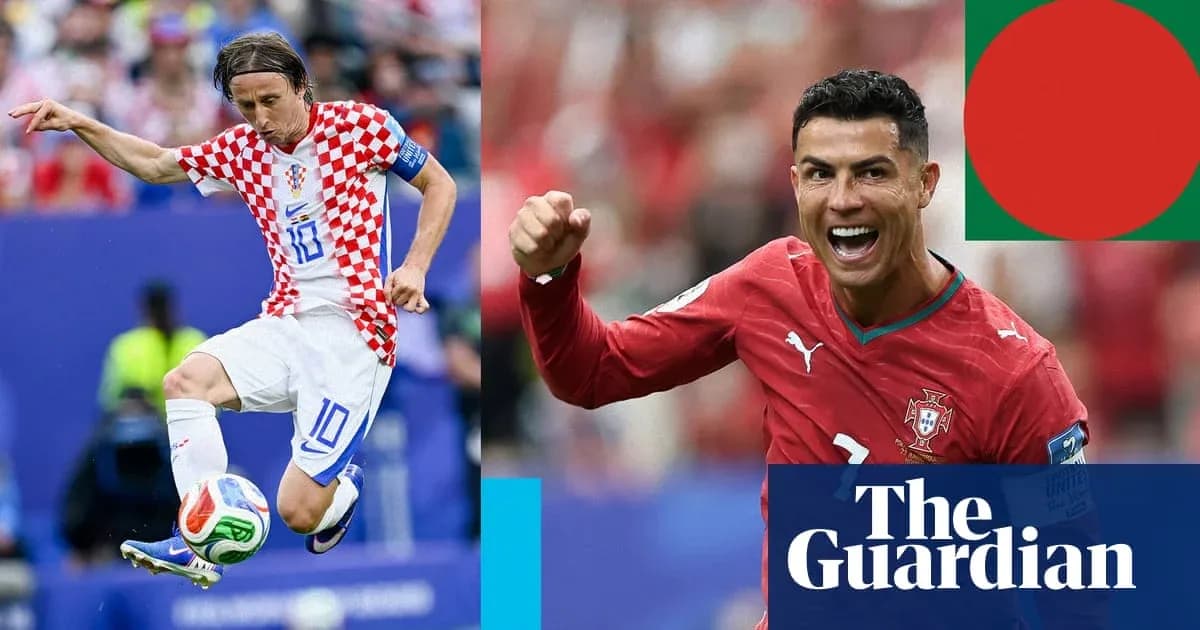
Luka Modric and Cristiano Ronaldo: A Legacy of Longevity in Football
Can you remember what you were doing on 1 March 2006?
Some were at Anfield, watching England edge Uruguay 2-1. Others saw Switzerland put three past Scotland at Hampden Park. On the same night in Basel, a slight, long‑haired midfielder pulled on the Croatia shirt for the first time and quietly began one of the great international careers. Luka Modric debuted as Croatia beat Argentina 3-2, a game that also delivered Lionel Messi’s first goal for his country.
In Riyadh, Cristiano Ronaldo scored twice in a 3-0 Portugal win over Saudi Arabia, already dreaming big, but with no idea that one day he would live and work there.
Messi and Ronaldo have dominated the conversation ever since. The goals, the Ballons d’Or, the endless debate over who stands tallest. Through it all, Modric has been there as well – less noisy, less obsessed over, but relentlessly present. A metronome rather than a megaphone. Passing more than scoring, shaping games more than headlines, yet staying at the same rarefied height.
They now belong to a tiny club. Only four men in history have reached 200 or more international caps. Ronaldo, Modric and Messi are three of them. The fourth? That one’s for the football obsessives.
This week, two of that group step out again. Ronaldo, now 41, and Modric, 40, are set for their 232nd and 202nd caps respectively when Portugal face Croatia in the last 32 of the World Cup. It might be the last time these giants of 21st‑century football share a pitch, their careers finally drifting apart after years of collision and collaboration.
Their loyalty to the national shirt is striking. When Modric made his Croatia debut that night in 2006, Ronaldo already had 29 caps. Two decades on, the gap has grown by just one. They have kept answering the phone when their countries called, season after season, tournament after tournament, their international journeys running almost in parallel.
Their paths first crossed in England in 2008-09. Modric, the new playmaker at Tottenham, and Ronaldo, the reigning superstar at Manchester United, both played the full 120 minutes of the Carling Cup final at Wembley. Both were given a 7 in the ratings. United won on penalties, a familiar outcome in that era, but it was an early glimpse of a rivalry that would soon move to a grander stage.
By the quarter-finals of the 2010-11 Champions League, Ronaldo had gone to Spain and Real Madrid. Modric was still at Spurs. They met again, this time in Europe’s elite competition. Madrid went through, as they so often would in the years to come, and Modric would soon join Ronaldo in white.
From 2012, they became the heartbeat and the cutting edge of the same side. Across six seasons at Real Madrid, they formed the spine of a dynasty. Four Champions League titles together. Semi-finals in the other two campaigns. Hundreds of games in tandem, one dictating the tempo, the other delivering the kill.
If there was a single image that captured their shared peak, it came in Cardiff in 2017. Juventus were threatening a comeback in the Champions League final when Modric darted to the byline and cut the ball back. Ronaldo arrived, as he so often did, to drive Madrid 3-1 up. The goal broke Juventus’ resistance and sealed another European crown, a moment born from the understanding between the conductor and the finisher.
That was one of 222 matches they have shared on a pitch. No central midfielder has played more often alongside Ronaldo than Modric. Their numbers are staggering, their trophy hauls almost absurd, but the more telling detail is their longevity. Two decades on from that night in 2006, they are still here, still central, still defining games on the biggest stage.
Now they meet again, not as club colleagues but as national icons, each carrying the weight of a generation. The next time they walk off together, will it be the last?
Related News
Raphinha’s Hat-Trick Powers Barcelona to 7-2 Victory Over Racing Santander
Carabao Cup Fourth Round Draw: Liverpool Set to Clash with Chelsea, Arsenal to Face Fleetwood Town
Key Football Matches to Watch in Azerbaijan This Autumn
Raphinha's Hat-Trick Drives Barcelona to 7-2 Triumph Over Racing Santander
Hansi Flick Leads Barcelona to Record-Breaking Seven Wins in a Row
Gavi Reflects on Injury Return as Barcelona Dominate Racing Santander 7-2