
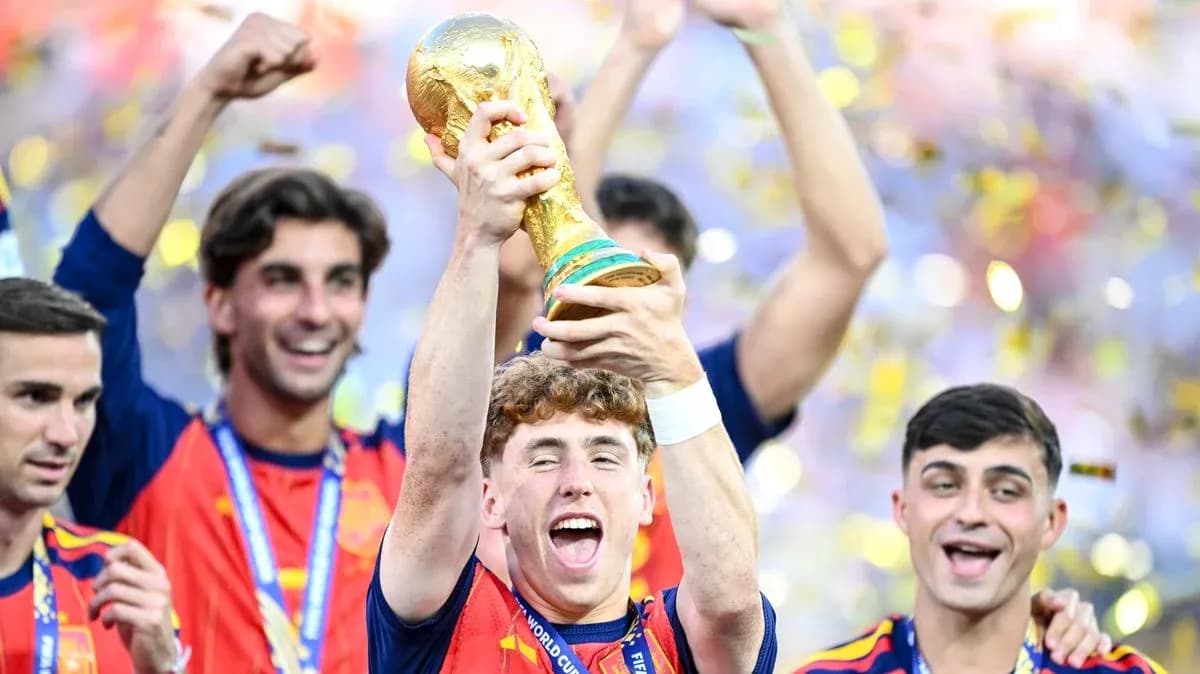
Liverpool Players at the World Cup: Champions and Rising Stars
After 104 games, a trail of flashpoints and a final that felt more fight than football, the World Cup is done. Spain stand on top of the world, Argentina are left nursing grievances and regrets, and Liverpool’s eight representatives return with medals, scars and stories that will shape Andoni Iraola’s first season at Anfield.
Two of them were guaranteed to touch the trophy. Only one actually kicked a ball.
Victor Munoz – N/A
Spain were still trying to work out how they’d drawn a blank against Cape Verde when the news broke: Liverpool had triggered Victor Munoz’s £34.5m release clause at Osasuna. The first signing of the Iraola era was heading to Anfield, and Reds supporters settled in to watch their new winger light up the World Cup.
He never got on the pitch.
Injury struck, ruled him out for a spell, and when he returned to fitness Luis de la Fuente never called his number. Munoz watched every minute of Spain’s run from the bench, right through to the moment they lifted the trophy.
No minutes, but a medal. And with it, a small slice of Liverpool history. Munoz becomes only the sixth serving Liverpool player to win the World Cup, joining Roger Hunt, Ian Callaghan, Gerry Byrne, Fernando Torres and Pepe Reina. Not a bad way to arrive at a new club, even if the Anfield crowd will have to wait to actually see him play.
Alexis Mac Allister – 7
The final will not live long in Alexis Mac Allister’s memory. Like most of his Argentina team-mates not named Lionel Messi, he struggled to find any rhythm in a turgid, bad-tempered showpiece that suited neither his touch nor his temperament.
But Argentina were there because of the work he had already done.
Mac Allister played every minute of the campaign bar the dead rubber against Jordan, when his country had already wrapped up top spot in the group. From a more advanced role than he often occupies for Liverpool, he knitted moves together, created a goal against Cape Verde and struck the opener in the quarter-final win over Switzerland.
He dragged Argentina back from the edge in the epic against England and, remarkably for a player who loves a tackle and never shirks a duel, collected only one booking in eight games. At 27, he looks like a midfielder right at his peak. Liverpool will expect him to walk straight from this form into Iraola’s system.
Alisson Becker – 7
Brazil’s aura has faded. Their goalkeeper’s has not.
Back from injury, Alisson Becker brought calm to a Brazil side that never came close to resembling their greatest vintages. His handling was clean, his positioning sharp, his decision-making exactly what you’d expect from one of the world’s premier goalkeepers.
Erling Haaland’s two goals in Brazil’s elimination at the hands of Norway said more about the defending in front of him and the ruthlessness of the striker than they did about Alisson. He had little realistic chance with either. The bigger question now sits with Liverpool: can they keep him fit for the demands of a season under a new manager who will want his keeper on the front foot, mentally and physically?
Alexander Isak – 6
For Liverpool fans, the numbers will sting a little. Alexander Isak completed three 90-minute outings in four games for Sweden. He managed precisely none for Liverpool last season.
Freed from his stop-start club campaign, he opened the tournament in style. A goal and two assists against a poor Tunisia side reminded everyone of his elegance and incision. He followed that up with another assist in the heavy win over Holland, again showing the blend of movement and technique that persuaded Liverpool to back him.
Then the returns began to dwindle. As Sweden’s level dropped, so did his influence. The sharpness of the early games gave way to frustration and heavier legs. By the time they went out, his World Cup had become a story of what it hinted at rather than what it ultimately delivered.
Cody Gakpo – 8
Cody Gakpo arrived at the World Cup with doubts hanging over him. Many Liverpool supporters had judged his first full season harshly. Too static. Not decisive enough. Not the player they thought they were getting.
For a few weeks in Holland’s orange, he looked like a man unburdened.
Ronald Koeman pushed him out to the left flank and Gakpo came alive. He ran at defenders, attacked the box and, crucially, finished. The standout performance came against Sweden, where he scored twice and laid on another, a complete display of wide-forward play: direct, ruthless, relentless.
Then came the moment that cut through the noise. In the round of 32 defeat to Morocco, Gakpo scored shortly after the deeply personal news of the loss of his unborn son emerged. It was a goal wrapped in raw emotion, a reminder that behind the tactical debates and social media verdicts, there is a human being carrying far more than form and reputation.
He leaves the tournament with credit restored and a strong case to be used on the left at Anfield.
Virgil van Dijk – 7
Virgil van Dijk’s relationship with parts of the Dutch football public remains complicated. Even here, as Holland played some of the tournament’s most entertaining football, the captain found himself under familiar scrutiny.
On the pitch, his contribution was clear. He scored in the lively draw with Japan and added an assist against Tunisia, stepping into midfield and joining attacks as Koeman’s side leaned heavily into their offensive talent.
The trade-off was obvious. Holland were built to go forward, not lock the back door. They conceded in all four of their matches and exited earlier than they believed they should. Van Dijk, as the face of the defence, absorbed a share of the criticism, even when the structure around him left gaps no centre-back could realistically plug alone.
Liverpool, though, will be more interested in the signs of authority and fitness than in the noise from home.
Ryan Gravenberch – 7
Ryan Gravenberch’s World Cup offered a glimpse of a player still being defined.
Koeman used him higher up the pitch than Iraola is likely to at Liverpool, and Gravenberch responded with a sparkling start. Two smart, incisive assists against Japan showcased his vision and ability to slide passes between lines, the kind of creative edge that has sometimes been hidden in his deeper club role.
Then the dial turned. Against Morocco he was moved back into a more defensive position, tasked with screening and recycling rather than breaking lines. He was substituted before Holland conceded the late equaliser that dragged the tie to penalties, but the game underlined the tension in his profile: destroyer or creator, holder or breaker?
That question now lands in Iraola’s in-tray.
Florian Wirtz – 6
The numbers on Florian Wirtz’s tournament look kind. Three assists in four games, operating mainly off the left, for a Germany side that never truly convinced.
The eye test told a different story.
His quality is obvious. Touch, awareness, the knack of drifting into spaces defenders hate to track. Yet there was a nagging sense he left something out there, that he never quite seized games in the way a player of his reputation should when the stakes rose.
By the time Germany’s campaign ended in controversy and penalties against Paraguay, Wirtz was already off the pitch. It felt symbolic of their World Cup: promise, moments, but no decisive hand on the tiller when it mattered most.
Eight Liverpool players went to the World Cup. One came back a champion without kicking a ball. Others returned with reputations enhanced, roles reimagined and, in some cases, questions sharpened rather than answered.
Iraola’s US tour, with Sunderland, Leeds United and Wrexham on the horizon, will not just be about fitness. It will be about finding out what this World Cup has really done to his new dressing room – and who is ready to carry that experience into a new era at Anfield.
Related News
Ilia Topuria Accuses Justin Gaethje After UFC Defeat
Tyson Fury vs Anthony Joshua Fight Date and Venue Confirmed
Switzerland Calls Up In-Form Sion Striker Winsley Boteli for Nations League
Bournemouth Secures Historic 2-1 Win Over Real Sociedad in Spain
Portugal Announces Squad for 2026 UEFA Nations League; Cristiano Ronaldo Expected to Play
Raphinha Channels Ronaldo Nazario as Barcelona's Leading Striker After Position Change