
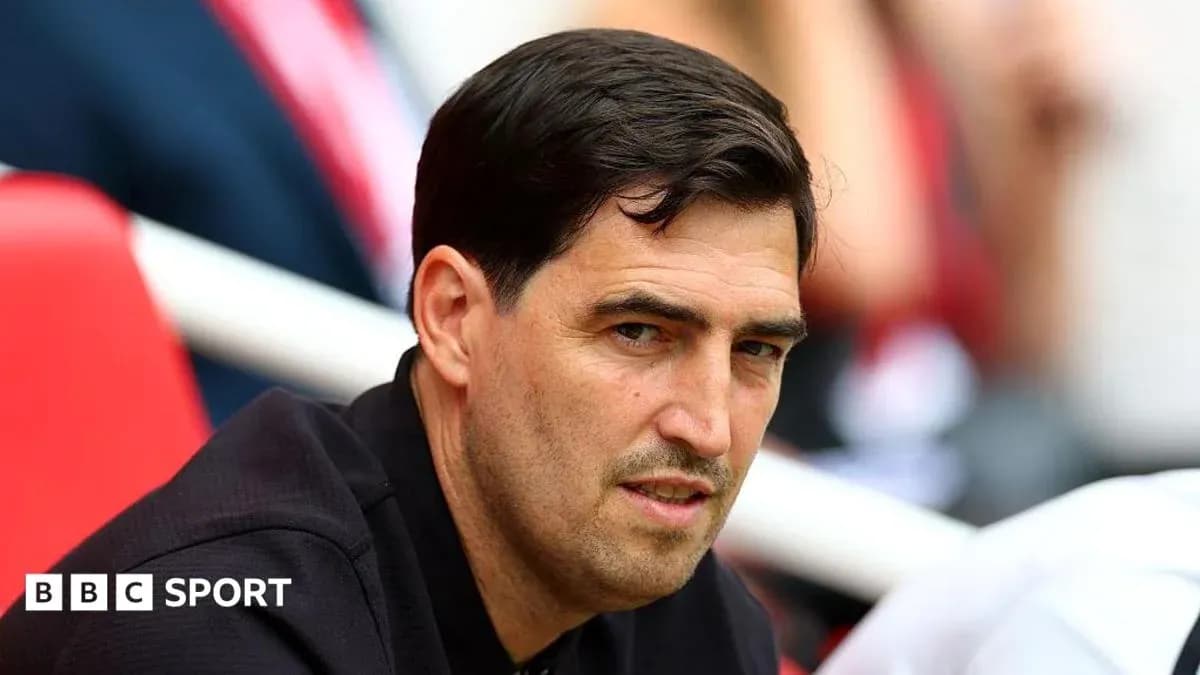
Liverpool’s New Era: Andoni Iraola's Challenges and Promises
Liverpool’s new era under Andoni Iraola is only a few weeks old, but the patterns are already uncomfortably clear.
For the second friendly in succession, his side raced into a two-goal lead, dazzled for half an hour, then collapsed. In Chicago, Leeds turned a 0-2 deficit into a 4-2 win. At Anfield on Sunday, Monaco followed the same script, recovering from 2-0 down to win 3-2.
The football at its best has been electric. The drop-off has been alarming.
A blistering start, then the lights go out
Iraola has been honest from day one. After the defeat by Leeds on 2 August, the new Liverpool manager called the setback “useful” and said he had “learned a lot of things” about his team. It sounded like a coach taking notes in pre-season, not panicking.
Monaco drew something sharper from him.
Two weeks out from the Premier League kick-off, he stood at Anfield and admitted his side have “work to do” because they cannot yet sustain the level he demands across a full game. He praised the opening half hour but added bluntly that his players “don’t have much more, in terms of the levels required to play like this”.
Those first 30 minutes against Monaco, just like the opening half against Leeds, were as close as Liverpool have come to Iraola’s blueprint. The ball fizzed forward with purpose. The press snapped into life high up the pitch. The team played direct, vertical football with an edge, and in Florian Wirtz and Alexander Isak there were clear signs of cutting quality in the final third.
Then the changes came. And so did the problems.
Iraola made nine substitutions against Leeds, 11 against Monaco. The intensity drained away. The structure loosened. Leeds hit four in 25 minutes. Monaco scored three in 44. Two friendlies, two collapses, two reminders that Liverpool’s squad is not yet conditioned to live inside their manager’s high-octane ideas.
Fitness, demands and a brutal pre-season
Some of this is predictable. A chunk of the squad is still playing catch-up after extended breaks following the World Cup. Others are unavailable altogether: Conor Bradley, Hugo Ekitike and Giovanni Leoni are out for lengthy spells, trimming Iraola’s options at a time when he is trying to drill a new identity.
Help is on the way. Uruguay defender Ronald Araujo is close to sealing a season-long loan from Barcelona, offering cover at centre-back and right-back. Virgil van Dijk, speaking after the Monaco defeat, did not hide the need for reinforcements.
“Let’s see what the next couple of weeks are going to bring,” the captain said. “Any quality we can add to the team will definitely be welcome so let’s see.”
But Iraola’s focus is not just on who arrives. It is on what those already at the club can physically withstand.
He is adamant that the squad’s general fitness must rise if Liverpool are to play the aggressive, front-foot football he insists on. Pablo de la Torre, who has followed him from Bournemouth and previously worked there as fitness coach, has been tasked with dragging the group up to those levels.
The early evidence is not subtle. Across four pre-season games, Liverpool have started like a side trying to compress 90 minutes of energy into 30. In an open training session in Chicago, Iraola’s voice cut across the drills, demanding “quicker, quicker” as players were pushed through high-tempo routines.
One player admitted to BBC Sport that he felt sick after the first few sessions. Lose in training and the punishment is simple: sprint to the far end of the pitch and back. No ball. No shortcuts.
Milos Kerkez summed up the demands in Chicago: Iraola wants his players to “play one-on-one all over the pitch, to press high and to always be on the front foot”. It is an unforgiving model. When it works, it can overwhelm opponents. When legs go, the gaps appear everywhere.
The Bournemouth template – and the warning
None of this is new for Iraola. His Bournemouth side last season ranked first in the Premier League for direct attacks and third for high turnovers. They were constantly looking to drive forward and constantly hunting the ball back.
It did not click straight away. It took him 10 games to claim his first win at Bournemouth in 2023-24. That kind of start at Liverpool would ignite a crisis before autumn has even settled in. Yet Bournemouth’s eventual transformation under him explains why he is so stubborn about his methods. Once the players absorbed the demands, the football carried a clear identity.
Liverpool are at the beginning of that process. Four games, some dazzling spells, some worrying collapses. A coach pushing the accelerator, a squad still trying to build the engine.
Iraola knows time is not a luxury at Anfield. He also knows he cannot compromise on the core of his approach.
“I would like to say, no, on the first day, we are going to be perfect, everyone will be in place, but probably it is not going to be like this,” he said in Chicago, when asked how long it would take to fully see his style. “We will have to do this as quickly as possible.”
The message is clear. The ideas are bold. The football, in bursts, is thrilling. Now comes the hard part: turning half an hour of chaos into 90 minutes of control before the real season starts counting the cost.
Related News
Carlos Alcaraz Urges Tennis Organizers to Stop Matches Finishing in the Early Morning
Carlos Alcaraz Frustrated by 3:30 a.m. US Open Finish: 'Too Much'
Jannik Sinner Set for ATP 500 Return in Beijing with Novak Djokovic Also Competing

Meet Iva Jovic: The Rising American Tennis Talent
Flavio Cobolli Shares Insights on Training with Jannik Sinner Ahead of His Tennis Return

Till vs Romero: Fight Details, Undercard, and Viewing Info for This Weekend