
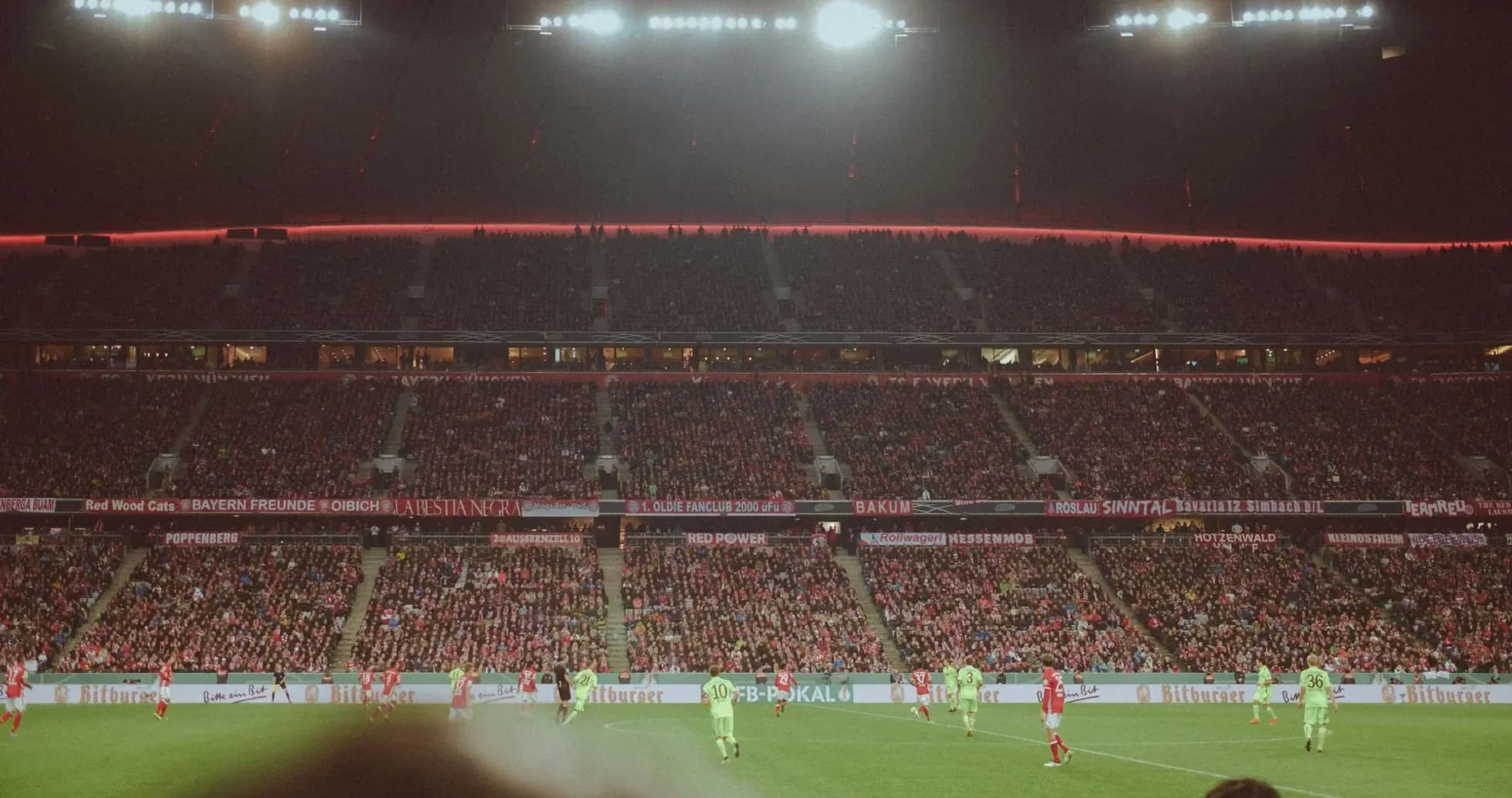
Lech Poznan’s Tactical Control in UEFA Europa League Win
Lech Poznan’s 1-0 win over KI Klaksvik at Enea Poznań was built on structural control rather than statistical dominance in the classic sense. In a 4-2-3-1 under Niels Frederiksen, the hosts used their shape to pin back Magnus Powell’s 3-4-3, generating a clear territorial and shot-volume advantage: 6 shots on goal to 1, 12 shots off target to 3, and a 5–4 edge in corners. The scoreline was narrow, but the pattern was one of sustained Polish pressure gradually wearing down a compact Faroese block until the decisive late strike from Y. Agnero, supplied by centre-forward M. Ishak.
Out of possession, Lech’s 4-2-3-1 gave them natural rest defence against Klaksvik’s front three. The back four of J. Pereira, T. Yegbe, W. Monka and M. Gurgul could match up directly with the visitors’ attacking line and wing-backs, while the double pivot of A. Kozubal and Radosław Murawski screened central spaces in front of them. This allowed the three advanced midfielders – P. Walemark, P. Rodriguez and A. Sayyadmanesh – to press high without exposing the centre-backs to constant isolation.
The key structural battle was on Lech’s right. Pereira pushed aggressively to pin Jean Carlos and A. Frederiksberg, with Walemark tucking inside to overload Klaksvik’s central trio of M. Sinyan, O. Ali and J. Danielsen. That pressure translated into repeated regains and shooting opportunities from the edge of the box, reflected in the 6 shots on target and 12 off target: Lech were able to reach shooting positions regularly, even if their final execution was often rushed.
Klaksvik’s 3-4-3, by contrast, was primarily a damage-limitation tool. With G. Sorensen and G. Tellechea flanking the central defender and the wing-backs frequently dropping into a back five, Powell’s side tried to keep distances tight between the lines. The front three of A. Frederiksberg, P. Klettskard and F. Brattbakk were forced into long defensive shifts, often retreating to form a 5-4-1 without the ball. Their attacking output – 1 shot on goal and 3 off target – underlines how rarely they could sustain possession high up the pitch.
The disciplinary profile also supports the tactical picture. Lech committed 12 fouls to Klaksvik’s 10, a typical pattern for a pressing home side trying to prevent transitions after losing the ball. Murawski’s yellow card before half-time came in that context and prompted Frederiksen to adjust immediately at the break, with L. Palma (IN) coming on for R. Murawski (OUT) at 46'. Functionally, the change freshened the double pivot and slightly increased Lech’s passing range from deep, with Palma more inclined to step into advanced pockets and link with Rodriguez between the lines.
That substitution subtly shifted Lech’s attacking structure. With Palma more progressive, Kozubal could sit as a single pivot at times, allowing both full-backs to advance simultaneously. The effect was to lock Klaksvik even deeper, which in turn contributed to the rising shot count and corner pressure. Sayyadmanesh’s withdrawal on 62' for Y. Agnero (IN) sharpened the front line further. Whereas Sayyadmanesh had drifted into half-spaces to help circulation, Agnero offered more direct runs in behind and a stronger presence attacking crosses and cut-backs.
The winning goal on 81' was the logical product of that evolution. With Klaksvik’s back line increasingly compressed around the box, Ishak’s role as a classic reference point became critical. Dropping off the centre-backs to receive, he was able to link play and then attack the penalty area late. His assist for Agnero’s finish reflected that pattern: a central forward combining outside the box and then releasing a more dynamic runner into the prime scoring zone. It was a rare moment where Klaksvik’s compactness broke, and Lech’s more vertical second-half structure punished them.
On the visitors’ side, Powell’s in-game changes were reactive and aimed at injecting energy rather than changing the basic 3-4-3/5-4-1 template. At 77', J. Johannesen (IN) replaced F. Brattbakk (OUT), and R. Joensen (IN) came on for O. Ali (OUT), freshening both the wide and central midfield roles. Later, E. Hustad (IN) for P. Klettskard (OUT) and M. Gonzalez (IN) for M. Sinyan (OUT) at 85' suggested a late attempt to add legs up front and in midfield after conceding. However, with only 1 shot on target across the 90 minutes, Klaksvik never managed to convert those changes into sustained pressure on Lech’s back line.
From a statistical perspective, the shot profile is the clearest indicator of Lech’s territorial dominance. Six shots on goal versus one for Klaksvik, plus the 12–3 gap in shots off target, shows that the home side repeatedly brought the ball into finishing zones, even if their accuracy and decision-making limited the margin of victory. The 5–4 corner count is closer, but that partly reflects Klaksvik’s occasional forays and set-piece opportunities rather than open-play control.
Discipline-wise, Klaksvik’s four yellow cards to Lech’s one underline how often the visitors were forced into last-ditch or disruptive interventions to halt attacks and counters. While possession values are listed as "0%" for both teams and therefore cannot be interpreted, the fouls, shots and corners together paint a coherent picture: Lech imposed the game, Klaksvik defended deep and broke sporadically.
Tactically, this was a textbook example of a higher-quality side using a stable 4-2-3-1 to dismantle a 3-4-3 that was effectively a low block. The timing and nature of Frederiksen’s substitutions – especially Palma’s introduction at half-time and Agnero’s entry on 62' – were decisive in converting structural superiority into a late, deserved winner that sets Lech Poznan up strongly in this UEFA Europa League 3rd Qualifying Round tie.
Related News
Francesco Totti Reveals Offers from Top European Leagues at Age 48
Benfica Dominates AC Milan in UEFA Europa League Opener
Levski Sofia vs Red Bull Salzburg: Europa League Defeat Analysis
Five Europa League Players to Watch in the 2026/27 Season

Celje vs Red Bull Salzburg Predicted Lineups and Team News

Anderlecht vs Red Bull Salzburg Predicted Lineups and Team News