
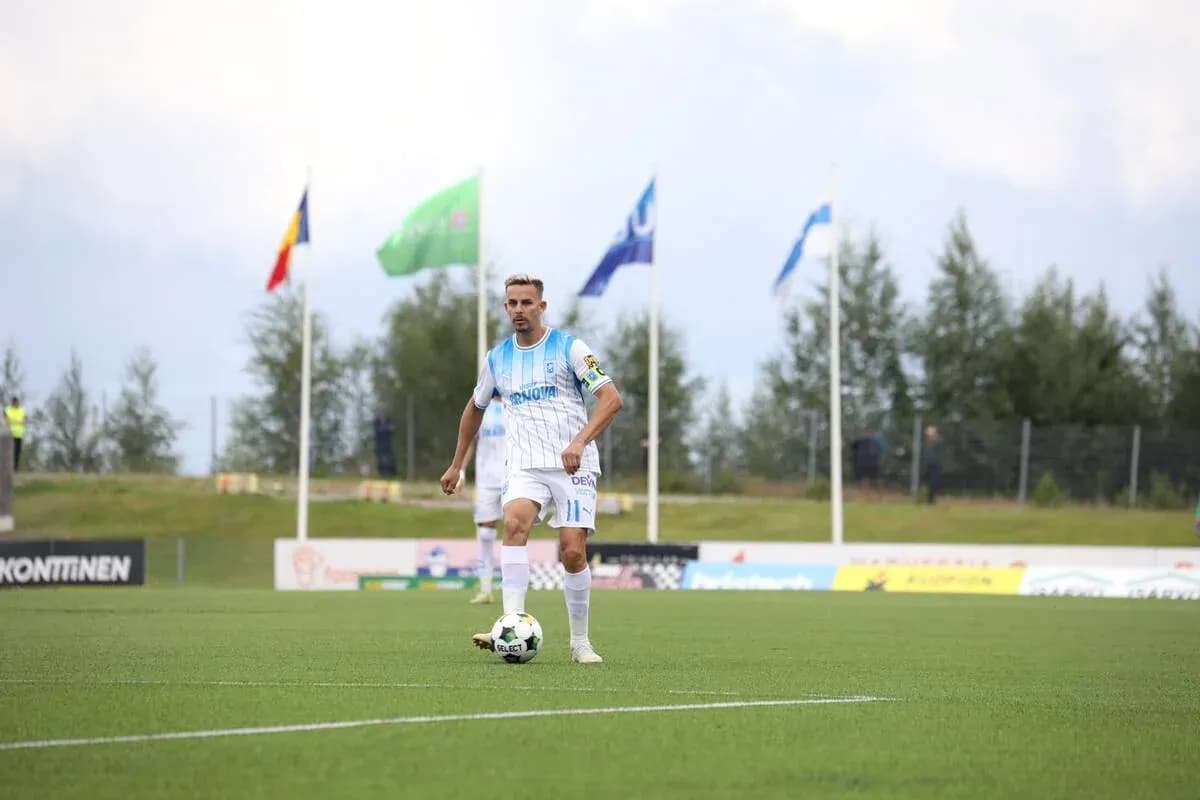
KuPS vs Craiova: Tactical Analysis of UEFA Europa League Qualifier
KuPS approached this UEFA Europa League 3rd Qualifying Round home leg at Savon Sanomat Areena in a 4-2-3-1 that aimed to dominate territory and rhythm, and the numbers confirm they largely achieved that structural objective. With 53% of the ball versus Universitatea Craiova’s 47%, the Finns controlled slightly more possession and translated it into territorial pressure: 6 corners to 2 and a remarkable 7 offsides, a clear indicator of an aggressive, high-positioned front line constantly probing beyond Craiova’s last line.
The shape of Miika Nuutinen’s side was clear from the lineup grid. A back four of A. Puukko, B. Magassa, K. Adams and Clinton Antwi supported a double pivot of V. R. Gasc and S. Touray, with J. Luyeye-Lutumba, T. Jyry and B. Armah operating behind lone striker J. J. Moreno Ciorciari. In possession, this morphed into a 2-3-5 at times, with full-backs pushing high and the No. 10 zone (Jyry) stepping into pockets between Craiova’s midfield and defence. The repeated offsides underline how often KuPS tried to release runners early, especially down the flanks, but the timing and coordination were imperfect in the first half.
Despite that territorial leaning, KuPS managed only 1 shot on goal, 2 shots off goal and 1 blocked shot. The key tactical issue was shot quality and volume: the structure progressed the ball into advanced zones, but Craiova’s compact 3-4-3 defensive block, marshalled by the back three of A. Rus, N. Stevanovic and V. Screciu, funneled attacks wide and prevented clean central looks. The Romanian side accepted a slightly lower share of possession but were far more incisive when they did attack, generating 4 shots on goal and 3 off goal with the same number of blocked efforts (1).
Craiova’s 3-4-3 under Filipe Coelho was built on vertical efficiency. The wing-backs C. Mora and N. Bancu had to manage both KuPS’ wide overloads and the transitions forward. In the first half, they did this by maintaining a mid-block line of engagement and springing quickly once possession was won. The opening goal at 38’ from S. Baiaram, assisted by A. Rus, reflected this approach: a quick progression from the back three into the front line, exploiting the spaces left by KuPS’ advanced full-backs. Even without xG data, the disparity in shots on goal (4 for Craiova, 1 for KuPS) strongly suggests the visitors crafted the clearer chances despite spending less time on the ball.
The foul count — 19 for KuPS against Craiova’s 15 — further illustrates the tactical story. KuPS’ higher defensive line and commitment to counterpressing after losing the ball led to more late challenges and tactical fouls as they tried to stifle Craiova’s transitions. The two yellow cards for KuPS (Clinton Antwi on 36’, Saku Heiskanen on 88’) bookend a match in which their defensive aggression was necessary to prevent Craiova from exploiting open spaces repeatedly. Craiova, by contrast, picked up just one yellow (Adrian Rus at 68’), consistent with a side defending more in structure than in emergency.
The substitution wave around the hour mark was tactically decisive. Coelho’s triple change at 59’ — S. Nsimba (OUT) replaced by A. Al Hamlawi (IN), A. Cicaldau (OUT) replaced by Teles (IN), and S. Baiaram (OUT) replaced by D. Matei (IN) — suggested an attempt to refresh the front line and midfield legs to preserve the 0-1 lead and maintain transition threat. Nuutinen responded immediately at 60’ by reshaping his own side: V. R. Gasc (OUT) with S. Savolainen (IN), B. Armah (OUT) with C. Kabuye (IN), and A. Puukko (OUT) with P. Parzyszek (IN). Those moves nudged KuPS toward a more attacking posture, injecting fresh energy into the wide and central attacking lanes.
The payoff came on 72’, when J. J. Moreno Ciorciari equalised, assisted by T. Jyry. Tactically, this reflected KuPS’ insistence on occupying the half-spaces and loading the box with more aggressive runs as Craiova’s initial press intensity dropped. Jyry, operating as a creative hub, finally found the vertical connection into the striker that had been missing in the first half. From that point, KuPS continued to push, further tweaking their shape at 73’ with J. Luyeye-Lutumba (OUT) replaced by A. Heinonen (IN), signalling a desire for more dynamism between the lines, and at 83’ with Antwi (OUT) for S. Heiskanen (IN), a move that both refreshed the left side and slightly rebalanced the risk-reward on that flank.
Craiova’s late substitution at 73’ — M. Etim (OUT) for Heriberto Tavares (IN) — and at 90+5’ — A. Mekvabishvili (OUT) for T. Baluta (IN) — were about stabilising the block and managing the final phases, accepting deeper territory to protect the 1-1 draw. Their reduced corner count (2) and zero offsides highlight a conservative, controlled attacking profile once the score was level: fewer high-risk runs in behind, more emphasis on compactness.
Without explicit goalkeeper save or passing data, the broader tactical verdict hinges on the observable balance: KuPS’ 4-2-3-1 gave them the ball and field position but not enough high-quality final actions; Craiova’s 3-4-3 prioritised verticality and chance quality over volume. The 1-1 final score mirrors that contrast: the hosts’ structural dominance against the visitors’ sharper execution in the boxes. For the tie as a whole, KuPS can draw confidence from their ability to push Craiova back and generate sustained pressure, but they will need to convert territorial control into more than 1 shot on goal if they are to progress from this 3rd Qualifying Round.
Related News

Francesco Totti Reveals Offers from Top European Leagues at Age 48
Benfica Dominates AC Milan in UEFA Europa League Opener
Levski Sofia vs Red Bull Salzburg: Europa League Defeat Analysis
Five Europa League Players to Watch in the 2026/27 Season

Celje vs Red Bull Salzburg Predicted Lineups and Team News

Anderlecht vs Red Bull Salzburg Predicted Lineups and Team News