
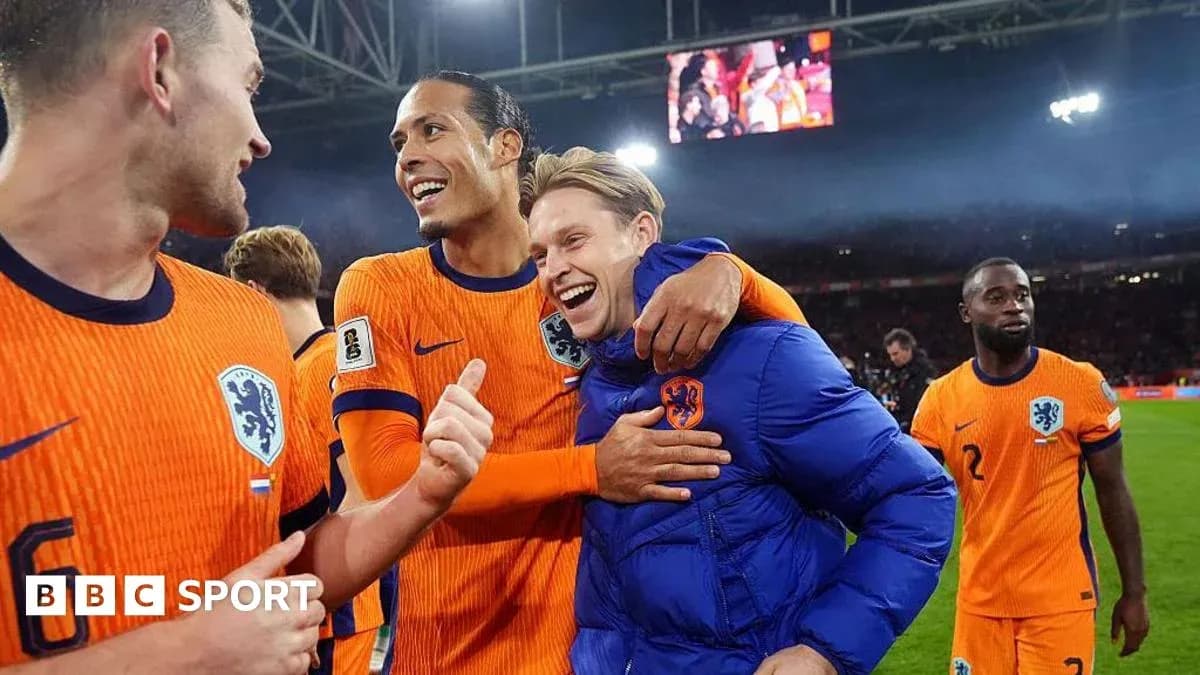
Klement's Statistical Model Predicts Netherlands as World Cup Champion
Paul the Octopus needed only a tank, a couple of mussels and a flag to become a World Cup icon. Joachim Klement needs a spreadsheet.
Fourteen years after Germany’s clairvoyant cephalopod stole the headlines in 2010, a German economist based in London has built something far more serious – and, so far, far more accurate. Since 2014, Klement’s statistical model has correctly picked every World Cup winner. Three tournaments. Three champions. No misses.
Now it points to the Netherlands.
If Virgil van Dijk lifts the trophy in July, the Dutch would become the fourth straight champions to match Klement’s forecast, extending a run that began with his homeland in Brazil.
The economist who keeps beating the World Cup
Klement, a strategist at investment bank Panmure Liberum, never set out to become football’s new oracle. He set out to mock the very idea.
“This started as an exercise in showing the world a hubris of economists who think they can forecast stuff that they actually have no clue about,” he says. Instead, the joke has turned on him. “Now it's become an exercise in how, if you're lucky often enough, people will think you're a guru.”
In 2014, he ran the numbers and the model spat out Germany. They won. So he tried again in 2018, expecting the spell to break. It didn’t. The data said France. France delivered. By 2022, the model backed Argentina. Lionel Messi did the rest.
Three tournaments, three winners. A gimmick had become a streak.
“With each correct prediction, people now think that this model is unbeatable and that I obviously will have to be right as well next time,” he says. The weight of expectation grows with every tournament, whether he wants it or not.
Why the Netherlands – and why it’s not magic
Klement’s model doesn’t lean on mysticism. It leans on “systemic” factors that, historically, help shape who thrives at a World Cup: national population, wealth, climate, Fifa world rankings and similar broad indicators of footballing power.
On that foundation, the model builds out the full 48-team tournament, mapping a path from the group stage to the final. The result is not just a winner, but a storyline.
In this version, the Netherlands emerge as champions. England go deep again but stall in the semi-finals, with Portugal cast as their executioner – just as they were in 2006. Scotland, by contrast, fall at the first hurdle and fail to escape their group. There is a shock on the way too: Japan upsetting Brazil in the second round.
It reads like a script, but Klement is the first to insist it isn’t prophecy.
He estimates those broad, structural variables explain only about half of what happens at a World Cup. The rest? Chaos.
“The other 50% is luck,” he says. “Every match – especially when you have these high-quality teams playing against each other that are very similar in skills and quality – it really depends on the form of the day, a ref call, a piece of luck in the sense of hitting the post versus the ball going in. Things like that are completely unpredictable.”
A distraction in a difficult year
Klement describes himself as a “pessimist” who has lived in the UK for a decade. His World Cup work is not a side hustle to beat the bookmakers or a shield against heartbreak. It’s an escape.
Each cycle, as the tournament nears, he disappears into the numbers. The model, for him, is a welcome break from the grind of global crises and market stress.
“In particular in 2026, when there are so many crises, wars and things going on, it is something that makes me feel good and hopefully the readers feel good and gives them a little bit of a distraction from all the kind of bad stuff that is going on in the world,” he says.
The forecasts have become a quadrennial ritual, with a growing audience. Every correct call pulls more people in. Every new reader arrives a little more convinced that this might be the year the model slips – or the year it proves unstoppable.
Office pressure and Dutch nerves
Inside Panmure Liberum, the model has become office folklore. Colleagues don’t just read the report; they interrogate it.
How does an injury change the odds? What happens if a key player goes down? One question in particular has cut through: what does Dutch Tottenham midfielder Xavi Simons’ ACL injury do to the Netherlands’ chances?
Klement hears it all. He answers as an economist, not a coach, but the questions keep coming. And so do the stakes.
“I've got several colleagues who bet some money on the Netherlands in response to me publishing that note,” he admits.
So while he fills his forecast with disclaimers and warnings about randomness, he knows there is real money – and a fair bit of pride – riding on those orange shirts.
If the Netherlands crash out early, Klement has already mapped out his own short-term future.
“If the Netherlands get eliminated from the World Cup,” he says, “I think the next day I have to work from home.”
Related News

Raphinha’s Hat-Trick Powers Barcelona to 7-2 Victory Over Racing Santander
Carabao Cup Fourth Round Draw: Liverpool Set to Clash with Chelsea, Arsenal to Face Fleetwood Town
Key Football Matches to Watch in Azerbaijan This Autumn

Raphinha's Hat-Trick Drives Barcelona to 7-2 Triumph Over Racing Santander

Hansi Flick Leads Barcelona to Record-Breaking Seven Wins in a Row

Gavi Reflects on Injury Return as Barcelona Dominate Racing Santander 7-2