
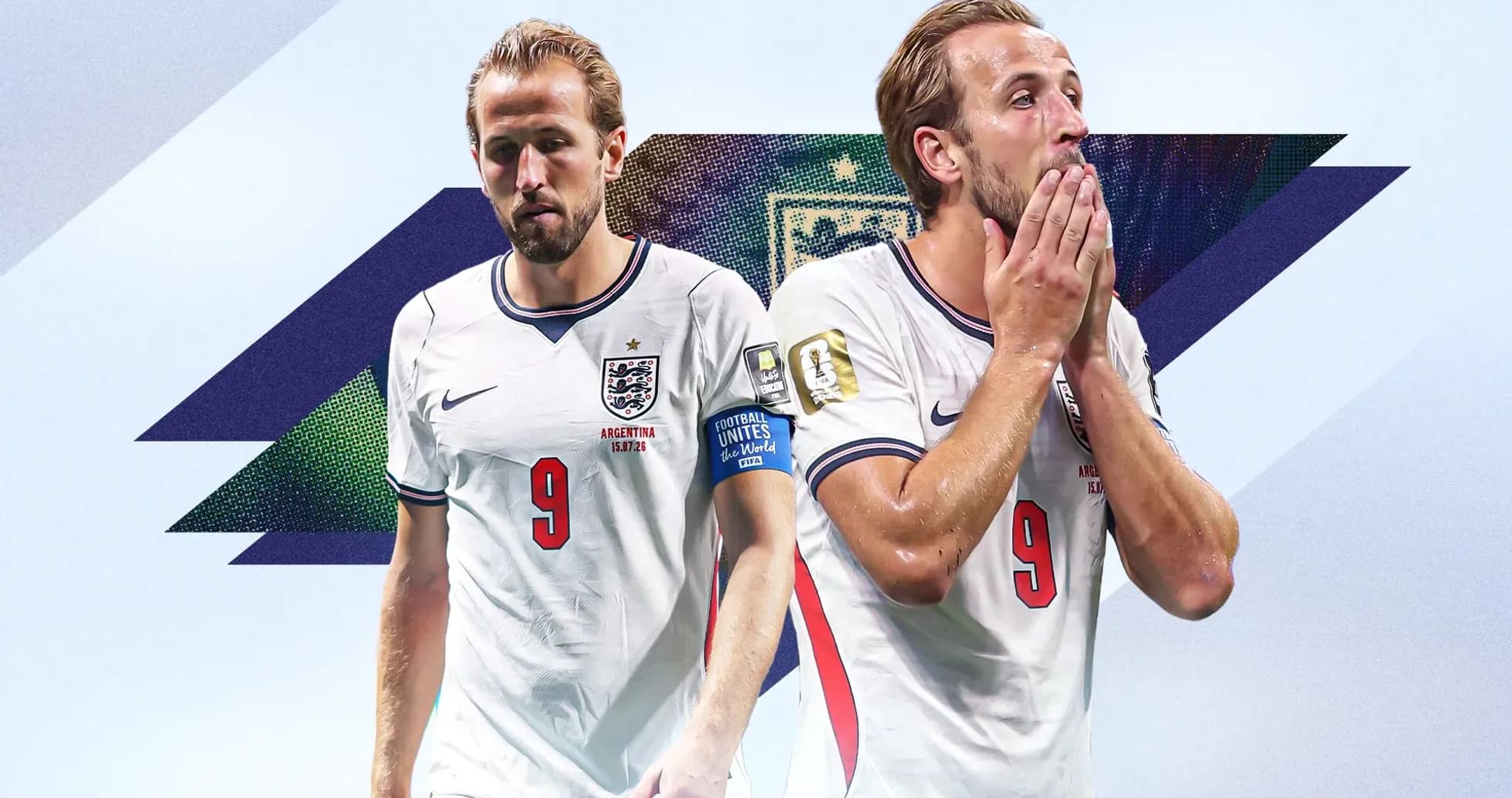
Kane's Struggles in World Cup Semi-Final Against Argentina
For an hour in New Jersey, England went toe-to-toe with the world champions and looked like they belonged. Thomas Tuchel’s team didn’t exactly dominate Argentina, but they traded blows, held their ground, and, at 1-0 up, had the game where they wanted it. When Anthony Gordon swept in the opener on 55 minutes, it didn’t feel like a smash-and-grab. It felt like the first clean connection in a heavyweight bout.
Argentina, you assumed, would respond. The question was whether England – hardened by that heroic rear-guard at the Azteca against Mexico – could stand up and throw back.
They didn’t. They shrank.
As Lionel Scaloni’s side swarmed forward, England retreated into their own penalty area. The world champions “smelled blood in the water,” as Scaloni put it. Tuchel’s England, instead of clearing the ocean, kept tipping buckets of chum over the side.
And Harry Kane, of all people, was left watching the feeding frenzy from the wrong part of the pitch.
Kane the scrapper, not the saviour
On paper, Kane’s night looks grim: 26 touches, nine completed passes, one blocked shot, no touches in Argentina’s box. For a striker chasing a Golden Boot, for a captain of his stature, it reads like a disappearing act.
It wasn’t quite that simple.
The game was ragged, spiky, and Kane embraced the chaos early. In the first half he fought for everything, flinging himself into challenges, backing into defenders, contesting more duels than Lisandro Martínez and Alexis Mac Allister. At times he seemed determined to turn it into a street fight, body on the line, boots flying.
That made sense when the ball was in the air more than it was on the grass. England weren’t building attacks, they were surviving collisions. Kane, as ever, did his share of the dirty work.
Once Gordon scored, the demands changed. England needed an outlet, a pressure valve, a centre-forward to pin one of Argentina’s hulking centre-backs and make them think twice about piling forward. They needed someone to stretch the pitch, to give them a way out.
They needed a type of striker Harry Kane has never been.
Kane is almost complete. He finishes, he links, he creates. What he does not do is run in behind with pace that scares defenders into retreat. So he did what comes naturally: he dropped deeper, tried to help England get a foot on the ball, tried to slow the storm.
He couldn’t. The waves just kept coming, breaking in front of him as Argentina poured through midfield and onto England’s back line.
“This is the national team. It's what I love to do more than anything,” he would say later of his England career. On the night, though, his love for the scrap turned into part of the problem. England needed a release ball; their No 9 kept coming towards the fire instead of away from it.
This was no longer a game for Kane. Tuchel should have seen it and acted. Instead, the captain stayed on, rooted between the lines as the match – and perhaps something larger – slipped away.
A season of superhuman numbers, undone
All of this lands harder because of what came before. Kane has just produced a season for Bayern Munich that would have looked outlandish even in the stat-stuffed eras of Robert Lewandowski, Lionel Messi and Cristiano Ronaldo.
- Fifty-eight goals in all competitions.
- Thirty-six in the league, more than anyone else in Europe’s top five divisions.
- The fastest Bayern player ever to reach 100 goal contributions.
- A Bundesliga title won by 16 points, with Bayern easing off the throttle in the final weeks.
Those are Ballon d’Or numbers. They are numbers Lewandowski never hit. They are numbers that, on paper, drag you into Messi and Ronaldo’s orbit. On statistics alone, the case for Kane as the first English winner of the award since Michael Owen was strong.
But Bayern faltered where it mattered most. They went stride for stride with eventual Champions League winners PSG, then failed to overturn a deficit in the second leg and slid out in a 6-5 semi-final defeat. Domestically ruthless, continentally short.
The World Cup, then, offered a reset. Kane knew it. He said so.
“I’d be one of the favorites, definitely,” he admitted before the tournament. “Given the trophies I’ve won this season and the number of goals I’ve scored, I’d be in the running. Especially as, should England win the World Cup, one could imagine the trophy going to an English player.”
For five games, he played like a man chasing that crown. Two goals against Croatia. One against Panama. Two more against Congo. An assist at the Azteca. He and Jude Bellingham carried the attacking load while everyone else did their jobs around them.
With the semi-finals looming, the equation was simple. Kane was two goals behind Messi and Kylian Mbappé in the Golden Boot race. England were unlikely to get past Argentina without their captain leaving a mark. This was his moment, perfectly set: form, narrative, numbers, all aligned.
And then: nothing. No shot of consequence, no penalty box presence, no late run at destiny.
Golden Boot gone, Ballon d’Or dream fading
By failing to score against Argentina, Kane has almost certainly watched the Golden Boot drift out of reach. Even a hat-trick against France in a third-place play-off he really shouldn’t be anywhere near would probably not be enough. Messi, with Spain ahead in the final, is overwhelmingly likely to add at least one more to his tally.
So Kane will return to Germany without the Golden Boot, without a World Cup final, without the one last push his season seemed to demand. His Ballon d’Or argument, once compelling, now feels paper-thin next to a world champion with decisive moments on the biggest stage.
The brutal part? This might have been his best – and last – clean shot at it.
His move to Bayern was a rebirth. In hindsight, he stayed at Tottenham too long. He was outstanding there, year after year one of the Premier League’s finest, but forever surrounded by structural flaws and limited investment. Spurs are only now, ironically, spending at the level he always needed.
Bayern changed the conversation. His success in Germany, especially across these first two seasons, proved that he could dominate at the very top, in a different league, under different pressures. It suggested he might even be approaching a late peak. He has talked often about studying other sports, learning from athletes who stretch their primes by obsessing over their bodies. His Bayern form shows he can do the same – at club level.
International football is a different beast entirely. No long campaigns. No gradual tactical evolution. No carefully managed workloads. England stretched their World Cup camp as far as they could, but it was still less than two months tacked onto a draining season. A sprint, not a marathon.
And when the gun sounded for the final bend, Kane stumbled.
A legacy with numbers – but no crown
If this is the last great chance, then his England legacy becomes a puzzle.
On one hand, the numbers are staggering. He is surely England’s greatest ever striker. Keep him fit and he will glide past 100 goals for his country. Peter Shilton’s 125-cap record is within reach; Kane is already at 121. He has scored more World Cup penalties than anyone in history and owns a Golden Boot from 2018.
On the other hand, the tournament scars are deep. Euro 2024 passed him by. Qatar 2022 brought that shuddering, crucial penalty miss. In 2018 and at the delayed 2021 Euros, he operated in weaker squads, but never quite took a major tournament by the throat in the way his talent suggested he might.
Look at the company his numbers keep: Messi, Ronaldo, Pelé, Maradona, Henry. All of them have a major international trophy to hold up as proof. Kane, for all his goals, does not.
The question, then, stretches beyond him. What do England do now?
England’s looming striker problem
Strip back the sentiment and the striker depth chart is stark. Tuchel brought a 30-year-old Ollie Watkins and a 30-year-old Ivan Toney to this World Cup. There is no obvious young centre-forward pushing from behind, no heir apparent ready to take the shirt and the burden.
Kane is not just the best option. He is, in many ways, the only one.
So England will almost certainly roll on with him. He will be in the squad for Euro 2028. England, given their talent elsewhere, will probably be good again. By then, though, he will be well into his thirties, fighting a battle with time he cannot permanently win, however diligent his preparation.
And still, who replaces him?
Kane, for his part, has no intention of walking away.
“The national team is my pride and joy,” he said. “It's what I love to do most more than anything. Obviously four years is a long way away, I'm 33 this summer but it never ended with Leo [Messi] there, he's still performing at the highest level. I never want to put a limit on these things.”
He shouldn’t. But football does it for you. Tournaments arrive, windows open, and then they slam shut.
Kane has had chances before to write himself into England’s history with ink that never fades. Each time, something has slipped. This World Cup, given the season he arrived from and the stage he stood on, feels like the biggest miss of all – not just a lost semi-final, but a door closing on the version of Harry Kane who could have ruled the world.
Related News
Ilia Topuria Accuses Justin Gaethje After UFC Defeat
Tyson Fury vs Anthony Joshua Fight Date and Venue Confirmed
Switzerland Calls Up In-Form Sion Striker Winsley Boteli for Nations League
Bournemouth Secures Historic 2-1 Win Over Real Sociedad in Spain
Portugal Announces Squad for 2026 UEFA Nations League; Cristiano Ronaldo Expected to Play
Raphinha Channels Ronaldo Nazario as Barcelona's Leading Striker After Position Change