
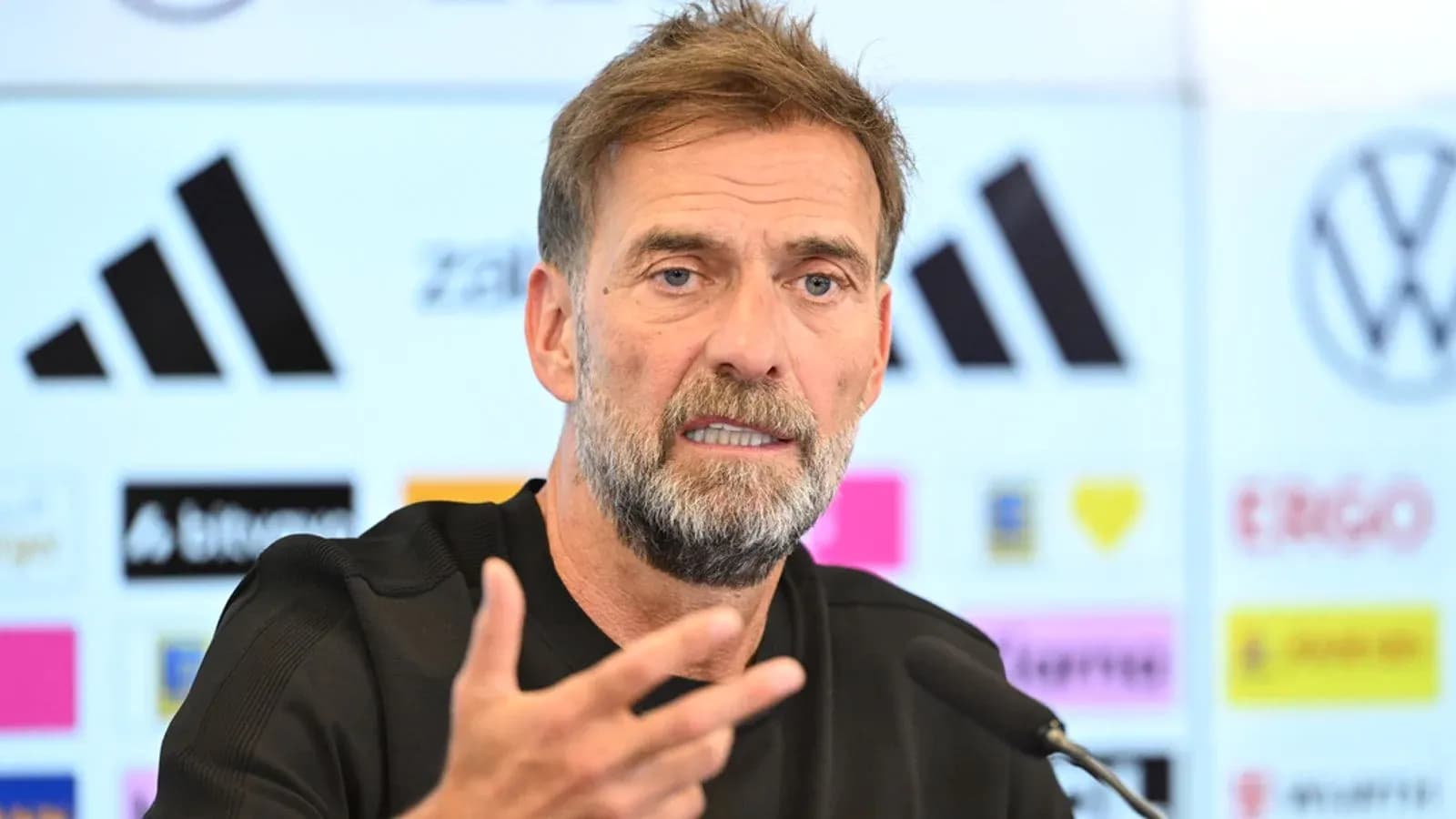
Jurgen Klopp Appointed Germany Head Coach Until 2030
Jurgen Klopp has walked back into the dugout – and straight into the hottest seat in German football.
The 59-year-old has been unveiled as Germany’s new head coach on a deal running to the end of the 2030 World Cup, a seismic appointment for a national team still trying to rediscover its identity after years of underachievement.
This is not a detour. This is his final destination.
“If tomorrow Jurgen Klopp is s***, I will be gone”
Klopp arrived with the same candour that defined his Liverpool era. No soft landing, no careful calibration of expectations. A warning.
"I will be remunerated very graciously and if tomorrow Jurgen Klopp is s***, I will be gone," he said, laying out the terms as bluntly as possible. Respect my work, protect my family, or I walk.
"And if you behave badly and don't let my family in peace, I'll be gone. I'll just turn away. I know there are other countries where national team head coaches are treated even worse. I love this job but I am also ready to call it quits if needs be."
It was a remarkable opening gambit: a coach who has spent a career feeding off the energy of supporters and media now drawing a hard line in public on day one.
For Klopp, this is the summit. There will be no next act.
"Jurgen Klopp is not going to have any 'career' after the national team. This is the pinnacle, the high point of my footballing career as a coach. I will give everything I've got, and I have the best possible assistant coaching team."
From burnout to the Bundestrainer
Klopp had stepped away from Liverpool in 2024 saying he was "running out of energy" after a nine-year spell that reshaped the club and yielded six trophies, including the Champions League, Premier League, Club World Cup, FA Cup and two League Cups.
He took a six-month break, then resurfaced in a very different role as Red Bull's head of global soccer. From there, he insisted he had no desire to return to club management.
The DFB, though, did not come calling for another club job. They came with the one role big enough to tempt him back to the touchline.
Klopp was the first name they turned to when Julian Nagelsmann resigned after Germany’s World Cup ended in the last 32 on penalties against Paraguay – a nadir that underlined how far the four-time world champions had fallen.
His first game will come against the Netherlands in the Nations League on September 24. A rivalry, a stage, and no time for a gentle introduction.
“We want to play like Germany”
If the appointment feels like a jolt of electricity, Klopp moved quickly to cut through the idea that his presence alone guarantees a return to the top.
"Jurgen Klopp being in the job doesn't automatically mean we're going to be world champions," he said. The name on the office door is not the trophy.
"Success is performance vs expectations. We need a new set of expectations."
Germany’s recent tournaments have been defined by that gap – a country still measuring itself against the very best, while results suggest something else entirely.
"Many people have asked themselves, are we as good as France? If the answer is no, then that is not necessarily true. If the question is, do we have players like Dembele, Barcola, Mbappe? Then the answer is no, we don't, but we can still beat them."
That line could have been lifted from his Dortmund days, when his team went toe-to-toe with richer, deeper squads and refused to bow.
"We don't want to play like Argentina, Spain, England or France. We want to play like Germany, do it the German way but very intense. Are we the number one team at the moment? No, we aren't; I accept that. Would we be happy to be the number two team? Then people would say we aren't number one.
"At the moment, we have 11 teams ahead of us. Yes, we can beat them, but for this to happen, you need to play very good, intense football."
That word again: intense. It has followed him from Mainz to Dortmund to Liverpool. Now it becomes the cornerstone of a national reset.
Building a German brain trust
Klopp has not come alone. The backroom team carries a distinctly familiar feel.
Former Liverpool assistants Pep Lijnders and Peter Krawietz are on board, reuniting the core coaching group that helped turn Liverpool into a relentless machine. Sven Bender, who played under Klopp at Borussia Dortmund, joins them, adding another trusted voice who knows exactly what the new head coach demands.
Off the pitch, there is a significant structural shift coming too. Per Mertesacker, who left his role as Arsenal's academy manager at the end of last season after eight years, will become Germany's sporting director in January, replacing Andreas Rettig.
Between Klopp on the touchline and Mertesacker in the corridors of power, Germany are entrusting their future to figures steeped in elite football and in the culture of accountability that has often underpinned their greatest eras.
A mission, not a crusade
Klopp framed his task in simple, almost understated terms.
"It is my mission to make the national team squad a better team and hope the pool for me to choose from will be bigger, but it is not something I am doing against you, I am doing it for you. It is an honour."
The words were humble. The implications are not.
This is a coach who turned Liverpool from nearly men into champions of Europe and England. Who took Dortmund from challengers to Bundesliga winners against the might of Bayern. Who has built teams that run, press and believe until the final whistle.
Now that energy is being pointed at a national team that has watched others set the standard.
Klopp knows the risks. He knows the scrutiny. He knows the weight of the shirt.
He also knows this is his last job.
The question now is not whether Jurgen Klopp can handle Germany. It is whether Germany, in all its impatience and expectation, is ready to handle Jurgen Klopp.
Related News
Ilia Topuria Accuses Justin Gaethje After UFC Defeat
Tyson Fury vs Anthony Joshua Fight Date and Venue Confirmed
Switzerland Calls Up In-Form Sion Striker Winsley Boteli for Nations League
Bournemouth Secures Historic 2-1 Win Over Real Sociedad in Spain
Portugal Announces Squad for 2026 UEFA Nations League; Cristiano Ronaldo Expected to Play
Raphinha Channels Ronaldo Nazario as Barcelona's Leading Striker After Position Change