
Jose Mourinho's Missed Opportunity at Manchester United
They still call it a "sliding doors" moment at Manchester United.
A decision made in days. A pursuit that lasted weeks. And a phone call that, in Sir Alex Ferguson's telling, ended in tears.
The manager who said no
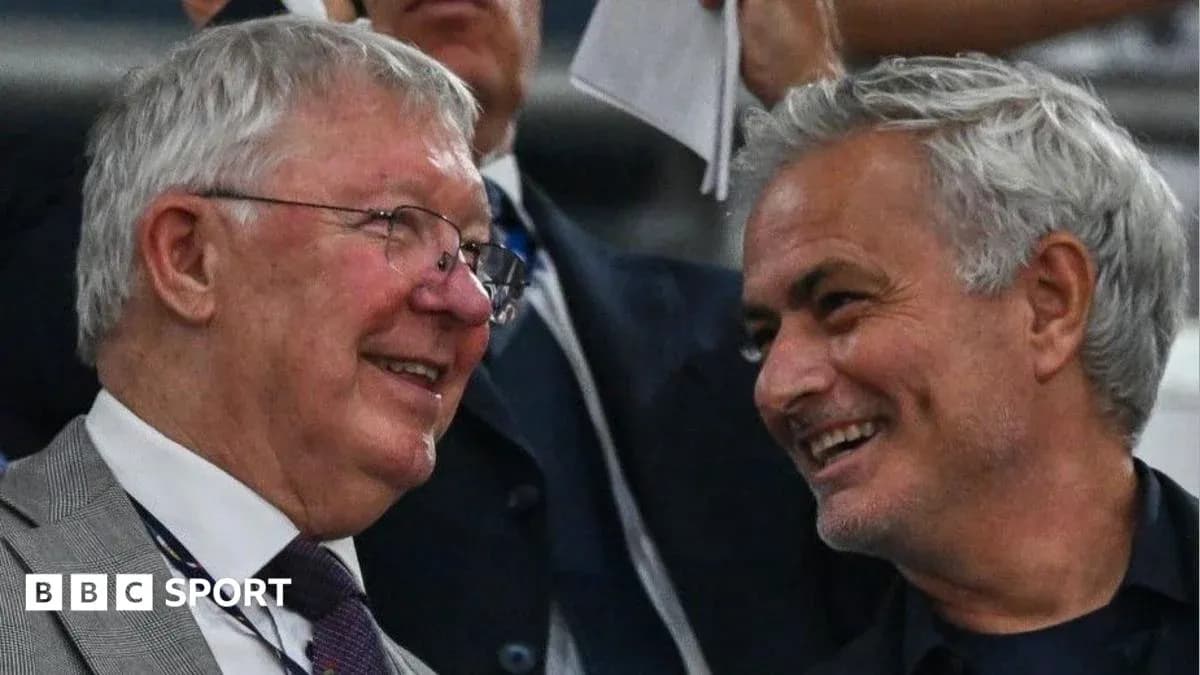
The story, long whispered in football circles, is laid bare in a new Netflix documentary on Jose Mourinho. In 2013, as Ferguson prepared to walk away from Old Trafford, United thought they had their next great manager lined up. Not David Moyes. Mourinho.
United officials had been working on it quietly. Meetings in Madrid. Conversations in London. Ferguson himself sat down with Mourinho and stunned him: he was retiring at the end of the 2012-13 season.
The admiration between the two managers was real. Ferguson liked Mourinho. Respected his edge, his record, his appetite for confrontation. United believed he had the stature to follow a legend and withstand the glare.
Talks quickly moved from possibility to detail. Terms were discussed. An agreement was reached.
Then it wasn't.
Ferguson recalls the moment the whole thing turned. "One night, he phoned me and he was crying and he says: 'Alex, I can't take it. I've given my word to Chelsea and I'm not going to break my word'."
Just like that, United's future shifted.
Mourinho pointed to his family. His home in London. The promise he had made when he was first sacked by Chelsea in 2007 that he would return. His relationship with Roman Abramovich, still strong enough to pull him back to Stamford Bridge, also loomed large.
Some inside Old Trafford still question whether it was only about family. But they all agree on one thing: for a short, dizzying spell, they believed Mourinho was theirs.
And that moment, they say, changed the club’s history.
A club at a crossroads
Ferguson was not the only pillar leaving in 2013. Chief executive David Gill, another stabilising force, was also stepping down. United were not just replacing a manager; they were trying to reinvent how the club worked.
For decades, Ferguson had been the axis around which everything turned. Team selection, discipline, recruitment, long-term planning – he had a hand in all of it. United knew that model could not simply be replicated. They needed a new structure, a new way of operating, while still winning on the pitch.
Mourinho, with his presence and certainty, looked like the man to bridge those worlds. A manager big enough to take on the job of succeeding Ferguson and still demand the changes United felt they needed.
When he chose Chelsea, the plan collapsed.
Pep Guardiola was already locked in at Bayern Munich. United pivoted to David Moyes, the Everton manager who shared some of Ferguson's values but not his experience at the very top level.
The club unveiled him as "The Chosen One". The banner hung from the Stretford End. The reality was harsher. He wasn't.
The Mourinho United never saw
Mourinho eventually walked through the Old Trafford doors in 2016, three years and two managers after Ferguson’s farewell. By then, the landscape had shifted.
Of the 18 players who started 10 or more league games in that 2012-13 title-winning campaign, only six – David de Gea, Phil Jones, Wayne Rooney, Chris Smalling, Michael Carrick and Antonio Valencia – did the same in Mourinho's first season.
The dressing room had changed. So had Mourinho.
He had returned to Chelsea and won the Premier League again, but his reign ended in December 2015 with the club 16th in the table, one point above the relegation zone. He left under a cloud, accused of burning too hot, too fast.
At United, his record still splits opinion. He delivered the Europa League and the EFL Cup in his first season. He took the club back into the Champions League twice. He called finishing second in 2017-18 – 19 points behind Manchester City – one of the greatest achievements of his career.
The numbers back up part of that claim. United’s 81 points that season remain their highest total in the Premier League since Ferguson retired.
Yet the story is never told without the friction. Mourinho clashed with Paul Pogba, the club’s record signing. He publicly questioned the board's ambition, frustrated that his request to sell Anthony Martial and reshape the attack was rejected. By the time he left, critics argued he had left the squad fractured and the club in turmoil.
Which leads back to the question that still hangs over Old Trafford: what if he had come in 2013?
The great what if
Inside United, there is a growing belief that Mourinho would have had a far greater impact had he walked straight into Ferguson's office rather than arriving three years later.
For a start, his personality seemed perfectly suited to the challenge. He would not have tiptoed into the job. He would have embraced the fight of following Ferguson, convinced he could not just sustain success but improve on it.
Those who were there remember the hesitancy that marked the Moyes era, particularly in the transfer market. Deals stalled. Targets slipped away. United lurched into the final hours of deadline day and overpaid for Marouane Fellaini, signing him for £27.5m after failing to trigger a lower release clause earlier in the summer.
People close to those talks insist that under Mourinho, that scenario simply would not have unfolded. Fellaini, they say, would never have been signed.
Thiago Alcantara is the name that still grates. United had agreed a move from Barcelona. Under Mourinho, sources are adamant, that deal would have been completed. Instead, Thiago joined Bayern Munich, and United’s midfield rebuild took a very different path.
Mourinho had already given his views on a series of potential signings, including Italy midfielder Daniele de Rossi. The sense around the club is that he would not only have attracted elite players but also extracted more from the experienced core Ferguson left behind.
Most accept that no-one could have squeezed more out of that final title-winning squad than Ferguson himself. They overperformed to reach the summit one last time. The drop to seventh the following season was brutal and unexpected.
Even the players have struggled to fully explain it. Confidence drained. Momentum vanished. The aura went.
Those who know Mourinho believe his presence – his intensity, his demands, his refusal to accept excuses – would have driven that group harder. Maybe not to another title, but certainly away from the cliff edge they tumbled over.
Tears, regret and a lingering bruise
In the documentary, Ferguson recalls Mourinho’s call with clarity. The emotion. The apology. The insistence he could not go back on his word to Chelsea.
For Ferguson, it was a personal disappointment. For Manchester United, it felt like a strategic blow from which they have never quite recovered.
One phone call. One change of heart. One of the game’s great what-ifs.
More than a decade on, as United continue to search for a stable identity in the post-Ferguson era, the question lingers: how different would the modern Old Trafford look if Mourinho had walked through that door in 2013 instead of crying down the line?
Related News
Carlos Alcaraz Urges Tennis Organizers to Stop Matches Finishing in the Early Morning
Carlos Alcaraz Frustrated by 3:30 a.m. US Open Finish: 'Too Much'
Jannik Sinner Set for ATP 500 Return in Beijing with Novak Djokovic Also Competing
Meet Iva Jovic: The Rising American Tennis Talent
Flavio Cobolli Shares Insights on Training with Jannik Sinner Ahead of His Tennis Return

Till vs Romero: Fight Details, Undercard, and Viewing Info for This Weekend