
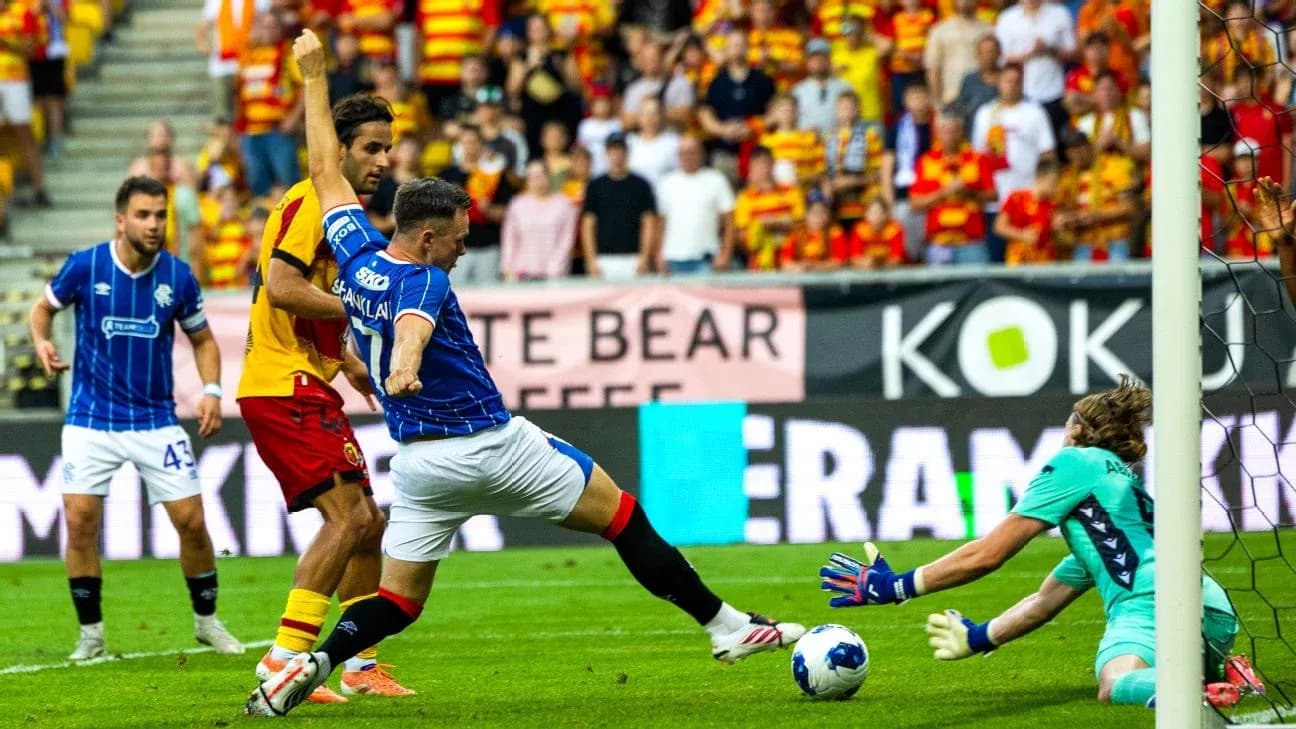
Jagiellonia's Tactical Mastery in 2-1 Victory Over Rangers
Jagiellonia’s 2-1 win over Rangers at Chorten Arena was built on a clear structural idea and an ability to tilt key phases of play in their favour, rather than on territorial dominance alone. In a tie framed by the UEFA Europa League 3rd Qualifying Round, Adrian Siemieniec’s side used their 4-3-3 to control central zones just enough to turn a marginal possession edge (52% to 48%) into higher-quality pressure, while Rangers’ 4-2-3-1 never fully solved the hosts’ midfield spacing or their wide rotations.
Out of possession, Jagiellonia’s 4-3-3 behaved more like a 4-1-4-1. T. Romanczuk held a conservative anchor role in front of the back four, with S. Lozano and K. Szmyt stepping higher to screen Rangers’ double pivot of T. Chukwuani and D. Neil. This allowed Jagiellonia to defend with compact vertical distances: the front three, led by N. Prelec, pressed triggers on sideways passes to the full-backs, while the midfield line stayed tight enough to prevent clean progression through the middle. The result was that Rangers, despite only trailing 52–48 in the ball share, were often forced to circulate in deeper areas and then play into contested wide channels.
On the ball, Jagiellonia’s structure was deliberately asymmetric. G. Montoia and N. Wojtuszek provided width from full-back, but the key was how the midfield three staggered. Lozano frequently dropped to the left half-space to help first-phase buildup, freeing J. Imaz to drift between the lines, while Szmyt attacked the right interior corridor. This occupation of both half-spaces stretched Rangers’ 4-2-3-1 block horizontally, opening lanes for vertical passes and allowing Jagiellonia to connect more cleanly into the final third.
The shot profile underlines that territorial balance did not mean chance equality. Jagiellonia generated 7 shots on goal from a relatively modest total volume (Total Shots is not specified but we know they added only 3 shots off target and no blocked efforts), indicating a high proportion of their attempts were at least testing the goalkeeper. Rangers, by contrast, finished with 3 shots on goal, 4 off target and 1 blocked. The hosts’ ability to convert possession into on-target efforts was closely tied to their midfield rotations: when Szmyt or Imaz received between the lines, they could immediately combine with Prelec’s central presence or use the overlapping full-backs to create cut-back angles.
Defensively, Jagiellonia were impressively clean in their own box. They committed 11 fouls to Rangers’ 15 but still only collected a single yellow card, for Yuki Kobayashi at 88'. That points to good timing in duels and a back line that largely stayed on the right side of contact. The fact that they recorded 0 blocked shots suggests Rangers were often forced to shoot from positions where Jagiellonia’s defenders could hold their line and rely on pressure rather than last-ditch interventions. The defensive unit of Montoia, Kobayashi, A. Konstantopoulos and N. Wojtuszek benefited from Romanczuk’s screening; his positioning reduced the need for emergency blocks by cutting passing lanes into the penalty area.
Rangers’ Tactical Story
Rangers’ tactical story was more reactive. In possession, their 4-2-3-1 often flattened into a 4-4-2 in the build-up, with M. Diomande stepping up alongside Chermiti while T. Aasgaard and D. Yokota (before his substitution) tucked inside. However, Jagiellonia’s narrow, well-timed pressing from the front three limited Rangers’ ability to play through their pivots. The Scottish side did manage to earn 5 corner kicks to Jagiellonia’s 1, which reflects some territorial gains and moments of sustained pressure, but they lacked consistent central penetration and relied heavily on wide deliveries and second balls.
Derek McInnes’ use of substitutions at 46'—C. Devlin (IN) came on for T. Chukwuani (OUT), N. Raskin (IN) came on for D. Neil (OUT), and F. Curtis (IN) came on for D. Yokota (OUT)—was a clear attempt to add energy and more vertical passing from midfield. The idea was to quicken circulation and challenge Jagiellonia’s central block with fresher legs and more aggressive line-breaking. Later, V. Dragojevic (IN) for T. Aasgaard (OUT) at 76' and L. Shankland (IN) for R. McCrorie (OUT) at 85' tilted the structure towards a more attacking posture, effectively loosening the double pivot to push numbers higher. Yet the statistical outcome—only 3 shots on goal—shows that the reshaping did not translate into sustained, high-quality final-third entries.
Discipline further shaped the tactical tone. Rangers picked up three yellow cards (Tuur Rommens 5', Tochi Chukwuani 34', Nicolas Raskin 90+2'), compared to Jagiellonia’s single booking. With 15 fouls, Rangers’ attempts to disrupt Jagiellonia’s rhythm increasingly came through contact rather than structural control. That accumulation of stoppages broke up the flow but also prevented them from building their own tempo, as transitions were repeatedly halted by fouls rather than exploited with quick forward play.
Set Pieces
Set pieces were an underused lever for Jagiellonia. With only 1 corner, they leaned almost entirely on open-play mechanisms to create danger, which makes their 7 shots on goal more impressive. Rangers’ 5 corners offered them a theoretical route back into the game, but Jagiellonia’s organisation on dead balls—compact zonal lines supplemented by man-marking on key targets—limited second-phase chaos and kept the visitors from capitalising.
Without explicit data on goalkeeper saves or xG, the clearest tactical verdict comes from shot quality and distribution. Jagiellonia’s slightly higher possession, lower foul count, and far superior shots-on-goal tally point to a side that controlled the game’s key zones and transitions better than the raw ball share might suggest. Rangers’ structure and substitutions did generate pressure, but they never fully dislodged Jagiellonia’s central compactness or forced the hosts into a chaotic, end-to-end contest. In a tight European qualifier, that balance between measured possession, intelligent spacing, and disciplined defending was decisive.
Related News
Francesco Totti Reveals Offers from Top European Leagues at Age 48
Benfica Dominates AC Milan in UEFA Europa League Opener
Levski Sofia vs Red Bull Salzburg: Europa League Defeat Analysis
Five Europa League Players to Watch in the 2026/27 Season
Celje vs Red Bull Salzburg Predicted Lineups and Team News

Anderlecht vs Red Bull Salzburg Predicted Lineups and Team News