
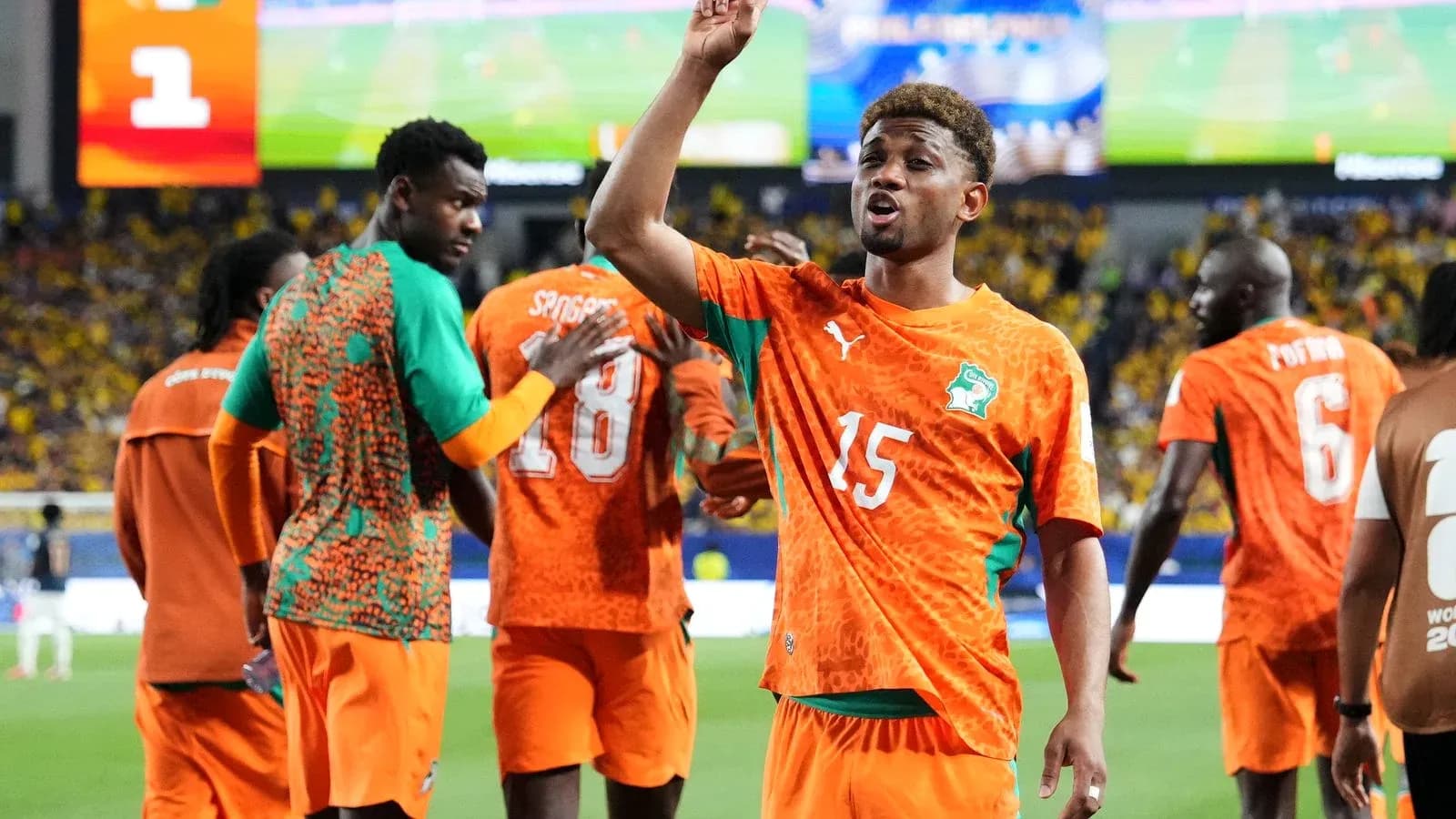
Ivory Coast vs Ecuador World Cup Tactical Analysis
Under the Philadelphia lights at Lincoln Financial Field, Ivory Coast and Ecuador opened their World Cup campaigns with a meeting that felt more like a knockout tie than a Group Stage - 1 fixture. Following this result, Ivory Coast sit 2nd in Group E on 3 points with a goal difference of 1 (1 goal for, 0 against), while Ecuador find themselves 3rd, pointless and inverted at -1 (0 for, 1 against). The 1-0 scoreline tells a story of fine margins, but the squads and structures hint at two very different tactical identities taking shape.
I. The Big Picture – Two 4-4-2s, two different ideas
Both sides lined up in a 4-4-2 on paper, yet the shapes behaved very differently once the game breathed.
Emerse Fae’s Ivory Coast used their 4-4-2 as a platform for territorial control. With Y. Fofana in goal and a back four of G. Konan, E. Agbadou, W. Singo and G. Doue, the Elephants had a solid, athletic base. In total this campaign, they have played 1 match, won 1, scored 1 and conceded 0; the clean sheet is not an accident but a reflection of a compact block that rarely gets stretched. Their home numbers are clear: 1 match at home, 1 win, 1.0 goals scored on average and 0.0 conceded.
Ahead of that line, the midfield quartet of B. Toure, S. Fofana, F. Kessie and Y. Diomande was built for control and vertical surges. Up front, N. Pepe and E. Wahi offered complementary threats: Pepe drifting into pockets and half-spaces, Wahi attacking the last line.
Sebastian Beccacece’s Ecuador also deployed a 4-4-2, but theirs leaned towards transition and verticality. H. Galindez anchored a back four of P. Hincapie, W. Pacho, J. Ordonez and A. Franco. In front, A. Minda, P. Vite, M. Caicedo and J. Yeboah formed a midfield that, on its best days, can compress space and spring quickly. G. Plata and E. Valencia led the line, a pairing meant to stretch defences and exploit any Ivorian over-commitment.
Yet the numbers frame the contrast: on their travels, Ecuador have played 1 match, lost 1, failed to score and conceded 1, giving them an overall average of 0.0 goals for and 1.0 goals against per match. Ivory Coast, by comparison, have a total average of 1.0 scored and 0.0 conceded.
II. Tactical Voids – Discipline, risk and the missing edge
There are no listed injuries or suspensions in the data, so the “voids” here are tactical and psychological rather than personnel-based.
Ivory Coast’s main concern is disciplinary rhythm in the first half. Their card distribution shows all 3 yellow cards so far arriving before the interval: 1 between 16-30 minutes (33.33%) and 2 between 31-45 minutes (66.67%). That pattern suggests a side that starts aggressively, sometimes overzealously, as it seeks to impose its will. S. Fofana embodies that edge: in his 77 minutes he committed 1 foul, received 1 yellow card and still managed to block 1 shot and make 2 interceptions. He plays on the line; for now, it’s working, but it is a risk profile that can turn quickly in tournament football.
Ecuador’s disciplinary story is more isolated but no less telling. Their only yellow card so far came in the 61-75 minute window (100.00% of their yellows), a phase of the game where fatigue and scoreboard pressure converge. J. Porozo, who came off the bench for 28 minutes, committed 2 fouls and was booked. His presence as both a top yellow and top red card profile in the competition data underlines that when Ecuador chase, they can become rash.
The absence that truly hurt Ecuador, though, was not a missing player but a missing connector between midfield and attack. With no goals in total this campaign and a “failed to score” mark in their only away match, the link between M. Caicedo’s ball-winning and the runs of Plata and Valencia never fully crystallised.
III. Key Matchups – Hunter vs Shield, Engine Room vs Enforcer
The “Hunter vs Shield” narrative belongs to Ivory Coast’s emerging attacking threats against an Ecuadorian back line that, in total, has conceded 1 goal in 1 match but looks more reactive than proactive.
From the Ivorian side, the standout finisher so far is not one of the starting strikers but A. Diallo. Used from the bench, he has 1 goal in 34 minutes, from 2 shots, both on target, and an 8.2 rating. He won 6 of 8 duels and completed 5 of 6 dribbles, numbers that speak of a direct, fearless runner who can change the tempo when introduced. He is the late-game “hunter” Fae can unleash when defences tire.
The “Shield” is Ecuador’s central defensive pairing and the structure around them. W. Pacho and J. Ordonez are tasked with absorbing those surges, but the fact that Ecuador’s only recorded defensive standout in the disciplinary and card data is Porozo – a substitute – suggests Beccacece is still searching for his ideal balance between aggression and control at the back.
In the “Engine Room”, F. Kessie and S. Fofana form Ivory Coast’s double core. Kessie’s presence stabilises, Fofana’s risk-taking breaks lines. Opposite them, M. Caicedo is Ecuador’s enforcer, supported by P. Vite’s more creative instincts. The match data hints that Ivory Coast’s pair had the upper hand: they dictated enough to protect a 1-0 lead and maintain a clean sheet, while Ecuador’s midfield never quite tilted the pitch in their favour.
IV. Statistical Prognosis – Margins, xG logic and what comes next
We do not have explicit xG values in the data, but the structural numbers allow a reasonable tactical prognosis.
Heading into their next games, Ivory Coast look like a side whose underlying process is built on defensive solidity and selective risk. Overall, they have 1 clean sheet in 1 match, 0 failed-to-score outcomes and no penalties taken or missed (penalty total 0, with 0 scored and 0 missed). They are not reliant on spot-kicks, and their 4-4-2 has already been used once, suggesting continuity of shape. A team that concedes 0.0 goals on average and scores 1.0 is typically sitting on modest but sustainable xG: tight games, controlled spaces, and a strong chance of progressing if they maintain that defensive base.
Ecuador, by contrast, are walking a thinner line. Overall they have 0 goals for, 1 against, 0 clean sheets and 1 failed-to-score outing. Their 4-4-2 has also been used once, but without a tangible attacking return. From an xG logic standpoint, a team that creates so little end product that it fails to score in its only match while conceding once is likely underperforming in chance creation rather than simply being unlucky. The defensive numbers (1.0 goals against on average) are not disastrous, but without any offensive threat, even small xG concessions become fatal.
In narrative terms, Ivory Coast emerge from this fixture as a tournament team in miniature: disciplined at the back, dangerous from the bench through A. Diallo, and anchored by a combative midfield. Ecuador, meanwhile, must recalibrate quickly. The structure is there, the names are there, but unless Beccacece finds a way to connect M. Caicedo’s industry with the runs of G. Plata and E. Valencia, their World Cup story risks becoming one of sterile possession and narrow defeats.
Following this result, the path forward is clear: Ivory Coast can lean into their identity, while Ecuador must reinvent theirs on the fly. In a group where every margin matters, the 1-0 here feels less like an isolated scoreline and more like a tactical verdict.
Related News

Thomas Tuchel Reflects on England's 10-Man World Cup Triumph and a Surprising Regret

Robert Moreno Takes Over as Interim South Korea Coach After World Cup Setback

Jude Bellingham Returns to Form with Real Madrid After World Cup Success

Chloe Kelly, Beth Mead & 13 Lionesses Who Must Shine in the Upcoming WSL Season for England’s 2027 World Cup Bid
Barcelona Cancels World Cup Tribute Amid Political Tensions
Messi Breaks Record for Most Penalties Taken and Missed in FIFA World Cup History