
Iran's World Cup Journey: Politics and Tension in Los Angeles
On Monday night in Los Angeles, Iran will walk into a World Cup with more than tactics on their shoulders.
They arrive as a team, but also as a symbol – of a country at war with the host nation until this week, of a fanbase split across continents, of a tournament where the noise around them has barely let football breathe.
For months, nobody was sure they would even make it here in one piece.
A World Cup under a ceasefire
Until Sunday, the United States and Iran were at war. An agreement to halt hostilities and reopen the Strait of Hormuz has calmed immediate fears of escalation, but it has not calmed the mood.
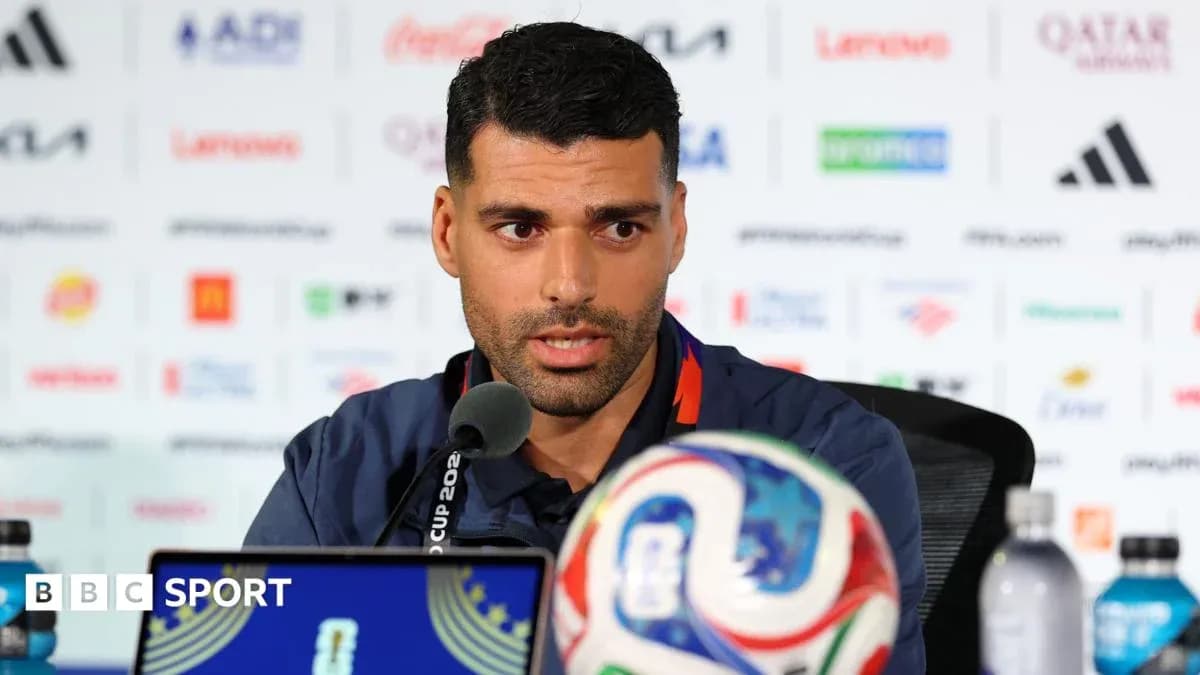
"This kind of tension undermines the joy of the World Cup," said striker Mehdi Taremi. He spoke like a man who has been living inside that tension for weeks.
"I felt the tension from the first moment we arrived. The tension started even before we got here."
It did. Long before a ball is kicked at SoFi Stadium against New Zealand, Iran’s campaign has been shaped by politics, logistics and suspicion.
Visa complications stalled plans. Security concerns grew. The political climate around the team darkened. Eventually, Iran abandoned their original World Cup base in Tucson, Arizona, and shifted across the border to Tijuana.
It was not a small decision. It was a statement that preparation would bend to politics, not the other way around.
A camp on the move, a squad on edge
Manager Amir Ghalenoei did not try to dress it up.
"Without any doubt, this kind of behaviour has impacted the spirit of football," he told the BBC. His words carried frustration, but also resignation.
"Football is supposed to bring nations and cultures together. It is about bringing joy. These conditions have affected our focus, but I have tried to make sure the players concentrate on strategy and performance."
He knows the clock has been ticking faster for his team than for most.
He pointed to the basics: late arrival, limited time to adjust, disrupted rhythm. The details that usually decide whether a team feels settled or scattered.
"But I know how committed these players are to performing," he added, leaning on the only certainty he has – the players’ willingness to shut out the noise, however impossible that might be.
Tehrangeles, divided
If any city could remind Iran that politics travel with them, it is Los Angeles.
The nickname "Tehrangeles" drew smiles from Ghalenoei and Taremi at the news conference, a brief moment of levity. But behind the joke lies a reality: this is the heart of the Iranian diaspora, the largest Iranian community outside Iran.
On Monday, many of them will head to SoFi Stadium. Not just to watch. To be seen. To be heard.
Fifa’s decision to ban the pre-revolutionary Lion and Sun flag – a potent emblem for Iranians abroad – has lit a fuse. For many in exile, that flag is not decoration. It is identity.
"You don't come to Los Angeles and tell us we can't fly the Lion and Sun flag," said activist Arezo Rashidian, one of those helping to organise protests outside the stadium.
"This is the largest Iranian community outside Iran. Many of us came here after the revolution. We're opposing Fifa's ban and standing in solidarity with the people of Iran."
For a significant part of this diaspora, the national team does not stand apart from the state. It stands alongside it.
"It's unfortunate that the regime turns athletes into mouthpieces," Rashidian said. "We want athletes to remain athletes."
Yet she will still be there. So will others who share her anger.
"We understand the pressure they're under," she said. "We'll carry our colours. We'll cheer for Iran – the country – held captive by the Islamic Republic."
That is the split in a single sentence: support for a homeland, rejection of the state that runs it, unease about the team that represents it.
A squad caught in the crossfire
Inside the camp, the players insist they are here for football.
"As players of the national team, we play for every single Iranian, whether in the diaspora or in Iran," Taremi said.
"In every country people have different opinions. We are here to unite people and bring joy. Everyone is entitled to their opinion. We don't get involved in politics."
It is the idealised version of international football – the game as a bridge, the dressing room as neutral ground.
But this World Cup keeps dragging Iran back into the real world.
"There is no winning for Iran's team," said investigative football journalist Samindra Kunti. He has watched the build-up, the pressure, the geography of it all.
"Given the circumstances, the political pressure, the location of the matches and the diaspora in Los Angeles, they're under enormous pressure."
"It's impossible to avoid the politics. Everything becomes a reminder of their situation."
The reminders are everywhere. In the stands, where some will wear the Lion and Sun in defiance. Outside the stadium, where chants will roll across the car parks long before kick-off. On social media, where every gesture, every silence, every anthem will be dissected.
The players are squeezed from three sides: from home, where the regime expects loyalty; from the host nation, where recent conflict has sharpened scrutiny; from a diaspora determined that this World Cup will not pass quietly.
All of that, and New Zealand still wait on Monday night, 02:00 BST, for a game that will finally put a ball at their feet.
For Iran, the World Cup begins in Los Angeles. The question is whether football will be allowed to start with it.
Related News
Raphinha’s Hat-Trick Powers Barcelona to 7-2 Victory Over Racing Santander
Carabao Cup Fourth Round Draw: Liverpool Set to Clash with Chelsea, Arsenal to Face Fleetwood Town
Key Football Matches to Watch in Azerbaijan This Autumn
Raphinha's Hat-Trick Drives Barcelona to 7-2 Triumph Over Racing Santander
Hansi Flick Leads Barcelona to Record-Breaking Seven Wins in a Row
Gavi Reflects on Injury Return as Barcelona Dominate Racing Santander 7-2