
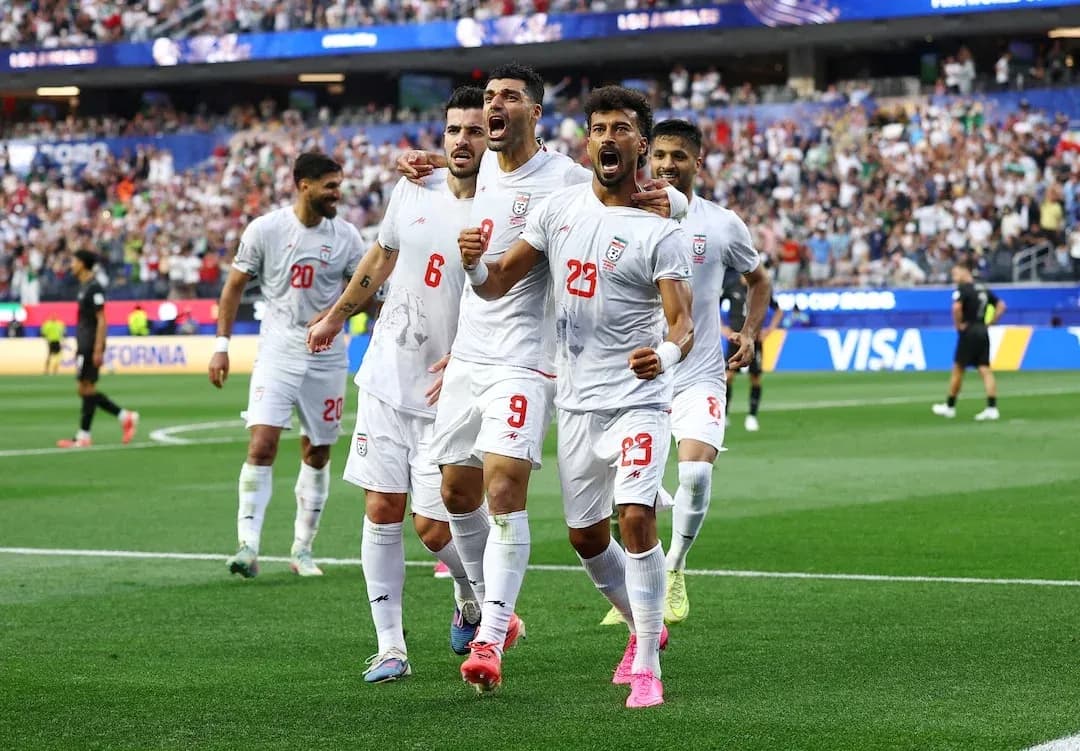
Iran and New Zealand Share Points in Tactical 2-2 Draw
Iran and New Zealand produced a tactically balanced 2-2 draw at SoFi Stadium, a match that oscillated between Iran’s structured 4-4-2 and New Zealand’s more fluid 4-2-3-1. Both sides had clear phases of control, and the underlying numbers underline just how even the contest was: Iran generated 17 shots to New Zealand’s 14, while New Zealand edged possession 52% to 48% and showed a cleaner passing game. The scoreline mirrored the tactical reality — neither side ever fully solved the other’s structure, and both coaches had to adjust on the fly.
New Zealand's Tactics
New Zealand’s 4-2-3-1 was built around Chris Wood as a focal point and a narrow band of three attacking midfielders behind him. Joe Bell and Marko Stamenić formed the double pivot, giving the All Whites a solid platform to circulate the ball and protect rest defence. Their 446 passes with 377 accurate (85%) reflect a side comfortable building through midfield, especially via Bell’s metronomic distribution. The early goal from Elijah Just at 7', assisted by Wood, came straight from this structure: Wood dropping to link, Just attacking the inside channel from the left of the three. It was a clear pattern — Wood as wall player, Just and Sarpreet Singh attacking the half-spaces.
Iran's Approach
Iran’s 4-4-2 under Amir Ghalenoei had a more direct, vertical feel. With Shahriar Moghanlou and Mehdi Taremi up front, the idea was to use the wide midfielders, Aria Yousefi and Mohammad Mohebi, to drive forward and deliver early. Iran’s 405 passes, 312 accurate (77%), show a slightly more risk-prone approach, looking to break lines rather than circulate endlessly. The full-backs, Milad Mohammadi and Ramin Rezaeian, were crucial in progressing play, especially Rezaeian, who not only equalised on 32' but later assisted Mohebi’s 64' strike. That dual impact underlines Iran’s reliance on full-back width to unlock New Zealand’s compact central block.
Defensive Strategies
Defensively, both teams had clear trade-offs. Iran allowed 8 shots on goal from 14 total, a high on-target ratio that put significant pressure on Alireza Beiranvand (Iran). His 6 saves were vital in keeping the game level, though the goals prevented figure of -0.2 suggests he conceded slightly more than the xG model expected from the shots he faced. Structurally, Iran’s 4-4-2 sometimes left Ezatolahi and Saman Ghoddos exposed against New Zealand’s three advanced midfielders, especially when the Iranian wide men were caught high. That created pockets for Just and Singh between the lines, which New Zealand exploited for both of Just’s goals, each again assisted by Wood.
On the other side, Max Crocombe (New Zealand) had a quieter but more concerning statistical night: only 2 goalkeeper saves despite Iran registering 4 shots on goal and an xG of 1.5. With goals prevented also at -0.2, the data hints that Iran’s finishing and chance quality slightly outstripped Crocombe’s shot-stopping. New Zealand’s back four, with Liberato Cacace and Tim Payne as full-backs, generally limited Iran to 10 shots inside the box and blocked only 2 efforts, compared to Iran’s 5 blocked shots. That disparity shows Iran’s back line throwing bodies in front of goal more aggressively, while New Zealand relied more on shape and possession to reduce danger rather than last-ditch interventions.
Substitution Patterns
The substitution pattern from Iran was clearly tactical rather than purely fitness-driven. At 46', the first change saw M. Ghaedi (IN) come on for A. Yousefi (OUT), signalling a desire for more direct dribbling and one-versus-one threat on the flank. At 53', A. Alipour (IN) came on for S. Moghanlou (OUT), offering fresher movement in behind and slightly different runs off Taremi. The timing is telling: Just’s second goal at 54' followed almost immediately, but Iran’s attacking reconfiguration helped them respond with Mohebi’s equaliser at 64', created by the advanced positioning of Rezaeian on the right. The later change at 65', with Ehsan Hajsafi (IN) for S. Ghoddos (OUT), added more defensive security and set-piece quality on the left side of midfield, balancing the risk Iran took by pushing Rezaeian high.
New Zealand’s substitutions were more about maintaining intensity and protecting legs within the same structure. At 68', Benjamin Old (IN) came on for Cacace (OUT), and Ryan Thomas (IN) replaced Callum McCowatt (OUT), refreshing both the left flank and central creativity. Later, at 78', Callan Elliot (IN) came on for Payne (OUT), another like-for-like full-back switch to preserve defensive solidity. In added time, Jesse Randall (IN) for Sarpreet Singh (OUT) and Tyler Bindon (IN) for Stamenić (OUT) at 90+2' suggested a late tilt towards fresh energy up front and additional defensive height, aiming to see out the 2-2 rather than chase a chaotic finish.
Discipline and Statistics
Discipline also reflected the tactical tenor. Iran committed 10 fouls to New Zealand’s 8, and the only card of the match went to Hajsafi at 89' — a Yellow Card for “Tripping”. That late caution encapsulated Iran’s willingness to break play to prevent transitions, especially once their midfield balance shifted with substitutions.
Statistically, the match was as even as the score. Iran’s 17 shots (4 on goal, 5 blocked) against New Zealand’s 14 (8 on goal, 2 blocked) show Iran as the higher-volume shooters, New Zealand as the more precise. New Zealand’s superior passing accuracy — 446 passes, 377 accurate (85%) versus Iran’s 405 and 312 (77%) — underpins their slight possession edge and more controlled tempo. In xG terms, Iran’s 1.5 to New Zealand’s 1.24 suggests Iran carved out marginally better chances overall, which aligns with their higher shot volume and territorial surges, particularly in the second half.
Yet both goalkeepers’ negative goals prevented values (-0.2 each) hint that finishing on both sides marginally outperformed the shot-stopping. That, combined with the tactical ebb and flow — Iran’s full-back-driven width against New Zealand’s structured 4-2-3-1 and Wood–Just axis — explains why a 2-2 draw in this World Cup group stage felt less like dropped points and more like a fair reflection of two coherent, contrasting game plans colliding without either fully imposing dominance.
Related News
Thomas Tuchel Reflects on England's 10-Man World Cup Triumph and a Surprising Regret
Robert Moreno Takes Over as Interim South Korea Coach After World Cup Setback

Jude Bellingham Returns to Form with Real Madrid After World Cup Success

Chloe Kelly, Beth Mead & 13 Lionesses Who Must Shine in the Upcoming WSL Season for England’s 2027 World Cup Bid
Barcelona Cancels World Cup Tribute Amid Political Tensions
Messi Breaks Record for Most Penalties Taken and Missed in FIFA World Cup History