
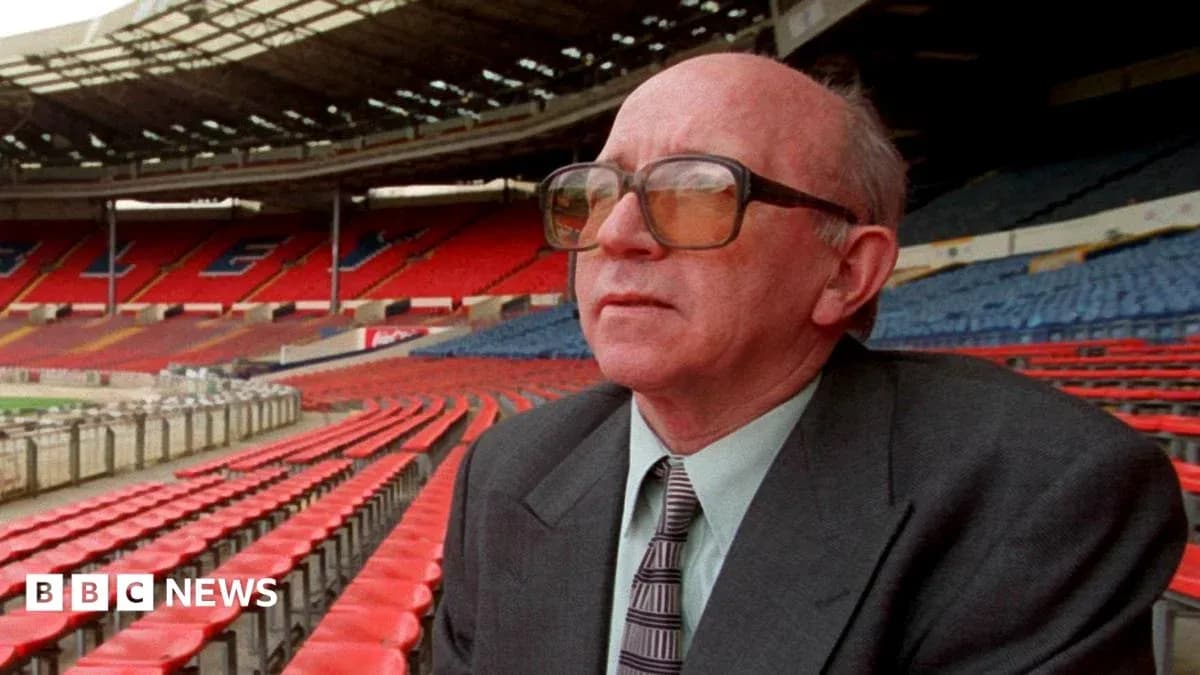
Inquest Ordered into Nobby Stiles’ Death Over Brain Injury Evidence
The game that made Nobby Stiles a national hero may also have helped to kill him.
A coroner has ordered a full inquest into the death of the 1966 World Cup winner after evidence showed he died with a traumatic brain injury, reigniting the debate over football’s duty of care to its former players.
Stiles, the toothless, tough-tackling midfielder who danced at Wembley with the Jules Rimet trophy in 1966, died in 2020 aged 78. A former Manchester United stalwart, he played nearly 400 times for the club and won 28 caps for England. Behind the glory, his final years were dominated by dementia.
Now, the circumstances of his death will be formally examined.
Coroner Cites Traumatic Injury
At Stockport coroner’s court, area coroner for Greater Manchester South, Chris Morris, confirmed that Stiles had been diagnosed posthumously with chronic traumatic encephalopathy (CTE) – a brain disease closely associated with repeated head impacts.
Morris told the court that Stiles’ brain had been examined by neuropathology expert Dr Daniel du Plessis, who reviewed both the tissue and the former midfielder’s medical records. Dr du Plessis concluded that Stiles’ primary cause of death was Alzheimer’s disease.
But that was not the full story.
The expert also found that high-stage CTE had contributed to Stiles’ death, alongside “stage three limbic predominant age related TDP-43” and small vessel cerebrovascular disease. That combination, crucially including a traumatic brain injury, was enough for the coroner to intervene.
“On the basis of that cause of death, particularly the inclusion of a traumatic injury included in the cause of death, I’m satisfied an inquest is required into the sad death of Mr Stiles,” Morris said.
He also revealed that Stiles’ death had not been referred to the coroner at the time in 2020, adding that “for reasons not entirely clear to me” the investigation only began after new information from the family. A full inquest hearing will now take place on Wednesday at the same court.
A Family Fighting for Answers
For Stiles’ relatives, this is not just a legal process. It is a campaign.
His son, John Stiles, has long argued that football “killed” his father. He now heads Football Families for Justice (FFJ), a group pressing the game’s authorities to better support former players living with brain disease and other long-term health problems they believe were caused by their careers.
The human cost has already been laid bare. Nobby Stiles was forced to sell his World Cup and European Cup winner’s medals to pay for his dementia care. Those medals, symbols of England’s greatest footballing triumph, became a lifeline to fund his decline.
He is one of dozens of former professionals, or their families, bringing legal action against the Football Association, the Football Association of Wales and the English Football League. The claimants allege the governing bodies were “negligent and in breach of their duty of care” by failing to protect players from the long-term risks of repeated heading and head impacts.
Lawyers for the families argue that football’s leaders knew, or should have known, for decades that repeated heading in training and matches carried a serious risk of brain injury.
Science, Responsibility and a Game Under Scrutiny
The sport’s authorities dispute that the science is settled. In March, lawyers for The Football Association told the High Court that it has “not been established by science” that heading a ball or “occasional” concussion can lead to permanent brain damage.
The tension between lived experience and formal evidence grows sharper with each new case.
In January, an inquest into the death of Gordon McQueen, the former Scotland, Manchester United and Leeds United defender, found that heading the ball was “likely” to have contributed to a brain injury that played a role in his death at 70. McQueen, like Stiles, was diagnosed with CTE.
His daughter, TV presenter Hayley McQueen, has spoken starkly about the toll on the generation that delivered England’s only World Cup. She said the 1966 winners had been “pretty much wiped out” by neurodegenerative disease.
The numbers are grim. A major study co-funded by The FA and the Professional Footballers’ Association in 2019 found that former professional footballers were three-and-a-half times more likely to die of neurodegenerative disease than people of a similar age in the general population.
Football has started to react. The FA is phasing out heading in youth football up to under-11s by 2026, a dramatic change for a sport built for more than a century on crosses, clearances and aerial duels.
But for the families of Nobby Stiles, Gordon McQueen and many others, the question is no longer about the next generation. It is about accountability for the past.
As the inquest into Stiles’ death finally begins, the image of him at Wembley in 1966 – socks down, teeth out, trophy in hand – now carries a darker edge. The joy of that summer remains untouchable. The cost of it is only just being counted.
Related News
Ilia Topuria Accuses Justin Gaethje After UFC Defeat

Tyson Fury vs Anthony Joshua Fight Date and Venue Confirmed
Switzerland Calls Up In-Form Sion Striker Winsley Boteli for Nations League
Bournemouth Secures Historic 2-1 Win Over Real Sociedad in Spain
Portugal Announces Squad for 2026 UEFA Nations League; Cristiano Ronaldo Expected to Play

Raphinha Channels Ronaldo Nazario as Barcelona's Leading Striker After Position Change