
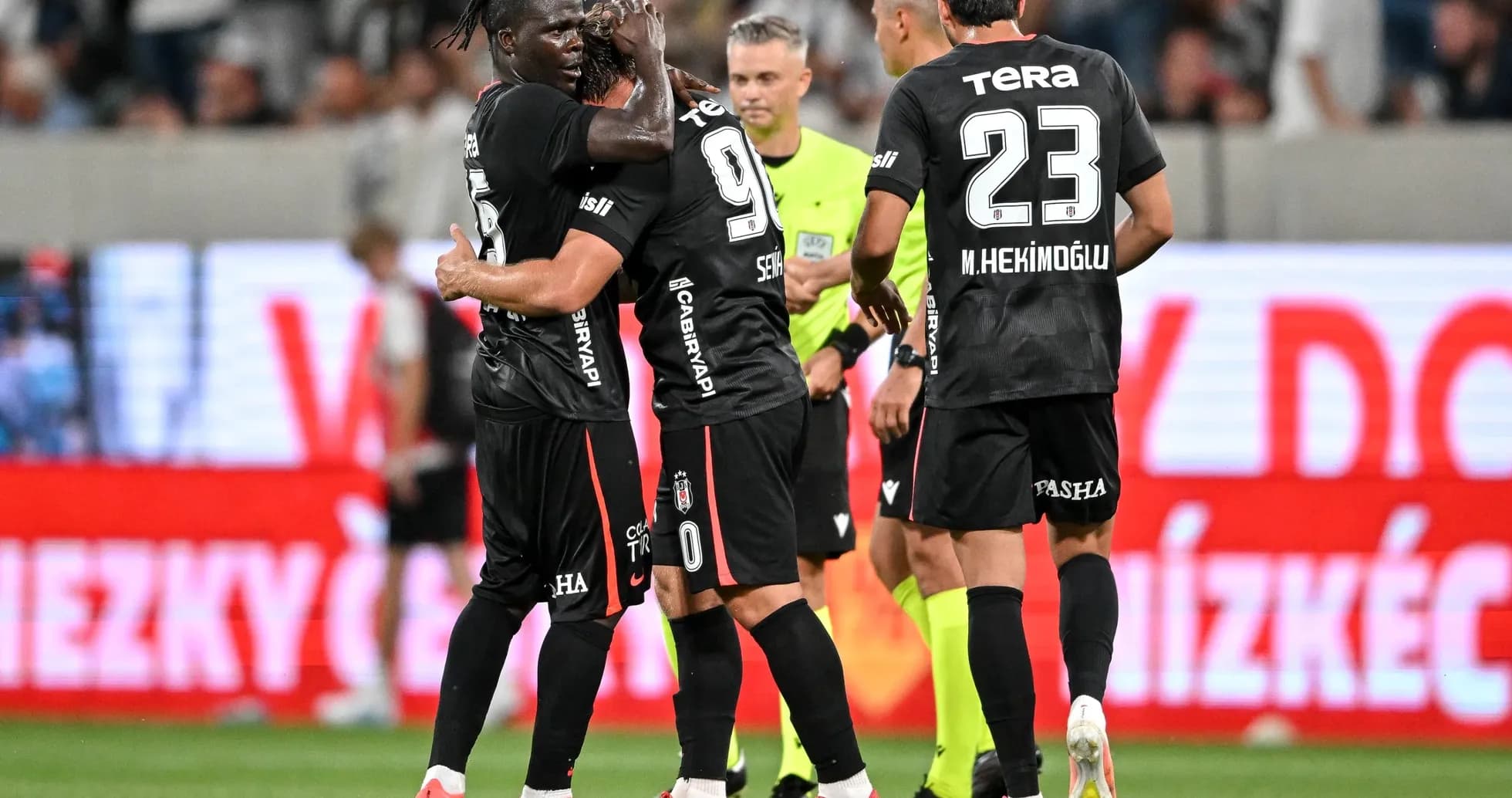
Hradec Králové vs Beşiktaş Tactical Analysis
Hradec Králové’s 3-4-2-1 at Malsovicka arena was built around territorial aggression and width, and the numbers back up how effectively they imposed themselves for long stretches despite the 0-1 defeat. With 48% possession against Beşiktaş’s 52%, the hosts were close to parity on the ball but far more direct in their use of it, generating 9 shots on goal from relatively limited build-up time. The back three of F. Cech, F. Cihak and J. Uhrincat allowed the wing‑orientated midfield four to push high, pinning Beşiktaş’s full-backs and creating a platform for repeated final-third entries.
The structure of the Hradec Králové midfield box was crucial. V. Darida and S. Dancak started centrally with J. Kucera and D. Horak as nominal wing-backs, but in possession the shape often resembled a 3-2-4-1. Darida operated as the main distributor, with Dancak more aggressive in stepping into half-spaces to support the front line. This helped Hradec Králové rack up 8 corner kicks, a clear sign of territorial pressure and repeated deliveries into the box. The lack of blocked shots (0) suggests Beşiktaş’s back line was often forced to defend deeper, allowing Hradec Králové to work clearer sightlines rather than having efforts smothered at source.
Up front, M. van Buren, T. Sloncik and O. Mihalik formed a fluid trio. Van Buren, carded as early as 2', set an intense pressing tone, harrying Beşiktaş’s first phase and forcing them to play longer than Vincenzo Italiano’s 4-1-4-1 typically prefers. His later withdrawal for A. Umar at 59' coincided with a tactical shift: Hradec Králové looked to inject fresh running in behind a Beşiktaş side that would soon go down to ten men. The simultaneous introduction of M. Valenta for S. Dancak at 59' further underlined David Horejs’ intent to maintain central energy and keep the tempo high in the second half.
Beşiktaş’s 4-1-4-1 was more measured but ultimately more clinical. With 52% possession, they controlled the rhythm rather than the territory, ending with 5 shots on goal from a total shooting profile of 16 attempts (5 on target, 11 off target). The double-digit off-target count illustrates a strategy of frequent shooting from varied positions, often at the end of more patient moves. The presence of S. Ozcan as the single pivot in front of the back four gave Beşiktaş a stable rest-defence platform, allowing the advanced midfield four — V. Cerny, J. Olaitan, O. Kokcu and I. Fakili — to rotate between lines.
Defensively, Beşiktaş’s 6 blocked shots were a defining tactical feature. The back four of K. Ouattara, E. Topcu, T. Djalo and M. Murillo held a compact line, stepping out aggressively to close down Hradec Králové’s shooters at the edge of the box. This high block count, combined with conceding 9 shots on goal, indicates that while Hradec Králové broke through regularly, many of their attempts were contested and forced under pressure. The defensive work rate was not always controlled — Ouattara’s yellow cards at 65' and 71', followed immediately by a red at 71', showed the cost of repeated last-ditch interventions on the left side.
The dismissal of Ouattara was the game’s tactical hinge. At 71', with Beşiktaş reduced to ten men, Italiano reacted quickly with a triple substitution at 76'. W. Ndidi (IN) came on for O. Kokcu (OUT), E. Agbadou (IN) for S. Ozcan (OUT), and S. Kilicsoy (IN) for V. Cerny (OUT). The net effect was a rebalancing of the structure: Ndidi added defensive steel and ball-winning in midfield, Agbadou reinforced the back line, and Kilicsoy provided a fresh outlet up front. Beşiktaş effectively morphed into a more conservative 4-4-1/4-2-3-0 hybrid, prioritising compactness and transitional threat.
That adjustment paid off on 80', when S. Kilicsoy struck the decisive goal. Coming only four minutes after his introduction, his impact epitomised Beşiktaş’s plan in the final phase: absorb pressure with a reinforced defensive block and break with efficiency through fresher legs. From that point, Hradec Králové doubled down on attacking changes — D. Trubac (IN) for T. Sloncik (OUT) at 81' added another creative profile between the lines — but the hosts could not convert their volume of shots on goal into an equaliser.
Beşiktaş’s late-game substitutions at 88', with M. Hekimoglu (IN) for Oh Hyeon-Gyu (OUT) and the earlier 76' reshuffle, further underlined a shift from a structured 4-1-4-1 to a more reactive, transition-focused shape. The foul count — 10 by Hradec Králové against 6 by Beşiktaş — aligns with this narrative: the hosts repeatedly had to stop counters and contest second balls after turnovers, while Beşiktaş, once ahead and a man down, focused on positional discipline rather than aggressive pressing.
In summary, Hradec Králové’s 3-4-2-1 produced pressure, corners and shots on goal, but lacked the cutting edge to translate that into scoring. Beşiktaş, operating from a 4-1-4-1 that evolved into a compact, ten‑man block, combined defensive resilience — showcased by 6 blocked shots and controlled foul numbers — with the decisive contribution of substitute S. Kilicsoy. The tactical story is of a home side that largely dictated where the game was played, and an away side that, through structure and in-game adjustments, dictated how it was decided.
Related News
Francesco Totti Reveals Offers from Top European Leagues at Age 48
Benfica Dominates AC Milan in UEFA Europa League Opener
Levski Sofia vs Red Bull Salzburg: Europa League Defeat Analysis
Five Europa League Players to Watch in the 2026/27 Season

Celje vs Red Bull Salzburg Predicted Lineups and Team News

Anderlecht vs Red Bull Salzburg Predicted Lineups and Team News