
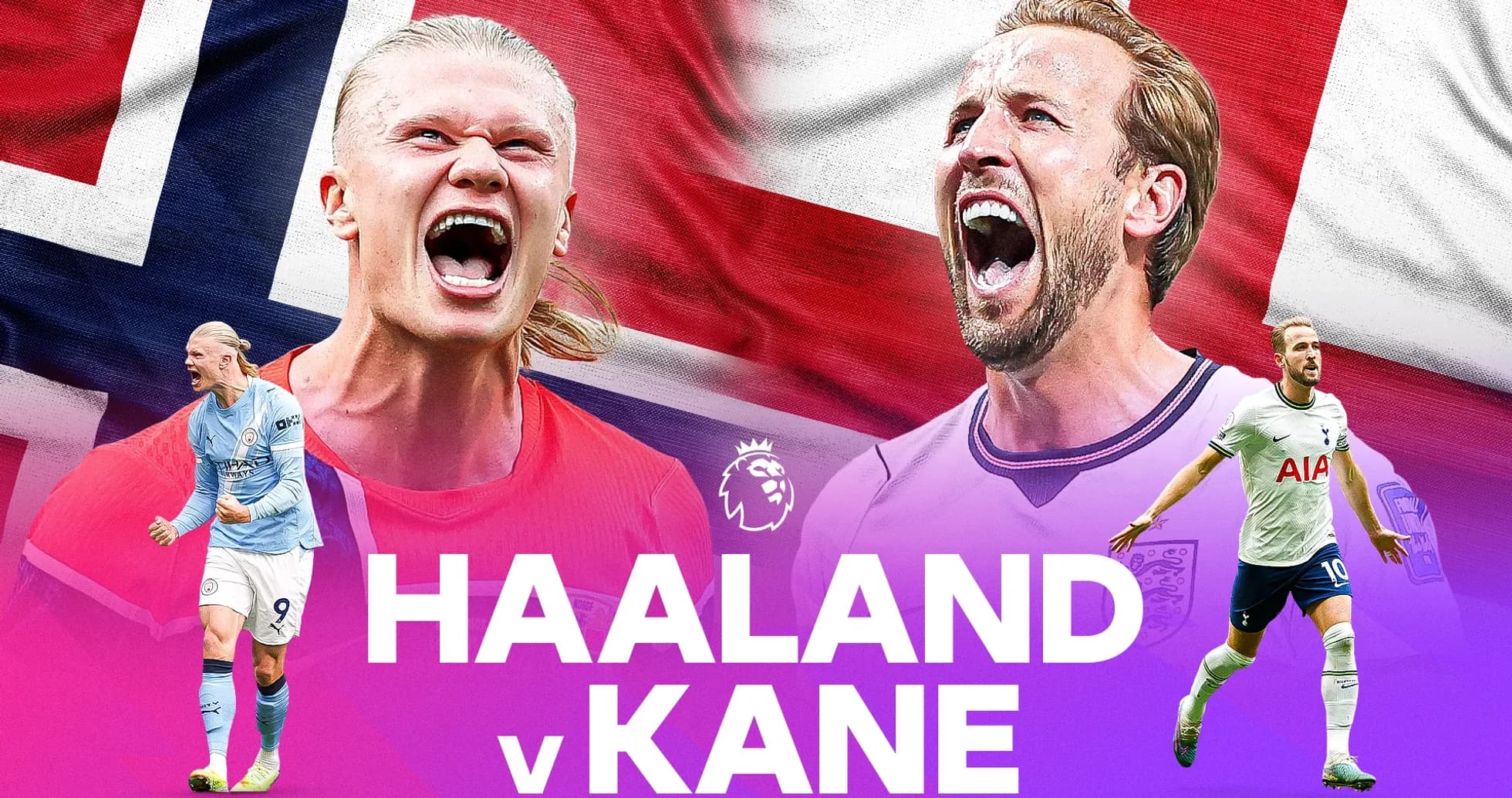
Harry Kane vs Erling Haaland: A Clash of Strikers
On Saturday in the 2026 FIFA World Cup quarter-final, England v Norway is being sold as Harry Kane v Erling Haaland. It is more than a marketing line. It is a clash between two strikers who define an era, yet play the position as if from different planets.
They share the same obsession – goals – and the same impact on teams and titles. But they do not share a style.
Haaland is blunt force. A ruthless machine who lives inside the penalty area, conserving energy, waiting for the moment to explode. He is cold, clinical, and utterly unmoved by the chaos around him. A hoarder of numbers and medals.
Kane is something else. A creator as much as a finisher, a conductor who sees the whole pitch and shapes it. He chose the number 10 shirt at Tottenham Hotspur for a reason: he has always seen himself as the heartbeat, not just the blade.
The rivalry has been strangely parallel. They overlapped in the Premier League for just a single season, 2022/23, barely sharing a stage in England. Yet their records already sit side by side in the history books, and Saturday in the United States offers a rare direct duel.
The numbers: Haaland’s insane rate, Kane’s towering total
Strip it down to the headline figures and both men belong in the Premier League’s inner circle of greats.
Haaland has 112 Premier League goals, already 25th on the all-time list. His strike rate is outrageous: 0.91 goals per 90 minutes, the best in the competition’s history.
Kane stands on 213 Premier League goals, second only to Alan Shearer’s 260. His rate? 0.71 per 90 – fourth-best of all time and sustained over a far longer period.
The gap in total goals is simple to explain. Kane spent nine seasons as a first-team regular at Spurs. Haaland has had only four in England.
Project Haaland’s numbers forward and the picture changes. At 0.91 per 90, he needs just 113 more Premier League games – roughly four more campaigns at his current average of 33 matches per season – to score the 102 goals required to overtake Kane and move into second place all-time.
Haaland’s current contract has eight years to run. He needs only half of that to catch Kane. Then, by the same logic, around 52 more games to chase down Shearer’s remaining 47-goal lead.
Give him time and the mathematics points one way: Haaland is on course to become the greatest goalscorer the Premier League has seen.
For now, though, Kane still sits higher on the mountain.
Peak seasons and early explosions
Their paths into the elite could hardly be more different.
Kane’s Premier League career was a slow ignition. He was 21 when he finally exploded under Mauricio Pochettino in 2014/15. From there he became a metronome of elite production, season after season.
Haaland arrived like a thunderclap. In his first year in English football, 2022/23, he smashed the single-season Premier League record with 36 goals. It was a statement that bent the league’s scoring landscape around him.
That same campaign was Kane’s last at Spurs. Amid the noise of Haaland’s record, Kane quietly hit 30 league goals – the second time in his career he had reached that landmark.
Look at the top five single-season tallies between the two and Kane’s consistency shows:
- Haaland – 36 goals (2022/23)
- Kane – 30 goals (2022/23)
- Kane – 30 goals (2017/18)
- Kane – 29 goals (2016/17)
- Haaland – 27 goals (2025/26)
Haaland owns the highest peak, but Kane has more seasons in that elite bracket. The caveat is obvious: Haaland has had fewer years to stack those campaigns.
Records, awards – and the weight of trophies
On the record front, the honours are split.
Haaland holds the record for fastest player to 100 Premier League goals, the most goals in a single season, and the best per-90 scoring rate ever in the competition.
Kane counters with longevity and loyalty: the most goals for a single Premier League club (213 for Spurs) and the most goals in London derbies (51).
The personal awards column is tight, which is significant given Haaland is seven years younger and still accelerating.
Haaland’s individual honours:
- 5 Golden Boots (3x Premier League, 2x UEFA Champions League)
- 3 Player of the Year awards (1x Premier League, 1x Bundesliga, 1x UEFA)
- 1 European Golden Shoe
Kane’s individual honours:
- 9 Golden Boots (3x Premier League, 3x Bundesliga, 1x UEFA Champions League, 1x World Cup, 1x Euros)
- 1 Player of the Year (Bundesliga)
- 2 European Golden Shoes
Then come the team trophies, where Haaland surges ahead.
Haaland’s clubs have collected:
- 3 league titles (2x Premier League, 1x Austrian Bundesliga)
- 1 UEFA Champions League
- 5 domestic cups (2x FA Cup, 1x EFL Cup, 1x DFB-Pokal, 1x Austrian Cup)
Kane’s haul is slimmer:
- 2 league titles (both Bundesliga)
- 1 domestic cup (DFB-Pokal)
It is the old debate. Do you judge a striker by medals or by the difficulty of the environment in which he scores? Kane’s supporters will argue his years outside the title-winning elite only make his numbers more extraordinary.
Kane in Germany, Haaland for Norway: elite in different worlds
Kane’s move to Bayern Munich has added a new layer to that argument.
His Bundesliga record is astonishing: 98 goals in 94 matches. Those are Lionel Messi and Cristiano Ronaldo figures, the kind of output usually reserved for players operating in dominant, chance-rich sides.
It raises an uncomfortable hypothetical for Premier League defences. If Kane had spent his English peak under Pep Guardiola at Manchester City, feeding off the volume of opportunities Haaland enjoys, how far past Shearer would he be already?
Haaland has his own version of that thought experiment – on the international stage.
For Norway, he has 62 goals in 54 caps. He scores at a rate of 1.26 goals per 90 minutes and has found the net in each of his last 14 internationals. Those numbers are staggering for any country, let alone one that does not sit at the game’s top table.
Kane’s England record is superb in its own right: 85 goals in 119 caps, at 0.83 per 90, and he is his nation’s all-time leading scorer. Yet Haaland’s ratio is on another level.
Side by side, the international picture looks like this:
- Haaland: 54 caps, 62 goals, 1.26 goals per 90
- Kane: 119 caps, 85 goals, 0.83 goals per 90
Different teams, different ceilings, the same relentless drive.
As of now, one man stands on top
Put it all together and the comparison lands somewhere in the middle.
Kane leads many metrics because he has simply been around longer. Haaland has more major team honours because he has played more years inside title-winning machines. One has built an empire over time; the other is still laying floors at breakneck speed.
Yet as of July 2026, one detail cuts through the noise.
Across all club competitions in 2025/26, Kane scored more goals than anyone in Europe. Not just more than Haaland. More than everyone.
The leaderboard reads:
- Kane – 61 goals
- Kylian Mbappe – 42 goals
- Haaland – 38 goals
That margin is not narrow. Kane finished 19 clear of Mbappe, 23 clear of Haaland. At 32, he produced the most prolific season of his career and the most prolific season in Europe.
Right now, that makes Harry Kane the best striker in the world.
On Saturday, under World Cup lights, Erling Haaland has 90 minutes – or perhaps 120 – to argue with that.
Related News

Ilia Topuria Accuses Justin Gaethje After UFC Defeat

Tyson Fury vs Anthony Joshua Fight Date and Venue Confirmed

Switzerland Calls Up In-Form Sion Striker Winsley Boteli for Nations League

Bournemouth Secures Historic 2-1 Win Over Real Sociedad in Spain

Portugal Announces Squad for 2026 UEFA Nations League; Cristiano Ronaldo Expected to Play

Raphinha Channels Ronaldo Nazario as Barcelona's Leading Striker After Position Change