
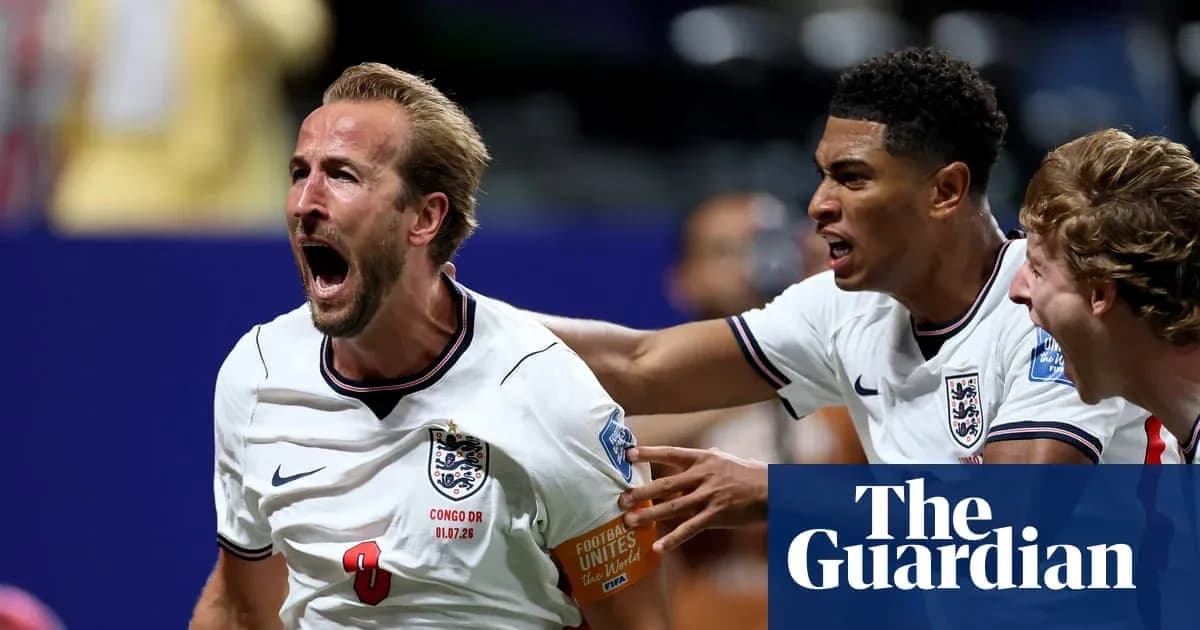
Harry Kane's Defining Moment: A Legacy in the Making
Thierry Henry leaned back in the Fox studio, watched the replay of Harry Kane’s second against the Democratic Republic of the Congo, and winced in admiration.
“Striking with the inside of the foot, almost wrapping the ball while the body is off-balance,” he said. “Do you know how hard it is to generate power then? At the end of the game? To redirect it like that? If I did that now, I’d break my back.”
From a man who turned ruthless finishing into an art form, that wasn’t flattery. It was recognition.
Kane’s winner in Atlanta was more than a clean strike. It was a study in controlled violence. He didn’t just swing a leg; he rotated through his entire frame, arms whipping through the air to squeeze every last ounce of force out of a tired body, happy to crash to the turf if that’s what the moment demanded. A centre-forward at full physical power, trusting his mechanics, trusting his preparation.
England’s captain has called it one of his favourite goals for his country. It is easy to see why. It kept England in the World Cup. It probably kept Thomas Tuchel in a job. And it felt, in real time, like the night Harry Kane finally planted a flag in the ground and said: this is my tournament.
A modern great, still climbing
Strip the emotion away and the numbers are brutal. Those two goals against the DRC were his 83rd and 84th for England in 118 caps. He has already left the rest behind as the country’s leading scorer. He has five goals in England’s first four games at this World Cup, right in the thick of the Golden Boot race again. Gary Lineker’s World Cup scoring record? Gone.
This is no longer a debate about whether Kane belongs among the greats. It is about where he sits. Top 10 all time for England feels conservative now. On the Stick to Football podcast this week, Gary Neville, Roy Keane, Ian Wright and Jill Scott talked about him in the same breath as Bobby Moore and Sir Bobby Charlton, weighing up a top three of all-time England players. That conversation no longer sounds outlandish.
The difference with Kane is that his career graph still points upwards. The longer he has played, the more complete he has become. He is still the ruthless finisher, but he is also the creator who drops off the front line to thread passes nobody else sees. No striker in the modern game is better at turning into a No 10 for 10 seconds and slicing a defence open.
And yet, for all the goals, one charge has always stuck: where is the defining performance at the sharp end of a major tournament?
Moore lifted the World Cup as captain in 1966. Charlton won the Ballon d’Or that same year. Kane has had big moments, big numbers, but not the crowning display when the stakes are highest. He faded at previous tournaments, sometimes arriving short of full fitness. He was quiet in the Euro 2020 final. In Qatar in 2022, he dragged England to the brink against France, then ballooned that late penalty that would have made it 2-2 in the quarter-final. This summer, some were ready to write him off after he was substituted in the Euro 2024 final defeat to Spain.
The narrative was simple: Kane is slowing.
Fitter, faster, hungrier
This season, for club and country, Kane has scored 72 goals. He is in the Ballon d’Or conversation. At this World Cup he has covered 43,433 metres, more ground than any other England player. Those are not the numbers of a man winding down.
They are the numbers of someone who has rebuilt his body for the demands of his thirties.
“It’s probably the best I’ve felt in my career,” Kane said. He talked about making a conscious decision at the start of the season to go again, to be even fitter, to obsess over recovery, to search for marginal gains. The winter break in Germany has helped. So has Bayern Munich’s ability to rest him during routine Bundesliga wins.
You can see the work in that second goal against the DRC. The way he twists, the way he lands, the way the shot explodes off his boot at the end of a draining contest. That is conditioning as much as talent.
“I look at my stats after each game and it’s really pleasing,” he said. There is a relentlessness to the way he speaks about his own improvement. No complacency, no sense that the records are enough.
His running sets the tone. “If you’ve got the leaders training and running like I do, it only helps,” he said. “I’m willing to run more and do whatever it takes to help the team.” That is not just a line. It is visible every time he drops into midfield to link play, then sprints into the box to finish the move.
Carrying a flawed contender
England need every metre from him. Because beyond Kane and Jude Bellingham, this is a team with problems.
The wingers have promised more than they have delivered. The midfield looks leggy. The defence has wobbled. There is an injury crisis at right-back. Now comes Mexico in Mexico City, the Azteca Stadium crackling, altitude biting at the lungs, a rampant home side playing for pride and a place in the last eight.
Kane is under no illusions about the physical challenge. “There is not much we could do with altitude training,” he said. England tried to prepare with 10 days of heat work in Florida, but the thin air is different. “The altitude was almost impossible to prepare for, unless we stayed in Mexico the whole time or based there for 10 days. Logistically, that wouldn’t have been great for the rest of the tournament. It wouldn’t have been worth it.”
So they will walk into the furnace and deal with it.
“It’s a big talking point and will have a small difference but we’re professional athletes. We have to deal with adversity every now and then. We’re doing as much as we can with little tips to help us. We’ll have to deal with it. There is no other way around it. If we get through it then all of those things will make the win feel even more special.”
This is how Kane frames everything now: as another obstacle to be managed, another variable to be controlled. He talks about peaking at the right time, about building into tournaments rather than exploding out of the blocks.
Kyle Walker, watching on as a former England right-back, liked what he saw against the DRC. He argued there are times when there is nothing better than winning after playing badly.
Kane agreed. “You very rarely see the team come out of the gates hot and then sustain that all the way through to the end,” he said. “Tournament football is about getting used to each other. What you do learn in tournament football is that there’s not always a perfect way to win.”
Against Mexico, he knows the script might be ugly. “We hope that we can play our style but we’re coming up against a team who are playing at home, playing for pride, playing for a place in the next round of the World Cup. You might need to grind it out. You might need to find a difficult way to win.”
Voice of a captain
What has changed most about Kane is not his finishing or his running. It is his voice.
He has always led by example. Now he leads with words. After the final whistle in Atlanta, he gathered his team-mates into a huddle on the pitch and delivered a message. No cameras, no choreography, just a captain deciding the moment needed something extra.
“It’s something I don’t normally like to do in a public situation,” he admitted. “Sometimes I feel like it can look a little bit staged.”
This wasn’t that. “It was more just to make sure we celebrated that moment. After the Panama game I felt like we didn’t really celebrate the moment as much as we probably should have. It’s easy as an England player sometimes to take things for granted and just say: ‘OK, we beat Panama, we’re top of the group, it is what it is.’ But that’s not always been the case for England.”
Kane has lived the other side. The underachievement. The near-misses. The weight of the shirt. He wants this group to feel the wins, to bank the emotion, to build new memories rather than be haunted by old ones.
Against the DRC, he also had to master his own frustration. In the first half he was denied what he was convinced was a clear penalty after colliding with goalkeeper Lionel Mpasi.
“It’s a clear penalty,” he said, still irritated. He described the speed of the run, the push in the back, the moment he reached the ball first and the split-second decision: jump over the keeper and probably fall without a foul, or brace for impact and protect himself.
“It’s not my problem that the keeper’s come rushing out,” he said. “He’s initiated the contact, he’s hit me, I’m falling over, and I’ve tried to protect myself. If I keep my leg planted in the floor you risk serious, serious injury. It is a foul. If it wasn’t the keeper and was just a defender using his feet, it’s a foul. I was really surprised it wasn’t given, I was really surprised VAR didn’t intervene as well.”
He could have stewed on it. Instead, he reset and decided the game anyway.
“In the end it doesn’t matter because we won,” he said. But nights like that do matter. They shift how a player is seen, how a legacy is written.
For years, Kane has been England’s great accumulator: of goals, of records, of individual accolades. Now, in the heat of Mexico, with altitude in his lungs and a nation on his back, he has the chance to turn accumulation into coronation.
The question is no longer whether he belongs in England’s pantheon. It is whether this World Cup will finally give him the defining moment to sit alongside Moore and Charlton – not just in the conversation, but in the history books.
Related News
Ilia Topuria Accuses Justin Gaethje After UFC Defeat
Tyson Fury vs Anthony Joshua Fight Date and Venue Confirmed
Switzerland Calls Up In-Form Sion Striker Winsley Boteli for Nations League
Bournemouth Secures Historic 2-1 Win Over Real Sociedad in Spain
Portugal Announces Squad for 2026 UEFA Nations League; Cristiano Ronaldo Expected to Play
Raphinha Channels Ronaldo Nazario as Barcelona's Leading Striker After Position Change