
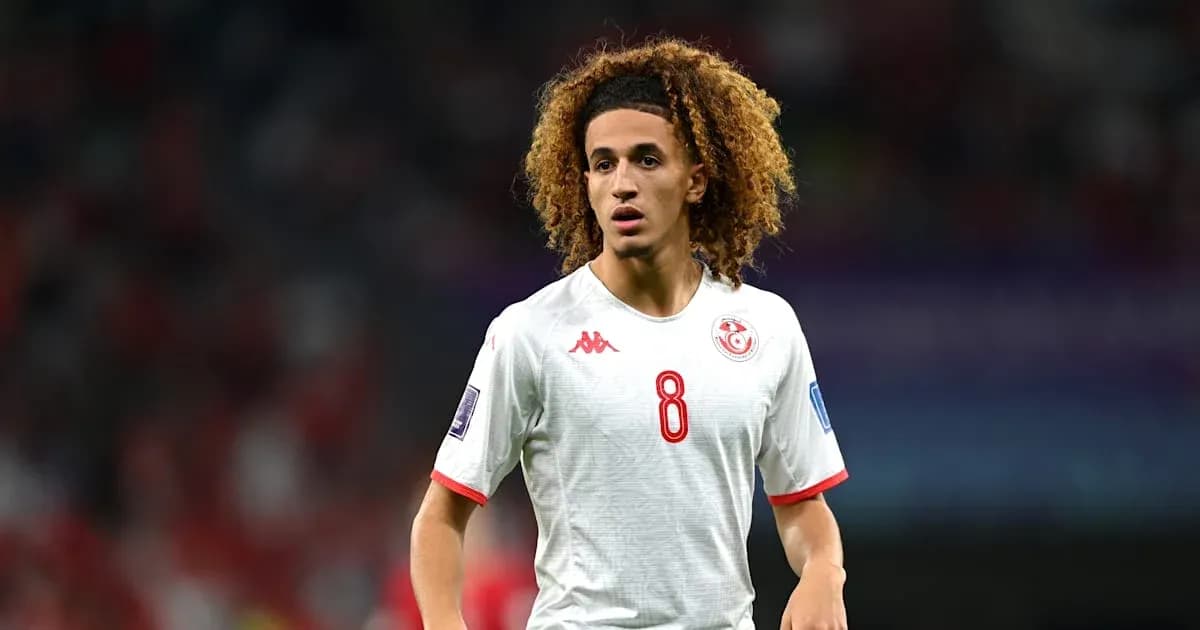
Hannibal Mejbri: From La Banane to the World Cup
The Eagles of Carthage have carried many fine players, but few names fit the shirt quite like his.
Hannibal.
Not the general on an elephant, but a 23-year-old midfielder with a shock of blond curls and a restless energy that now drives Tunisia towards the 2026 FIFA World Cup. The echoes are obvious. Another Hannibal, another mountain to cross, another empire to challenge. This time, the target is far simpler and yet historically elusive: getting Tunisia out of the group stage.
From La Banane to the world
Hannibal Mejbri’s story does not begin in Tunis, but in Paris’ 20th arrondissement, a dense, working-class slice of the capital where football fills the gaps that life leaves.
He was born there to Tunisian parents and grew up in a neighbourhood he describes as a mix of “many Tunisians, many Algerians, many Moroccans, lots of Senegalese, Malians as well” — a crossroads of North and West Africa squeezed into a few city blocks. In that world, a ball is never far away, and language is less important than first touch.
At the heart of the area stands a curved block of flats known as La Banane. It is ordinary concrete, but for Mejbri it became a launchpad. The courtyard, the surrounding streets, the makeshift pitches: that was his first training ground.
“Instead of going straight up to my house, I used to stay out and play football until night fell,” he recalls in the series World at Their Feet, which follows emerging talents on the road to the 2026 World Cup. No academies, no private coaches, no grand plan. “I was a normal boy, there was no master plan. I had my friends, I was focused on my life as a kid.”
The boy was not easy to miss. Childhood friend Hubert Mbuyi remembers the talent, but also the silhouette.
“He had a unique style, with big hair, big blonde hair. So everyone knew him and had a lot of expectations for him,” Mbuyi says. The hair became a beacon. “Where you could find a pitch and a ball, you will find Hannibal.”
The fast lane: Paris, Monaco, Manchester
Organised football arrived early. Mejbri joined Paris FC’s academy at six, staying for most of the next seven years. The club gave structure to the street skills, a framework around the instinct. A short spell at Boulogne-Billancourt followed, the kind of stepping stone that dots many French careers but rarely makes headlines.
The turning point came in 2018. Monaco, then one of Europe’s most fertile talent factories, moved for the 15-year-old, paying €1 million to bring him into their academy. For a kid from La Banane, the contrast was jarring.
“I could feel the richness of Monaco,” he says. “So yeah, it was a little bit of a shift, a little dream, and I learned a lot there.”
The experience on the pitch did not always match the dream. He did not have the smoothest of stays, but his ability and potential were impossible to ignore. Bayern Munich, Paris Saint-Germain, Barcelona — the roll call of suitors read like a Champions League draw.
He chose Manchester United.
In August 2019, at 16, Mejbri signed for the three-time European champions, stepping into the glare of Old Trafford with a confidence that belied his age. His rise through the ranks was brisk. By 2021, he had his Premier League debut. Two years later, in September 2023, came the moment every academy graduate chases: a first top-flight goal for the club.
It arrived in a 3–1 home defeat to Brighton. United were 3–0 down when he struck, a fierce consolation that barely changed the scoreline but meant everything to the scorer.
“I still get chills,” he says. “I don’t know why I started to celebrate when we were losing 3–0, and you can see in my celebration that I had a certain rage in me and that I let go of everything when I scored.”
The result was forgettable. The feeling was not.
Choosing a flag with the heart
On the international stage, Mejbri had options. He represented France at under-16 and under-17 level, a natural path for a Paris-born prodigy in one of the world’s deepest talent pools.
Then came 2021, and a call from Tunisia.
He did not hesitate.
“I joined Tunisia because I chose with my heart,” he explains. “Even though I lived in France, it doesn’t take away the love I have for France. But I find that the love I have for Tunisia is greater.”
That decision changed the trajectory of his career and his life. The Eagles of Carthage gained a midfielder who plays with the intensity of someone constantly proving a point — to himself, to his roots, to the people who watched him grow up.
He has already amassed 44 caps and has twice been named African Revelation of the Year at the Africa d’Or awards. The honours matter, but they are not what he thinks about when he pulls on the red shirt.
“When I represent my country, I also represent my neighbourhood,” he says. “Because I know that I will represent them, and so all of that, it’s a bit related to pride.”
The pride is mutual. Mbuyi sees it every time Tunisia play.
“All Tunisians are proud of him,” he says. “Because in the end, he’s a kid from the neighbourhood. When he plays matches, everyone focuses on the match. We’re all watching Hannibal’s hair on the pitch. We try to spot him every time.”
Giving back to La Banane
The link between Mejbri and La Banane has never frayed. Every summer, he returns to the block that shaped him and stages a football tournament for the community. It is not a photo opportunity. It is a ritual.
Last year, he handed out around 100 shirts. The impact is visible on any random day.
“You can just walk around here and find two or three people wearing his shirt,” Mbuyi says.
For the kids chasing a ball between parked cars and concrete walls, the message is clear. Someone from their staircase, their courtyard, their pitch, made it. Not just to a professional club, but to Manchester United. Not just to a national team, but to the World Cup.
“Hannibal is a great example of what the people look for in this area,” Mbuyi adds. “Because of him, the young kids can dream.”
Now, as the 2026 World Cup looms, those dreams stretch far beyond La Banane. Tunisia have never climbed out of the group stage. They have never turned promise into a deep run on the biggest stage. With Mejbri at the heart of their midfield, with that restless energy and that name echoing through history, the Eagles of Carthage are daring to believe that this time, they might finally cross their own Alps.
Related News
Raphinha’s Hat-Trick Powers Barcelona to 7-2 Victory Over Racing Santander
Carabao Cup Fourth Round Draw: Liverpool Set to Clash with Chelsea, Arsenal to Face Fleetwood Town
Key Football Matches to Watch in Azerbaijan This Autumn
Raphinha's Hat-Trick Drives Barcelona to 7-2 Triumph Over Racing Santander
Hansi Flick Leads Barcelona to Record-Breaking Seven Wins in a Row
Gavi Reflects on Injury Return as Barcelona Dominate Racing Santander 7-2