
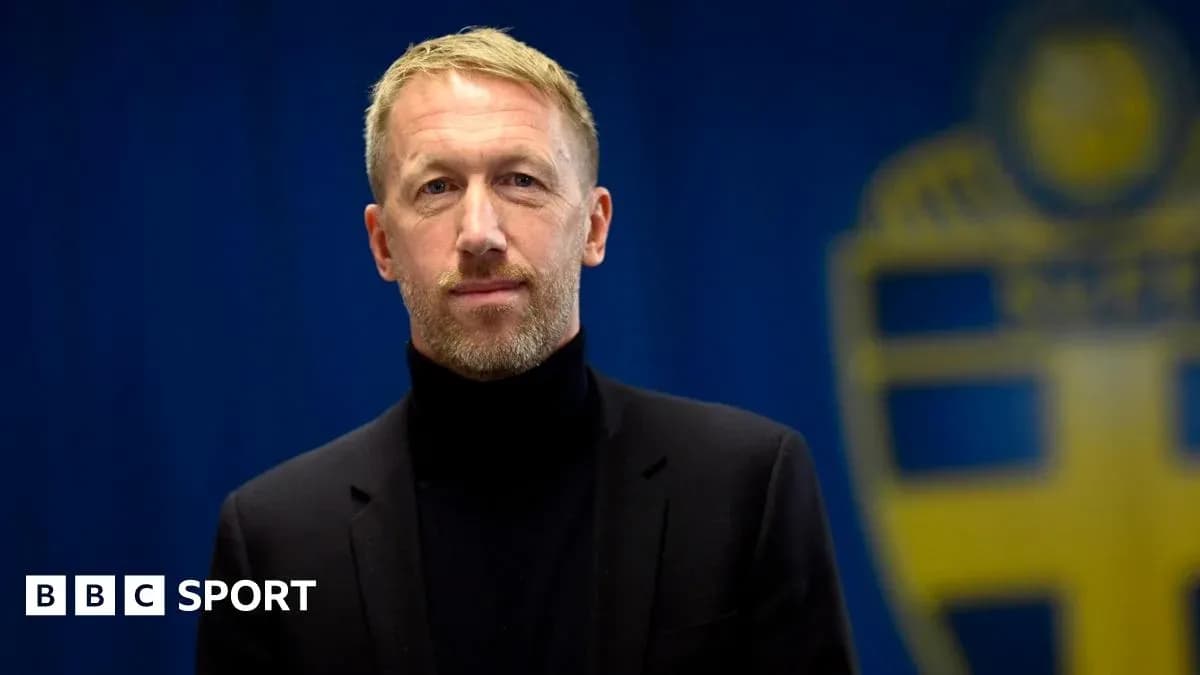
Graham Potter's Journey to World Cup Glory with Sweden
Graham Potter stood on the touchline in Stockholm, arms spread wide, swallowed by the noise. “We are going to the World Cup, baby.”
The words were his, but the moment belonged to a country.
Viktor Gyokeres had just crashed in an 88th‑minute winner against Poland, a wild, nervy 3-2 play-off finally tipping Sweden’s way in front of 50,000 at Strawberry Arena. Substitutes sprinted on. Yellow shirts blurred into one. For a few seconds, order disappeared.
“Viktor scores and it's like an out of body experience,” Potter said later. “All our subs are running on the pitch. There's 15 players on the pitch and I'm thinking, 'That's yellow cards, that's problems'. But of course it's a World Cup, so all the rules are out the door.”
For a manager who has worn failure in public in England, this was something else entirely. The best night of his career. He said it twice. He meant it.
From sackings to Stockholm
Potter is 51 now, old enough to have been scarred by the game and still young enough to chase something bigger. The scars are obvious. Chelsea first, then West Ham. Two big Premier League jobs, two short and bruising exits. Seven months at Stamford Bridge, eight at the London Stadium. Both over by last September.
“It hurt. They are painful experiences,” he admitted. “I have lived failure. I've had quite a bit of success too. That's what life is.”
He talks about perspective, about listening only to the people who matter, about trying to be grateful for the worst days as well as the best. It sounds like a coping mechanism because it is.
“You have to deal with the failure, but you become a better person for it, that's for sure.”
On that night against Poland, the better person finally got the better script.
When the final whistle went, the release inside Strawberry Arena felt almost physical. Years of near misses, a missed World Cup in 2022, the pressure of a one-off play-off. Gone in an instant.
“The feeling in the stadium was just incredible,” Potter said. “It's so nice to have to experience positivity through football, because obviously recently I haven't had too much of that.”
How did he celebrate? He laughed the question away. “What do you think I did?” A few drinks, a few hours when the noise of English football and its judgments stayed firmly on mute.
He still refused to get lost in it.
“You're never quite as good as you say when you're there [high], and you're never quite as bad as they say when you're there [low]. So, you've got to find some way of keeping some perspective.”
The Englishman who feels Swedish
If Potter sounds unusually at ease in Sweden, it is because this is where his coaching life truly began. Long before Chelsea, before Brighton and Swansea, there was Ostersunds FK in the Swedish fourth tier.
He arrived as an unknown and left as a cult figure, having climbed from the regional backwaters to the Allsvenskan, won a domestic cup and taken a tiny club into Europe. Seven years that changed his career and, by his own admission, his identity.
“I feel very Swedish when I'm working,” he said. He sings the national anthem before matches. He speaks the language. “I even look a bit Swedish. Two of my children were born in Sweden. I had seven unforgettable years at Ostersunds, with memories that will stay with me for life.”
He knows the system, the clubs, the culture. He knows what it means for Sweden to be back on the biggest stage.
“I came from the fourth tier of Swedish football, which is quite low, and worked my way up through the system to the Allsvenskan. You almost become Swedish in a coaching sense because of the experiences you have. I think it has definitely helped.
“Now I'm working for the Swedish FA as head coach of the national team, so I feel very Swedish.”
His reference points are Swedish too. Mention the World Cup and he goes straight to 1994 in the United States, the bronze-medal run that still shapes the country’s football memory. He even recalls the tournament song – “När vi gräver guld i USA” – lodged in the same cultural space as “World in Motion” and “Three Lions” in England.
No wonder the short-term deal he signed in November, replacing Jon Dahl Tomasson, never felt like a risk to him. It was a calculated return home. The Swedish FA agreed. Before a ball was kicked in March, they extended his contract to 2030.
Now he is guaranteed to lead Sweden into this World Cup, and, if they qualify, Euro 2028 and the 2030 World Cup as well.
“Maybe in England we have taken it for granted because we usually qualify,” he said. “But the reality is that many countries do not, so it is special when they do. It is also very important for the finances of the football structure.”
The achievement has not gone unnoticed. A message dropped in from Zlatan Ibrahimovic, “one of the kings of Sweden”, as Potter put it. Another sign that the Englishman has been accepted at the top table.
Isak, Gyokeres and a new Swedish edge
If Sweden are to do more than just turn up in Group F, they will lean heavily on two of the Premier League’s most expensive forwards.
Alexander Isak, now at Liverpool after his £125m move from Newcastle last summer, and Viktor Gyokeres, the £55m Arsenal striker who has just fired his club to the Premier League title and a Champions League final, give Potter something Sweden have not always had: genuine, high-end firepower.
“I think they are different in their styles, which is good for us because you can hopefully use them effectively,” Potter said. “The honest truth is that we haven't played them together yet in my time, so that will be exciting to develop. If we can get them enjoying their football and firing, they are top players.”
Isak has barely featured under him, his first season at Anfield shredded by injuries and the weight of a record fee.
“It can take a bit of time,” Potter said. “At the biggest clubs there is pressure and expectation, and when expectation and reality begin to diverge, it can create problems. His injuries have been disappointing, but I know him well. He is a top professional who wants to play and help his team.”
Gyokeres arrives from a different angle. Twenty-one league goals, a title, a Champions League final – and still critics. That, Potter says, is the modern game.
“From our perspective, he has scored four goals in two matches and helped take us to the World Cup, so his impact has been significant.”
The relationship between coach and strikers goes back further than this qualifying run. Potter still remembers Isak as a teenager at AIK, scoring on his professional debut against Potter’s Ostersunds side at 16. Even then, the talent was unmistakable. Now both meet again, with the stakes immeasurably higher.
Sweden’s group – Tunisia, the Netherlands and Japan in Group F – offers danger without glamour. No obvious superpower, no straightforward path either. If Isak and Gyokeres click, Potter suddenly has a front line capable of unsettling anyone.
San Diego heat, Stockholm calm
As one of the last nations to qualify from an expanded 48-team field, Sweden had slim pickings when it came to training bases. They ended up at SDJA, a high school facility in San Diego.
Some coaches might bristle at that. Potter does not. He talks up the facilities, talks about the value of set-pieces in the heat, talks about the human side of squad selection.
He calls those conversations “the toughest” he has had as a father and as a human being. Players cut from a World Cup squad do not forget the phone call. Managers do not either.
Where England will decamp to Miami before the tournament, Sweden will stay rooted in Stockholm until they fly. Time with family and friends, a chance to decompress after long club seasons. Potter sees value in the quiet.
The build-up will include friendlies against Norway and Greece. Then comes the real thing: Tunisia on 15 June, Sweden back on the world’s biggest stage for the first time since 2018.
From Maradona on TV to the touchline
Potter’s first World Cup memory is not Swedish at all. It is Diego Maradona in 1986, an 11-year-old boy watching genius unfold on a television screen.
“My first football memory is from 1986 - I was 11, watching Diego Maradona,” he reflected. “That was when I realised how special the game was. To work in that environment now is a dream.”
From Ostersunds’ frozen pitches to Strawberry Arena in full roar, from sackings in London to a World Cup ticket with Sweden, his career has twisted in ways even he could not have scripted.
Now comes the hard part. The qualifying miracle is banked. The contract is signed. The anthem is learned and sung. The country is behind him.
The next chapter will not be judged on how loudly Sweden celebrate getting there, but on what Graham Potter and his adopted nation do once the ball starts rolling in June.
Related News
Raphinha’s Hat-Trick Powers Barcelona to 7-2 Victory Over Racing Santander
Carabao Cup Fourth Round Draw: Liverpool Set to Clash with Chelsea, Arsenal to Face Fleetwood Town
Key Football Matches to Watch in Azerbaijan This Autumn
Raphinha's Hat-Trick Drives Barcelona to 7-2 Triumph Over Racing Santander
Hansi Flick Leads Barcelona to Record-Breaking Seven Wins in a Row
Gavi Reflects on Injury Return as Barcelona Dominate Racing Santander 7-2