
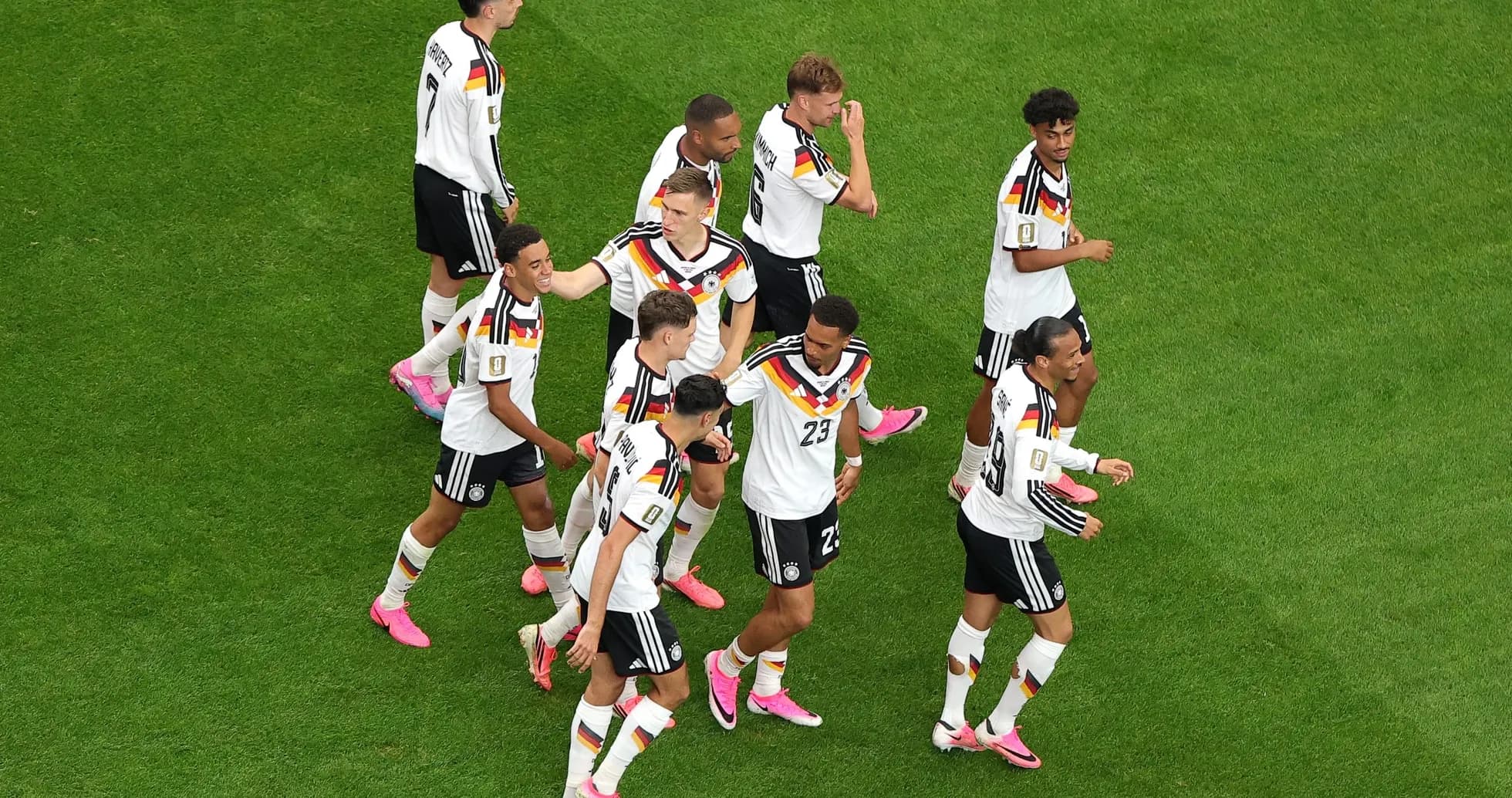
Germany's Dominant World Cup Opener Against Curaçao
In the humid Houston evening at NRG Stadium, Germany’s World Cup campaign began with a statement that bordered on ruthless. A 7–1 dismantling of Curaçao in Group Stage – 1 did more than deliver three points; it sketched out the tactical identities of both sides with brutal clarity.
Heading into this game, Germany were an unknown quantity in this tournament context, but their seasonal DNA already pointed to a front‑foot, possession‑heavy approach under Julian Nagelsmann. The statistics now crystallise that picture: overall they have played 1 match, won 1, scored 7 and conceded 1, with an overall goals-for average of 7.0 and goals-against average of 1.0. Curaçao, by contrast, emerge from their opening fixture with a stark record: overall 1 match, 1 defeat, 1 goal scored and 7 conceded, with an away goals-for average of 1.0 and an away goals-against average of 7.0. The goal differences tell the story cleanly: Germany sit on +6 (7 scored, 1 conceded), Curaçao on -6 (1 scored, 7 conceded).
I. The Big Picture – Structures and Intent
Nagelsmann set Germany up in a 4‑2‑3‑1 that felt less like a conservative double pivot and more like a springboard. M. Neuer anchored behind a back four of J. Kimmich, J. Tah, N. Schlotterbeck and N. Brown. Ahead of them, F. Nmecha and A. Pavlovic formed the nominal shield, but the real damage came from the line of three: L. Sane wide, J. Musiala between the lines, F. Wirtz drifting in from the left, all feeding K. Havertz as the central forward.
Curaçao’s 4‑3‑1‑2 under Dick Advocaat was, on paper, compact and narrow: E. Room in goal, a back four of S. Floranus, R. Bazoer, A. Obispo and D. Fonville, a midfield trio of L. Comenencia, L. Bacuna and J. Bacuna, with T. Chong operating as the advanced midfielder behind the front pair J. Locadia and S. Hansen. The idea was clear: crowd central zones, deny Musiala and Wirtz space, and then break quickly through Chong and the two strikers.
Instead, the match became a demonstration of what happens when an elite possession side meets a block that cannot compress horizontally or vertically enough.
II. Tactical Voids – Where It Fell Apart
Germany’s lineup continuity is already notable: their only recorded formation in the competition so far is this 4‑2‑3‑1, played once and producing a 7‑1 home win. There were no listed absences; Nagelsmann had a full deck and used it to keep the tempo relentlessly high. Disciplinary data for both sides shows no recorded yellow or red cards in any minute range, underlining that this was not a stop‑start, cynical contest but an open game where quality dictated outcomes more than fouls.
For Curaçao, the tactical void opened in the channels around their centre-backs and full-backs. With a narrow midfield three and Chong pushed high, the protection in front of Bazoer and Obispo was intermittent. Once Germany’s full-backs, especially Kimmich and Brown, began to step into midfield, Curaçao’s first defensive line was constantly outnumbered. The 4‑3‑1‑2 never managed to slide quickly enough to cover Wirtz’s drifting and Sane’s width.
Germany’s only statistical blemish is that they have yet to keep a clean sheet overall, conceding 1 goal despite the dominance. That small crack hints at a risk: the back four, so aggressive in their positioning, can leave space for direct counters. Curaçao’s lone goal fits that pattern: a reminder that even in a rout, transition defence remains a live issue for Germany.
III. Key Matchups – Hunter vs Shield, Engine Room Battles
Hunter vs Shield
K. Havertz emerges from this opener as one of the competition’s early “hunters.” With 2 goals overall from 2 shots, both on target, and 1 penalty scored, he was clinical rather than wasteful. His 41 passes at 92% accuracy, plus 1 key pass, show a forward who drops in to connect, not just finish.
Curaçao’s “shield” – the defensive record of 7 goals conceded away in a single match – simply could not cope. The 4‑3‑1‑2 block left Havertz too often between the lines, with L. Bacuna and J. Bacuna torn between pressing Nmecha/Pavlovic and tracking Musiala. Whenever they stepped out, Havertz and Musiala found pockets behind them; whenever they stayed, Kimmich advanced from right-back to overload the flank.
Engine Room
In midfield, the game was decided by Germany’s technical superiority. J. Musiala, with 1 goal, 2 key passes and 5 dribble attempts (4 successful), turned the half-spaces into his playground. His 14 duels overall, winning 9, speak to a player who not only receives under pressure but also regains possession.
Behind him, F. Nmecha and A. Pavlovic quietly ensured Germany’s platform. Their task was to lock down second balls and prevent Curaçao’s transitions through Chong. For Curaçao, L. Bacuna and J. Bacuna faced an impossible equation: cover lanes to Musiala, step to Nmecha, and still protect their full-backs. As Germany’s passing carousel accelerated, their midfield three were stretched beyond their pressing capacity.
On the flanks, J. Kimmich’s influence was immense. With 73 passes overall at 89% accuracy and 5 key passes, plus 2 assists, he effectively functioned as an extra playmaker from right-back. Opposite him, N. Brown turned his World Cup debut into a statement: 1 goal, 1 assist, 36 passes at 88% accuracy, 3 key passes and 2 tackles. His willingness to underlap into the half-space compounded Curaçao’s problems, drawing their narrow midfield out of shape.
From the bench, D. Undav added another dimension. Coming in as a substitute, he produced 1 goal and 2 assists in just 26 minutes, with 3 key passes. His movement across the front line and ability to receive between defenders transformed late phases into a training exercise in chance creation.
IV. Statistical Prognosis – What This Result Projects
Following this result, Germany top Group E with 3 points, a +6 goal difference and a form line of W. Their overall goals-for average of 7.0 and goals-against average of 1.0 will obviously regress as opposition stiffens, but the underlying structure is sustainable: a settled 4‑2‑3‑1, multiple creative hubs (Musiala, Wirtz, Kimmich, Undav), and a centre-forward in Havertz who is both scorer and connector. Their penalty record is perfect so far: 1 overall, 1 scored, 0 missed – another small but important marker of composure.
For Curaçao, the numbers are harsh but instructive. Overall, they have 1 goal scored and 7 conceded, an away goals-for average of 1.0 and away goals-against average of 7.0, with a -6 goal difference. Yet they did find a way to score against a side that otherwise dominated, suggesting that in more balanced fixtures their front three of Chong, Locadia and Hansen can trouble defences.
Tactically, Advocaat will need to reconsider the 4‑3‑1‑2 against elite, wide-oriented opponents. Without a clear plan to contain full-backs like Kimmich and Brown, and without more compact distances between midfield and defence, the central block will continue to be pulled apart.
The narrative emerging from Houston is thus twofold: Germany have announced themselves as early contenders with a fluid, high‑ceiling structure; Curaçao, bloodied but not broken, must now pivot from survival mode against a giant to more pragmatic, compact game plans where their technical attackers can operate on more equal terms.
Related News
Thomas Tuchel Reflects on England's 10-Man World Cup Triumph and a Surprising Regret
Robert Moreno Takes Over as Interim South Korea Coach After World Cup Setback

Jude Bellingham Returns to Form with Real Madrid After World Cup Success

Chloe Kelly, Beth Mead & 13 Lionesses Who Must Shine in the Upcoming WSL Season for England’s 2027 World Cup Bid
Barcelona Cancels World Cup Tribute Amid Political Tensions
Messi Breaks Record for Most Penalties Taken and Missed in FIFA World Cup History