
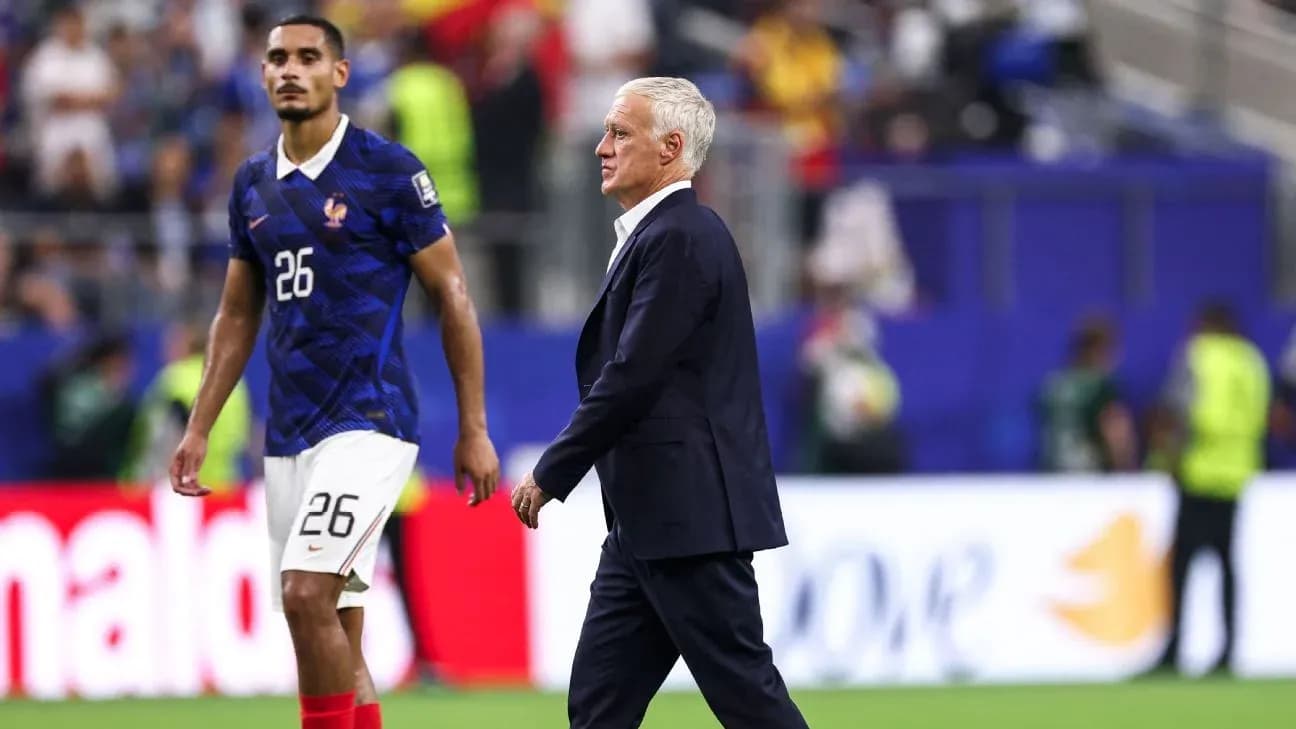
Deschamps' Era Ends: France's World Cup Defeat to Spain
ARLINGTON, Texas — The end came not with drama, but with a dull, unforgiving thud.
France arrived at this World Cup as the benchmark, the squad every other nation measured itself against. They went through the tournament without trailing once. Then Spain walked into Jerry Jones’ vast Texas palace on Tuesday, landed the first punch, and never let them back up. A 2-0 defeat, as clear as the scoreline suggests, sent Les Bleus home and closed the book on the Didier Deschamps era.
Fourteen years. One hundred eighty-four games. Three major finals and a UEFA Nations League title.
All of it gone in 90 minutes that felt like a slow, methodical dismantling.
Deschamps’ last stand
Deschamps leaves as one of international football’s great operators: World Cup winner as a player and a coach, two World Cup finals as manager in 2018 and 2022, a Euros final, and a Nations League trophy. His résumé is bulletproof. His exit performance was anything but.
France’s front four, hyped as the most devastating unit in the tournament, produced 0.04 xG in the first 64 minutes. That number tells its own story. They barely laid a glove on Spain. For a team this loaded, that is not a bad day at the office. It is an indictment.
Spain were excellent, but that was expected. Luis de la Fuente’s side are not far behind France in pure talent. Losing to them is no disgrace. Losing like this is.
This was the third time in three years De la Fuente has outcoached Deschamps: the Euro 2024 semifinal, the 2025 Nations League thriller that ended 5-4 after Spain led 5-1, and now this World Cup semifinal. Same matchup, same outcome, growing margin. At some point it stops being coincidence and starts becoming a pattern.
Either De la Fuente really is Deschamps’ bespectacled, bald, bearded kryptonite, or France’s long-serving coach simply never found the next step on the learning curve.
A plan that never changed
Everyone knew what Spain would do. They would have the ball. They would drag France around the pitch, probing, recycling, waiting for gaps. The tactical question sat in plain sight: Would France adapt?
They could have pressed higher. They could have bolstered midfield, where, as Kylian Mbappé himself noted, it was two against three. They could have tried to disrupt Spain’s rhythm instead of trusting their own to appear on cue.
Deschamps went the other way. He backed his stars, stuck to his template, and expected Spain to bend. Spain didn’t bend. They took control of the ball, took away the space, and with that, took away everything that makes France’s attackers dangerous.
Without the ball and without space, all that talent turns into something ordinary. Michael Olise, so often electric, looked lost. In those conditions he was only marginally more effective than a sitcom character with the same first name.
That is the moment a coach must adjust. Deschamps never really has. Not in 2018, not in 2022, and certainly not here. His in-game changes in Arlington felt like muscle memory: Manu Koné for Adrien Rabiot to add more passing from deep, Désiré Doué for Bradley Barcola to freshen up the flank. Logical swaps, entirely predictable. Football’s version of predictive text.
On a good night, that kind of continuity keeps a team calm and compact. On this night, it simply extended the suffering.
His loyalty cut both ways too. Rabiot, again, kept his place. Olise stayed on long enough to underline just how far off his usual standard he was. The same faith that built a tight, committed group over a decade also trapped France in a failing plan when they most needed something different.
The limits of a philosophy
Deschamps’ core belief has always been straightforward and, for the most part, successful: keep the dressing room happy, keep the system simple, let superior talent decide the rest. In a low-scoring sport, overcomplication can kill you. He lived that philosophy as a player alongside Zinedine Zidane, Patrick Vieira and Thierry Henry in 1998, and he rode it to glory again in 2018 and to within a Randal Kolo Muani finish of another World Cup title in 2022.
But when an opponent strips away the ball and the space, when they suffocate your strengths and refuse to give you the chaos you thrive in, that philosophy hits its ceiling. Spain did exactly that. They turned France’s attacking riches into static figures on a team sheet.
The irony is brutal. The very tools that made Deschamps arguably the most successful international coach of his generation are the same ones that failed him when he finally had his most complete squad.
Enter Zidane?
Now the conversation turns, inevitably, to Zidane.
The idea of Zidane on the France bench has hovered over Deschamps’ reign for years. Three Champions League titles, two LaLiga crowns with Real Madrid: his achievements as a club coach are undeniable. The image is seductive — the national icon returning to lead the most talented French generation since his own.
But the reality is more nuanced. Zidane has not coached in five years. His last trophy came in 2020. His only job has been at Real Madrid, a club unlike any other, where you train with your players every day and, if one doesn’t fit, you ask the president for another.
International football offers none of that. No transfer market to fix problems. Limited training time. Long gaps between games. Different pressures, different rhythms.
At Madrid, Zidane also kept things simple. He trusted stars, managed egos, and avoided tactical excess. Given his shared history with Deschamps for France and Juventus, it is tempting to assume he will be a slightly shinier version of the man he replaces.
That might be enough. Matching Deschamps’ record would already count as a triumph. But France’s exit in Texas offers a clear warning: at this level, with opponents as sophisticated as Spain, you cannot just send your best players out, fire them up, and assume talent will tilt the field.
Sometimes balance matters more. Sometimes you have to sacrifice a name to win a battle in midfield. Sometimes less really is more.
Zidane knows that on some level. He won a World Cup in 1998 with Stéphane Guivarc’h as his center-forward, a reminder that the collective can elevate the ordinary. Deschamps was there too. They have both lived the lesson from the inside.
A new standard to meet
If Zidane was watching, the message from Arlington could not have been clearer: when the gap in individual quality is small, the team that functions better as a unit usually prevails. Spain were cohesive, synchronized, ruthless in their structure. France were a constellation of stars, each dimmed by the lack of a shared plan that fit this specific opponent.
Zidane will inherit an absurdly deep pool of attacking talent and a group that has been to the mountaintop and back. He will also inherit the expectations created by Deschamps’ decade-plus of success.
Equal that, and he will be celebrated. Surpass it, and he reshapes French football history.
The bar has been set. Spain just showed how high it now sits.
Related News
Ilia Topuria Accuses Justin Gaethje After UFC Defeat
Tyson Fury vs Anthony Joshua Fight Date and Venue Confirmed
Switzerland Calls Up In-Form Sion Striker Winsley Boteli for Nations League
Bournemouth Secures Historic 2-1 Win Over Real Sociedad in Spain
Portugal Announces Squad for 2026 UEFA Nations League; Cristiano Ronaldo Expected to Play
Raphinha Channels Ronaldo Nazario as Barcelona's Leading Striker After Position Change