
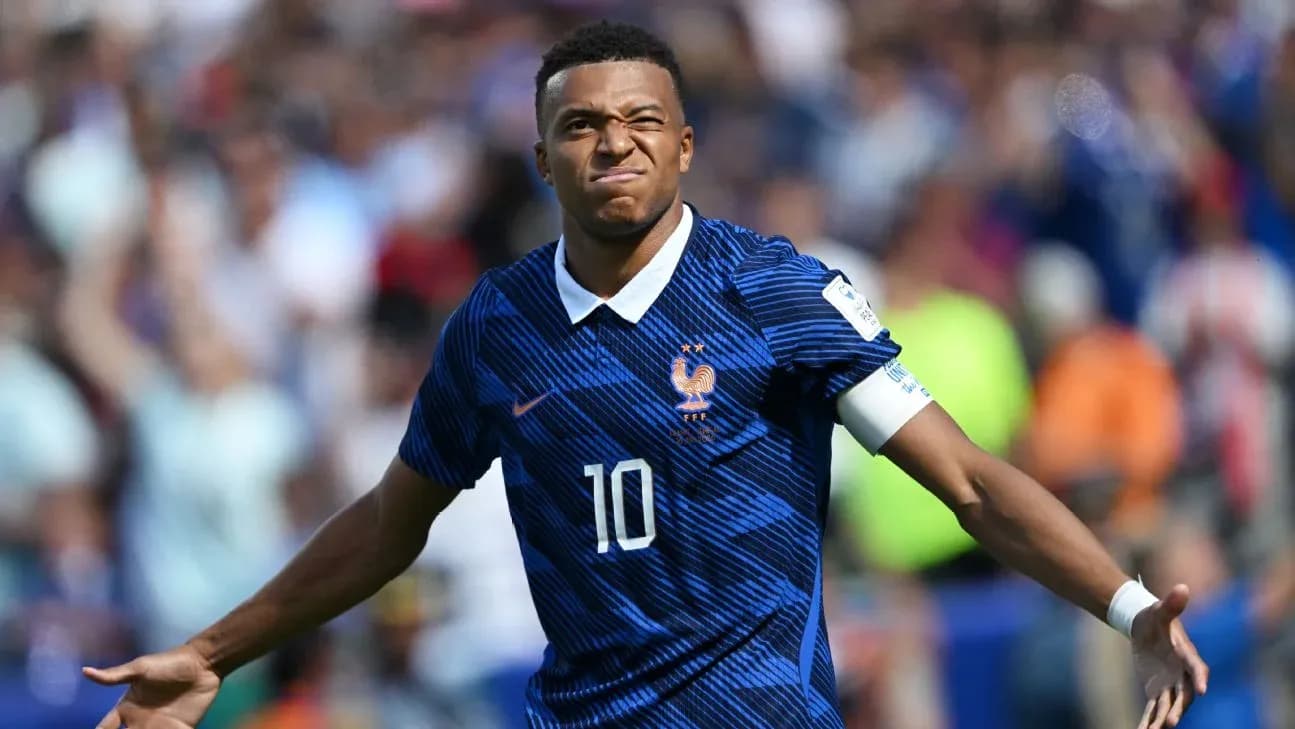
France's Tactical Mastery in 3-1 Victory Over Senegal
France’s 3-1 win over Senegal at MetLife Stadium was built on structural control from a 4-2-3-1 base, efficient shot quality, and a decisive use of the right flank in the second half. Despite a goalless first period, France’s territorial and technical dominance (53% possession, 575 passes, 88% accuracy) steadily squeezed Senegal’s 4-2-3-1 block until the game broke open after the hour.
Both sides mirrored each other on paper, but France’s interpretation was far more progressive. Aurélien Tchouaméni and Adrien Rabiot formed a double pivot that consistently positioned themselves behind Senegal’s first line, offering short options to the back four and enabling clean progression through the thirds. With William Saliba and Dayot Upamecano comfortable splitting wide, France created a 2-4 structure in build-up that pinned Senegal’s front four deep and limited their pressing triggers.
Senegal’s plan relied on compactness and transition. Idrissa Gana Gueye and Pape Gueye sat close to the centre-backs, trying to screen passes into Kylian Mbappé’s feet and delay switches to the wings. The back line stayed relatively narrow, which initially succeeded in forcing France to circulate in front of them. However, this same compactness left space outside for France’s full-backs and wingers to exploit, particularly on the right.
Turning Point
The turning point arrived around the 60th minute. At 60', a potential penalty for France involving Kylian Mbappé was cancelled by VAR, a warning sign for Senegal that the defensive line was being stretched. Rather than destabilise France, the decision sharpened their tempo. Six minutes later, the structure that Deschamps had been building paid off: at 66', Mbappé (France) finally broke through, finishing a move assisted by Michael Olise. The pattern reflected France’s tactical idea all night — circulate through the pivot, draw Senegal’s midfield narrow, then find the advanced playmaker between the lines to feed Mbappé attacking the channels.
Senegal’s response was to lean even harder into direct transitions. At 75', Ibrahim Mbaye (IN) came on for Ismaïla Sarr (OUT), and at 76', Habib Diarra (IN) replaced Lamine Camara (OUT). These changes aimed to refresh the wide threat and add vertical running. Structurally, though, Senegal still struggled to turn their 47% possession and 502 passes (86% accuracy) into sustained pressure, finishing with just 6 total shots and 0.53 xG.
France’s bench then became a tactical weapon. At 80', Bradley Barcola (IN) came on for Ousmane Dembélé (OUT), adding a more direct, north-south runner to attack tired legs. The impact was immediate: at 82', Barcola (France) scored, assisted by Rabiot. The goal underlined France’s ability to attack from both half-spaces — Rabiot stepping higher from the pivot line, Barcola running off the shoulder, and Senegal’s double pivot now caught between protecting the back four and stepping out to press.
Senegal made a double change at 83', with Ahmadou Bamba Dieng (IN) for Nicolas Jackson (OUT) and Iliman Ndiaye (IN) for Pape Gueye (OUT), seeking more dynamism up front and between the lines. Yet France’s control of rhythm remained intact. At 87', Rayan Cherki (IN) replaced Désiré Doué (OUT), adding another creative profile to help France manage possession and exploit transitions against a stretched Senegal.
France’s third goal at 90+6' again came from Mbappé (France), this time unassisted, encapsulating the tactical story: repeated waves of structured attacks gradually isolating Senegal’s defenders until Mbappé could decide the game individually. Senegal’s late consolation at 90+5' through Ibrahim Mbaye (Senegal), assisted by Iliman Ndiaye, showed their threat when they could finally break in transition, but it arrived too late to alter the tactical balance.
Defensively, France’s back four were rarely exposed in open play. Senegal managed only 2 shots on goal, reflecting how effectively France’s rest defence — with the double pivot and full-backs well positioned behind the ball — smothered counters. Mike Maignan (France) made 2 goalkeeper saves, supported by a compact central box around the penalty area that limited clear looks.
On the other side, Edouard Mendy (Senegal) faced 8 shots on goal and made 5 saves, a workload that illustrates how often France were able to reach the final third in good positions. Senegal’s defensive block absorbed pressure for long spells, but the xG numbers (France 1.79, Senegal 0.53) confirm that the better chances belonged to Deschamps’ side.
Statistically, France’s 11 total shots to Senegal’s 6, combined with more blocked efforts (2 vs 1) and a higher share of attacks inside the box (7 shots inside vs 4), map directly onto the tactical picture of a team camped in the opposition half, probing for openings. The foul count (France 5, Senegal 9) also reflects France’s superior control — they rarely needed to resort to disruptive challenges, whereas Senegal were repeatedly forced into interventions to halt France’s combinations between the lines and down the flanks.
Overall, France’s 4-2-3-1 functioned as a flexible possession machine, with the double pivot dictating tempo and the wide players, especially after the introduction of Barcola and Cherki, overwhelming Senegal’s defensive structure. Senegal’s mirrored shape never found a consistent pressing reference or transition outlet, and the underlying numbers — from xG to shots on goal and saves required — validate a 3-1 scoreline built on clear tactical superiority.
Related News
Thomas Tuchel Reflects on England's 10-Man World Cup Triumph and a Surprising Regret
Robert Moreno Takes Over as Interim South Korea Coach After World Cup Setback

Jude Bellingham Returns to Form with Real Madrid After World Cup Success

Chloe Kelly, Beth Mead & 13 Lionesses Who Must Shine in the Upcoming WSL Season for England’s 2027 World Cup Bid
Barcelona Cancels World Cup Tribute Amid Political Tensions
Messi Breaks Record for Most Penalties Taken and Missed in FIFA World Cup History