
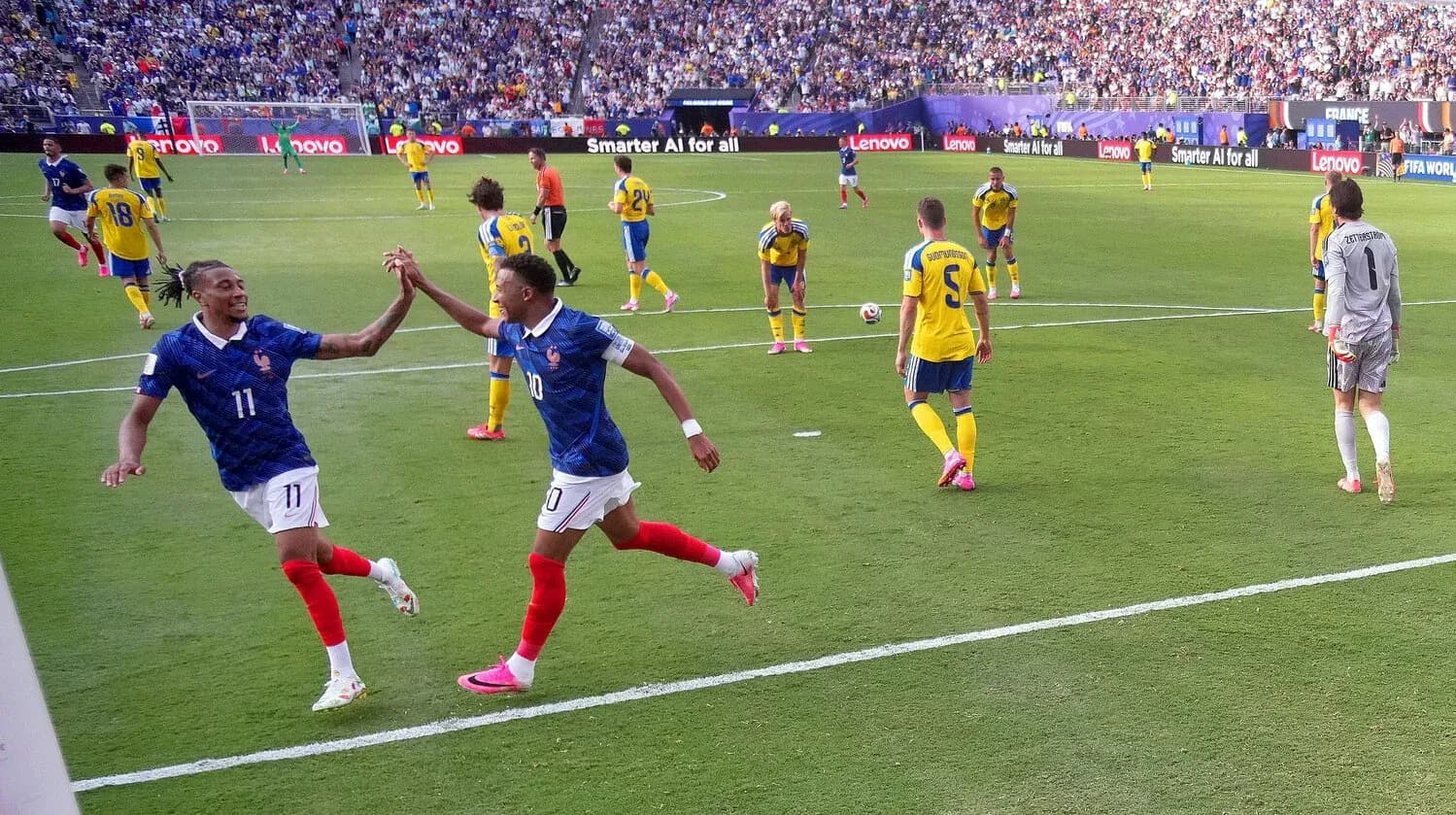
France Dominates Sweden 3–0 in Round of 32 Clash
MetLife Stadium in New-York staged a Round of 32 meeting that felt more like a tactical examination than a simple knockout tie. France arrived as group winners, ranked 1st in Group I with 9 points and a goal difference of 8, having won all 3 of their group matches. Sweden, second in their section with 4 points and a goal difference of 0, came in as the dangerous outsider. By full time, the scoreboard read 3–0 to France, a result that mirrored the broader seasonal trends: a ruthless French attack, and a Swedish side whose structural frailties on their travels were finally exposed.
I. The Big Picture – France’s control vs Sweden’s volatility
Heading into this game, France had built an almost machine-like profile. Across the campaign they had played 4 matches in total, winning all 4, with 3 of those at home and 1 on their travels. Offensively, they were devastating: 13 goals in total, split as 9 at home and 4 away. The scoring rhythm was relentless, with averages of 3.0 goals at home, 4.0 on their travels, and 3.3 overall. Defensively, they were equally composed, conceding only 2 goals in total (1 at home, 1 away), for an overall average of 0.5 goals against.
Sweden were the opposite: a team of extremes. Across 4 matches in total they had won 1, drawn 1 and lost 2. Their attack was respectable – 7 goals in total, with a striking split of 5 at home and just 2 on their travels. But the defensive record was the warning sign. Sweden had conceded 10 goals overall, only 1 at home but 9 on their travels, for an away average of 3.0 goals against and an overall average of 2.5. A side that can score but cannot close the door is always vulnerable against a heavyweight like France.
II. Tactical Voids – Discipline and structure
Injuries and suspensions did not distort the squad choices; there was no recorded list of absentees. That meant both Didier Deschamps and Graham Potter could lean into their preferred shapes.
France’s season-long identity was clear in the numbers: they had used the 4-2-3-1 in all 4 matches. That continuity translated directly into the starting XI here – M. Maignan behind a back four of J. Kounde, D. Upamecano, W. Saliba and L. Digne; A. Tchouameni and A. Rabiot as the double pivot; O. Dembele, M. Olise and B. Barcola supporting K. Mbappe as the lone forward. It was a structure that had already delivered 2 clean sheets at home and had never failed to score in any setting.
Sweden, by contrast, arrived with tactical fluidity that bordered on instability. Over the campaign they had alternated between 3-1-4-2, 3-4-3 and 4-4-2. For this knockout, Potter chose a 4-4-2: J. Widell Zetterstrom in goal, a back line of D. Svensson, G. Lagerbielke, V. Lindelof and G. Gudmundsson, a midfield band of four featuring A. Elanga, L. Bergvall, Y. Ayari and E. Stroud, and a front duo of V. Gyökeres and A. Isak. On paper, the extra defender compared to a back three should have offered stability; in practice, it risked leaving Sweden’s midfield outnumbered against France’s 4-2-3-1 box.
Disciplinary trends reinforced the sense of imbalance. France’s yellow-card profile was almost eerily clean: across the campaign, only 1 yellow card in total, and that came in the 61–75 minute window – a single late-game flash of aggression rather than a pattern of chaos. Sweden, however, had accumulated their bookings in a way that mapped onto fatigue and pressure. Their yellows were spread 31–45 (20.00%), 46–60 (20.00%), 61–75 (20.00%) and especially 76–90, where 40.00% of their cautions arrived. This late spike suggested a team that frayed under sustained pressure – precisely the phase where France’s relentless attacking rhythm tends to squeeze opponents.
III. Key Matchups – Hunter vs Shield, and the Engine Room
The headline duel was always going to be Kylian Mbappé against Sweden’s defensive block. Mbappe entered the Round of 32 as the competition’s leading scorer: 6 goals and 2 assists across 4 appearances, with 19 shots in total and 13 on target. His overall rating of 8.65 underlined how central he was to France’s attacking identity. In a side averaging 3.3 goals overall, he was both finisher and creator, supported by O. Dembele (4 goals, 2 assists, rating 8.28) and M. Olise (5 assists, rating 7.73).
Sweden’s “shield” had never looked entirely secure. On their travels they had conceded 9 of their 10 total goals against, and their biggest away defeat, 5–1, hinted at what happens when the back line is dragged into wide spaces. V. Lindelof’s leadership and G. Lagerbielke’s aerial presence were tasked with containing Mbappe’s diagonal runs, Dembele’s direct dribbling and Barcola’s stretching of the left channel. But with Sweden’s full-backs also needing to track France’s wingers, the centre-backs were often left exposed to Mbappe’s movements between the lines.
In midfield, the “engine room” battle was defined by M. Olise and A. Tchouameni against Sweden’s young pivot of L. Bergvall and Y. Ayari. Olise had quietly become the World Cup’s leading provider, with 5 assists and 9 key passes, while also winning 19 of his 34 duels and completing 8 of 11 dribbles. His ability to drift inside from the right and act as an auxiliary playmaker forced Sweden’s midfield to choose: track him deep and leave space for Dembele and Mbappe, or hold position and allow Olise time on the ball.
Bergvall, Sweden’s most card-prone player with 1 yellow and 7 fouls committed, was walking a fine line. His job was to disrupt France’s rhythm without tipping into reckless challenges – particularly in the period after half-time, when Sweden’s yellow-card history showed a steady build-up of bookings. Behind him, Ayari had to shuttle laterally to cover the half-spaces, but that only increased the physical toll as the match wore on.
Up front, Sweden’s own “hunters” – A. Isak and V. Gyökeres – carried real threat. Isak had 1 goal and 3 assists with 7 shots (6 on target), while Gyökeres added 1 goal and 2 assists with 9 shots and 6 on target. Their partnership was designed to stretch France’s high line and isolate the French centre-backs in duels. Yet France’s defensive numbers – only 2 goals conceded overall, 2 clean sheets at home – suggested that W. Saliba and D. Upamecano were well-equipped to handle that challenge, especially with A. Tchouameni screening in front.
IV. Statistical Prognosis – Why 3–0 felt inevitable
When you align the season-long data with the tactical setups, the eventual 3–0 scoreline in France’s favour feels less like a surprise and more like the logical outcome of contrasting profiles.
France, playing in their favoured 4-2-3-1, brought an attack that averaged 3.0 goals at home and 3.3 overall against a Sweden side that conceded 3.0 goals on their travels. The French had never failed to score, while Sweden had never kept a clean sheet in any setting. Even without explicit xG values, the shot and chance-creation numbers for Mbappe, Dembele and Olise implied that France routinely generated high-quality opportunities.
Defensively, France’s structure and discipline – just 2 goals conceded overall, a single yellow card all tournament, no penalties conceded or missed by either side – created a platform for control. Sweden’s best hope lay in transitional moments via Isak and Gyökeres, but those moments were always going to be sporadic against a team that dominated territory and possession through its double pivot and creative trio.
The late phases of the match were where Sweden’s profile was most fragile. With 40.00% of their yellows arriving between 76 and 90 minutes, and with France accustomed to maintaining attacking intensity deep into games, the probability of France extending any lead in the final quarter-hour was high. Fatigue, stretched distances between Sweden’s lines, and the constant threat of Mbappe’s pace combined to tilt the closing stages decisively towards Deschamps’ side.
In the end, the 3–0 win at MetLife Stadium was a crystallisation of the tournament’s underlying numbers. France’s attacking trident, anchored by Mbappe’s clinical edge and Olise’s creativity, overwhelmed a Swedish defence that had already shown its vulnerability on the road. The Round of 32 thus became less a shock and more a statement: France’s squad is built not just on star power, but on a coherent, data-backed structure that is carrying them deeper into the World Cup.
Related News
Thomas Tuchel Reflects on England's 10-Man World Cup Triumph and a Surprising Regret
Robert Moreno Takes Over as Interim South Korea Coach After World Cup Setback
Jude Bellingham Returns to Form with Real Madrid After World Cup Success
Chloe Kelly, Beth Mead & 13 Lionesses Who Must Shine in the Upcoming WSL Season for England’s 2027 World Cup Bid
Barcelona Cancels World Cup Tribute Amid Political Tensions
Messi Breaks Record for Most Penalties Taken and Missed in FIFA World Cup History