
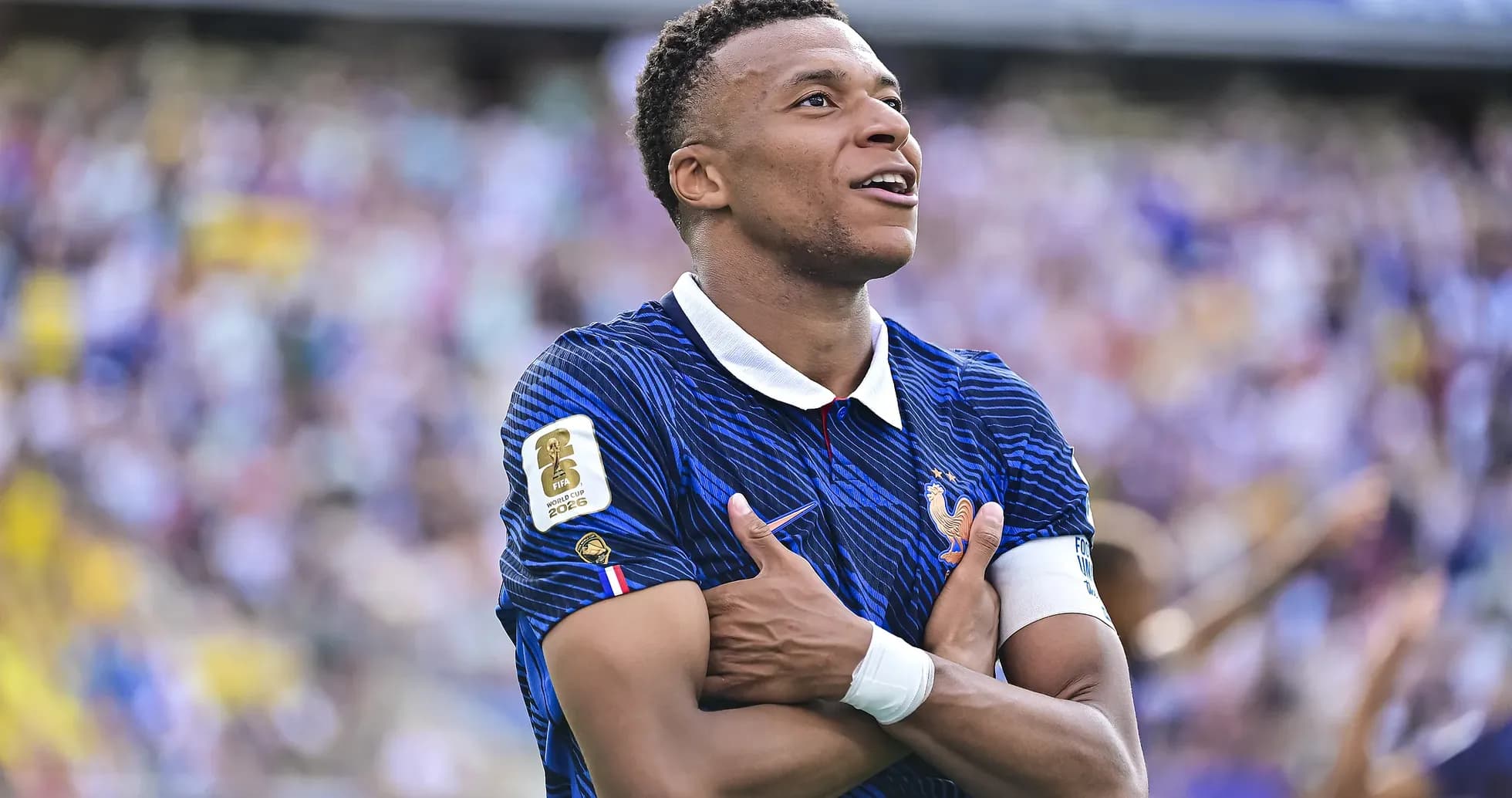
France Dominates Sweden 3-0 in World Cup Round of 32
France’s 3-0 win over Sweden at MetLife Stadium in this World Cup Round of 32 tie was a controlled, methodical dismantling built on structural superiority and individual quality between the lines. Didier Deschamps’ 4-2-3-1 imposed itself territorially and technically, pinning Graham Potter’s 4-4-2 deep for long stretches. With 61% possession, a 25–8 shot advantage and a 3.17–0.65 xG split, France turned dominance of territory into a steady accumulation of chances, while Sweden were reduced to sporadic transitions that rarely stretched the French back line.
I. Executive Summary
France set up with Mike Maignan behind a back four of Jules Koundé, Dayot Upamecano, William Saliba and Lucas Digne, shielded by Aurélien Tchouaméni and Adrien Rabiot. Ahead of them, Ousmane Dembélé and Bradley Barcola flanked Michael Olise, with Kylian Mbappé as the lone striker. Sweden’s 4-4-2 paired Viktor Gyökeres and Alexander Isak up front, supported from wide by Anthony Elanga and Elliot Stroud, with Lucas Bergvall and Yasin Ayari initially tasked with central control before later substitutions altered the midfield profile.
The match’s tactical story was of France’s constant occupation of the half-spaces and their ability to recycle possession through the double pivot, forcing Sweden’s midfield four to compress centrally and concede wide zones. That, in turn, opened diagonal lanes into Mbappé and the three attacking midfielders, who repeatedly attacked the Swedish back line on the turn.
II. Scoring Sequence & Disciplinary Log
There were no cards in the match, so the narrative ran without major disciplinary interruptions and without any change in numerical balance.
The breakthrough came at 45', a critical psychological moment. France had already established a territorial lock, and their 4-2-3-1 was camped in Sweden’s half. After sustained pressure, Dembélé received in the right half-space and combined with Mbappé. The move ended with Kylian Mbappé (France) finishing from close range, assisted by Ousmane Dembélé, to make it 1-0 on the stroke of half-time. It rewarded France’s aggressive positioning of both wingers high and narrow, with full-backs providing the width.
At 53', France doubled their lead and effectively reshaped the match dynamics. With Sweden trying to step five to ten metres higher, France exploited the extra space between the lines. Michael Olise received centrally and slipped a pass into Bradley Barcola (France), who attacked the channel and scored, assisted by Michael Olise. The 2-0 cushion allowed Deschamps to lean even more into ball control and rest defence, with the double pivot dropping slightly to prevent Swedish counters.
The third goal at 74' was the culmination of France’s constant threat in depth. Again, Olise found a pocket between Sweden’s lines and released Mbappé (France), who finished clinically for his second of the night, assisted by Michael Olise. At 3-0, the tie was effectively settled, and subsequent substitutions from both sides were more about energy management and giving minutes than altering the fundamental tactical pattern.
III. Tactical Breakdown & Personnel
France’s 4-2-3-1 functioned as an aggressive positional structure. Tchouaméni and Rabiot formed a stable base, allowing both full-backs to advance. Koundé often underlapped Dembélé, creating interior overloads on the right, while Digne provided more traditional width on the left, freeing Barcola to drift inside closer to Mbappé. This created a 2-3-5 shape in settled possession: Saliba and Upamecano as the rest-defence pair, Tchouaméni central with the full-backs wide, and a front five of Dembélé–Olise–Barcola behind Mbappé or alongside him when he drifted wide.
The shot profile underlines the effectiveness of that structure: 25 total shots, 12 on goal, with 16 efforts from inside the box. France were not limited to low-quality attempts from range; they consistently reached the penalty area, reflecting well-timed runs from Mbappé and Barcola and the ability of Olise to receive on the half-turn between Sweden’s midfield and defence. The 3.17 xG is consistent with the volume and quality of those chances.
Out of possession, France pressed selectively rather than constantly. The front four screened Sweden’s double pivot and centre-backs, forcing longer passes toward Gyökeres and Isak. With Saliba and Upamecano dominant in duels and well-protected by Tchouaméni, Sweden’s direct balls rarely led to sustained pressure. France committed 14 fouls but remained structurally sound, conceding only 8 shots and 3 on goal.
In goal, Mike Maignan (France) was largely protected by the block, but he still had to make 3 saves. France’s defensive organisation meant those saves came from relatively contained situations, aligning with Sweden’s modest 0.65 xG. At the other end, Jacob Widell Zetterström (Sweden) faced a barrage: France produced 12 shots on target, and he made 9 saves. Sweden’s goalkeeper also registered 1.16 goals prevented, underlining that the 3-0 scoreline could have been heavier without his interventions.
Sweden’s 4-4-2 struggled to get pressure on the ball in midfield. With only two central midfielders against France’s double pivot plus the dropping movements of Olise, they were consistently outnumbered in the central lane. The wide midfielders, Elanga and Stroud, were forced into long lateral shifts, which opened channels for diagonal passes into Mbappé and Barcola. When Sweden did win possession, their transitions were often isolated; Gyökeres and Isak had to chase longer passes with limited midfield support.
Graham Potter’s substitutions were aimed at refreshing the wide and central areas to regain some control. Besfort Zeneli replaced Elliot Stroud at 66', and Taha Abdi Ali came on for Lucas Bergvall at the same minute, indicating a desire for more dynamism and ball-carrying from midfield. Later, Benjamin Nygren replaced Yasin Ayari at 82', and Mattias Svanberg came on for Daniel Svensson, further tilting the side toward more attacking profiles. Finally, Gustaf Nilsson replaced Alexander Isak at 89', adding aerial presence. However, with France already 3-0 up and managing tempo, these changes had limited impact on the overall pattern.
Deschamps’ substitutions were more about load management and maintaining defensive stability. At 75', Malo Gusto (IN) came on for Jules Koundé (OUT), and Désiré Doué (IN) replaced Ousmane Dembélé (OUT), injecting fresh legs on the right flank. Theo Hernández (IN) then replaced Lucas Digne (OUT) at 78', keeping the left side athletic and aggressive. At 85', Jean-Philippe Mateta (IN) came on for Michael Olise (OUT), and Rayan Cherki (IN) replaced Kylian Mbappé (OUT), with France shifting toward a more conservative, possession-oriented shape with less emphasis on depth runs and more on ball retention.
IV. The Statistical Verdict
The raw numbers confirm the tactical impression. France’s 61% possession and 551 passes, with 485 accurate at 88%, reflect a side in full control of tempo and territory. Sweden, with 39% possession and 352 passes (280 accurate at 80%), were forced into a more reactive role, relying on moments rather than sustained phases. The corner count (9–1 to France) underscores how often Deschamps’ team pinned Sweden back and generated pressure sequences.
Defensively, France limited Sweden to 8 shots and just 3 on target, consistent with their compact rest-defence and strong central pairing. Sweden’s single blocked shot contrasts with France’s 4 blocked efforts, showing how often Sweden had to defend inside their own box. The xG split of 3.17–0.65 aligns almost perfectly with the 3-0 scoreline, suggesting the result was an accurate reflection of chance quality rather than goalkeeping variance. Both goalkeepers posted 1.16 goals prevented, but the volume and quality of France’s opportunities meant that, tactically and statistically, this was a comprehensive, controlled French performance that fully justified progression to the next round.
Related News
Thomas Tuchel Reflects on England's 10-Man World Cup Triumph and a Surprising Regret
Robert Moreno Takes Over as Interim South Korea Coach After World Cup Setback
Jude Bellingham Returns to Form with Real Madrid After World Cup Success
Chloe Kelly, Beth Mead & 13 Lionesses Who Must Shine in the Upcoming WSL Season for England’s 2027 World Cup Bid
Barcelona Cancels World Cup Tribute Amid Political Tensions
Messi Breaks Record for Most Penalties Taken and Missed in FIFA World Cup History